
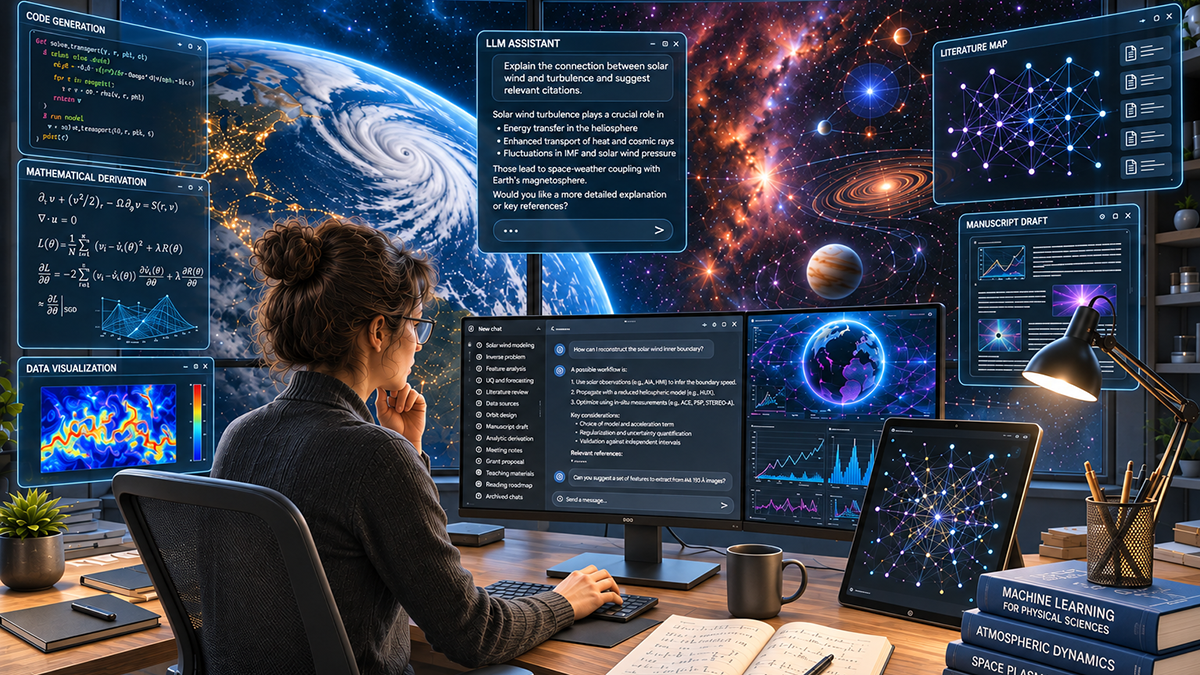
Language is the foundation of human communication and, together with mathematics, is the medium through which science is formulated, performed, debated, and shared. A technology that transforms our relationship with language inevitably transforms how we practice and communicate science. Five years ago, we wrote in Eos about practical applications of machine learning for Earth and space scientists. Since then, the emergence of large language models (LLMs) has, indeed, been transformative, dramatically expanding the landscape of artificial intelligence (AI) capabilities and tools available to scientists. Much of scientists’ work consists of translating ideas into words—in the form of manuscripts, proposals, and reviews—as well as code and figures. Although human scientific insight and communication remain indispensable, this work is fundamentally linguistic and often largely procedural, the very domains in which LLMs can excel. Our aim here is practical: to describe concrete ways large language models (LLMs) can support everyday research in which language, code, math, and reasoning intersect. Yet this new technology has become polarizing. Many scientists use it daily, others remain skeptical, and some feel left behind. LLMs can capably automate numerous tasks and draw on vast stores of accumulated online information to tackle myriad questions. However, they also make mistakes, misunderstand context, and occasionally breach their guardrails. Scientists can, knowingly or not, use AI systems in ways that are unethical or illegal, for example, if they use LLMs to review or analyze unpublished, confidential materials in a way that exposes the writers’ intellectual property without their knowledge or consent. Amid the real and reasonable concerns about LLMs, we believe the technology nevertheless offers powerful tools that scientists can use productively to improve and dramatically accelerate their work. Our aim here is practical: to describe concrete ways LLMs can support everyday research in which language, code, math, and reasoning intersect. The Earth and space sciences are an ideal testing ground because many applications inherently combine physical theory, numerical modeling, and complex data processing. The following seven use cases are neither exhaustive nor unbiased; they reflect our direct experience and are intended to inspire readers to explore these new tools effectively and responsibly in their own work and to come up with further uses and extensions to the ideas listed below. 1. Coding and Programming Programming is a workhorse of modern science. Researchers routinely write scripts to download and process files and data, run models, produce figures, and reverse engineer legacy code. These tasks rarely constitute core scientific contributions, but they consume substantial amounts of research time. LLMs, prompted with plain-text requests, can dramatically accelerate this workflow by generating, debugging, explaining, and translating code across virtually every major programming language. We see coding assistance as the use of LLMs with the most immediate and practical impact on day-to-day science. However, because LLMs can generate plausible-looking code that contains subtle errors, meticulous testing, inspection, and validation remain essential. As code generation becomes increasingly automated, the ability to write code from scratch may become less important than the ability to devise diagnostic tests and counterexamples that expose errors and establish whether the code behaves as intended. 2. Scientific Writing and Proofreading Scientists also spend considerable effort writing in various formats and for different audiences. Some formats, such as scientific journal papers, grant proposals, and reports from manuscript peer reviewers, tend to follow well-established structural conventions. For example, research papers typically comprise an abstract and introduction followed by sections on methods, results, and so on. This consistency in formatting makes manuscript preparation a useful and growing application for LLMs. LLMs can further democratize scientific publishing by helping researchers overcome barriers to writing in non-native languages. Indeed, LLMs can assist at many stages of the drafting process. They can turn rough notes or voice dictation into coherent prose, clarify methodological descriptions, shorten and tighten abstracts, and draft figure captions, allowing researchers to spend more time considering and communicating their core scientific claims and interpretations. LLMs can also further democratize scientific publishing by helping researchers overcome barriers to writing in non-native languages, a benefit we see among colleagues in our own labs virtually every day. Proposal writing, a high-stakes and time-consuming activity, is another task with which LLMs can be beneficial. Proposals demand a persuasive narrative combining scientific ambition, insight, expertise, and feasibility. LLMs, drawing on published literature, can act as expert sounding boards, helping researchers transform preliminary ideas into specific aims, identify weaknesses and missing components such as omitted references, and develop risk mitigation strategies (i.e., backup plans if the initially proposed research workflow does not pan out). They can also suggest ways to rewrite technical text suited for multidisciplinary review panels and maintain consistency across objectives, tasks, deliverables, and expected outcomes. Along with its upsides, however, fluent AI writing can easily conceal and even introduce incorrect or flawed reasoning, and it can invent sources and references. So every LLM-assisted statement and reference must be rigorously verified for accuracy and consistency. Scientists should also follow current publisher and institutional policies regarding disclosure of AI usage and prohibitions about uploading unpublished and confidential materials into commercial AI systems. 3. Accelerating Calculations Many scientific calculations are straightforward in principle but may require tedious multistep derivations and simplifications of equations, a process that can easily become error prone. LLMs can help derive equations step by step; suggest useful relationships, mathematical identities, or approximations; check intermediate algebra for errors; and translate physical descriptions into mathematical form. Furthermore, before running numerical models, researchers often have to translate their physical understanding of a system into mathematics. This step can involve identifying the main processes at work, formulating governing equations, rescaling variables so that the equations are easier to compare and analyze, and checking how the model behaves in simple or extreme cases. LLMs can accelerate this process by producing a transparent line of reasoning that scientists can efficiently inspect, verify, and refine. Unlike derivations reported in a static journal paper, researchers can ask the AI system to expand upon and explain any steps that are unclear, giving as much detail or examples as necessary. 4. Searching the Literature The corpus of scientific literature is growing far faster than any individual can read. Scientists, particularly those entering a new field, must identify key papers, learn unfamiliar terminology, distinguish established results from open questions, and connect ideas across subfields. LLMs can accelerate this process by summarizing papers, comparing methods, extracting recurring themes, and suggesting open problems and efficient reading paths, for example, which foundational papers to read first and which more specialized studies to follow. They can also help researchers formulate targeted queries for discipline-specific bibliographic databases, such as NASA’s Astrophysics Data System (ADS), to identify relevant publications more efficiently. Although they are not a substitute for careful reading, LLMs are especially valuable early in the research process for refining search strategies, organizing notes, and synthesizing the literature. Although they are not a substitute for careful reading—LLMs can sometimes hallucinate references and misrepresent findings—they are especially valuable early in the research process for refining search strategies, organizing notes, and synthesizing the literature. To mitigate concerns about hallucinated references, researchers should verify AI-generated citations against trusted bibliographic databases, such as Crossref and ADS. A common criticism is that LLMs, as statistical models, naturally converge toward the mean or most typical behavior, favoring established ideas over less prominent ones. This tendency deserves attention, but it is not unique to AI; human researchers are likewise influenced by citation networks and disciplinary consensus. The most effective workflow for using LLM assistance to parse the scientific literature is interactive. If the goal is to better understand different methodologies, for example, researchers can prompt an LLM with trusted papers, ask the model to compare the methods or assumptions used, and then verify the outputs against their own understanding of the original sources. Used this way, an LLM becomes a literature guide rather than a replacement for scholarly judgment. 5. Learning and Mentorship Much research training happens informally as students ask questions and receive expert feedback about, for example, why a method is chosen in given circumstances, what a parameter means, or how a formula is derived. Human mentors are indispensable in this process, but they are not always immediately available and cannot always provide students with sufficiently detailed explanations. LLMs can provide initial explanations, translate jargon, explain unfamiliar code, and suggest targeted exercises. The idea is to enhance mentoring accessibility, not replace it. Unlike traditional reference materials or problem sets, an LLM can serve as a highly adaptive tutor: Students can ask follow-up questions indefinitely, request that the same concept be explained in different ways, ask for simpler or more technical versions, work through examples step by step, and immediately probe whatever remains unclear. This ability to sustain an interactive explanation can help students develop a deeper understanding before meeting with a human adviser, allowing them to focus on more sophisticated or research-specific questions during limited face-to-face time. In addition, LLMs make it easy to repurpose the same material into multiple learning formats. For example, a researcher could upload several journal papers, websites, and videos to an LLM and have it summarize and create a podcast that students can listen to at their convenience. 6. Analyzing and Visualizing Data Data analysis in Earth and space sciences is often messy. Datasets come from satellites, ground stations, ships, aircraft, simulations, and reanalysis products, typically each with its own format, resolution, uncertainties, and coordinate system. Much of the work of analysis lies in understanding metadata, cleaning and combining datasets, and deciding how best to visualize results. LLMs can shorten the loop from posing a scientific question to implementing data analysis to visualizing and interpreting results. LLMs can help researchers efficiently design analysis workflows by suggesting analysis steps (e.g., where to download relevant data, what data quality issues or flags are listed in technical documents, or what best practices exist for processing data products), generating code for data visualizations, explaining error messages, and providing clear documentation to facilitate reproducibility. In effect, they can shorten the loop from posing a scientific question to implementing data analysis to visualizing and interpreting results. The improved efficiency allows researchers to explore more alternatives—different data processing choices, statistical summaries, or visualizations—more quickly before committing to a final analysis. Looking ahead, domain-specific LLMs trained on Earth and space sciences datasets, literature, and terminology may become more useful than general-purpose models because they better reflect the conventions and recurring challenges of the field. 7. Formalizing Reasoning Scientific reasoning often begins informally: a hypothesis, a sketch on a whiteboard, an intuition about cause and effect. Turning that intuition into a testable scientific argument is rarely straightforward. LLMs can help make reasoning explicit, transforming an initial idea into a rigorous research plan. Rather than asking an LLM what research question to pursue, we have found it more useful to ask how to think about a problem. It then becomes a brainstorming partner, rather than an oracle, in helping the researcher to generate and refine ideas. It may expose hidden assumptions, propose competing explanations or alternative reasoning, or identify observations that would distinguish between hypotheses. Many scientific failures ultimately stem from errors in reasoning: ambiguous hypotheses, circular arguments, missing controls, or conclusions that extend beyond the evidence. LLMs do not guarantee better reasoning, but through the process of making arguments more explicit and structured, they can help researchers inspect, challenge, and refine their own thinking. AI as a Coscientist The most ambitious vision for LLMs lies beyond their use as tools for individual tasks like writing code and summarizing scientific literature. It is that they may be able to participate as partners in every stage of the scientific process because every stage is connected through language: Hypotheses are described in words, models are expressed in mathematics and code, results are interpreted in figures and prose, and new questions emerge through discussion and argument. Ideally, an AI coscientist would act as a persistent collaborator that can retain the full context of a project, connect ideas across disciplines, propose and critique hypotheses, help design analyses, interpret results, and continuously refine its understanding as new evidence becomes available. The emergence of agentic AI systems that combine language models with tools enabling code execution, database handling, symbolic mathematics, and scientific software suggests that this vision is already taking shape. The goal should not be to automate science. It should be to amplify human capability and curiosity, support scientific judgment, and accelerate discovery. By reducing the human costs of exploration and iteration, AI partners could allow scientists to test more hypotheses, examine more approaches, and generally spend more of their time on uniquely human aspects of science: deciding which questions are worth pursuing, judging which evidence is convincing, and imagining explanations that no model can anticipate. The goal should not be to automate science. It should be to amplify human capability and curiosity, support scientific judgment, and accelerate discovery. The limitations of LLMs are real, and careless use undermines both individual credibility and trust in science itself. Yet dismissing them entirely would mean ignoring a historically significant development in the tools of knowledge production. Ultimately, the utility of LLMs is best understood through direct experimentation. We encourage readers to test LLMs’ performance for themselves, beginning with tasks they already know well. Comparing a model’s approach with one’s own is one of the fastest ways to understand both its strengths and its limitations. Let the LLM accelerate the rote work while allowing scientists to conduct and remain responsible for the science. Author Information Enrico Camporeale ([email protected]), Queen Mary University of London, U.K.; also at University of Colorado Boulder; and Jacob Bortnik, University of California, Los Angeles Citation: Camporeale, E., and J. Bortnik (2026), Seven ways to use LLMs in the Earth and space sciences, Eos, 107, https://doi.org/10.1029/2026EO260375. Published on 20 November 2026. This article does not represent the opinion of AGU, Eos, or any of its affiliates. It is solely the opinion of the author(s). Text © 2026. The authors. CC BY-NC-ND 3.0Except where otherwise noted, images are subject to copyright. Any reuse without express permission from the copyright owner is prohibited.
Seven Ways to Use LLMs in the Earth and Space Sciences
Full Article
Original Source
Read the full article at Eos →KhanList aggregates and links to publicly available news content. We do not host full articles from third-party sources. Always verify important information with original sources.