
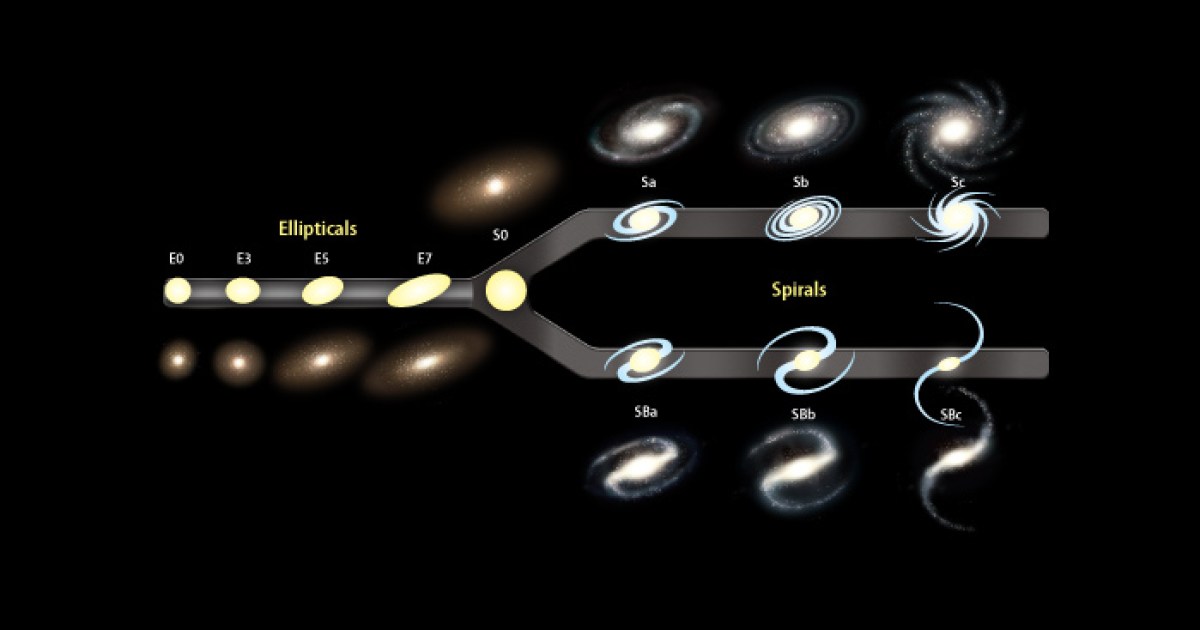
Today in the history of astronomy, the astronomer who would both expand our universe and help us organize the cosmos is born. | Published: November 20, 2026 Among Edwin Hubble’s many contributions to astronomy was the “tuning fork” classification diagram for sorting galaxies by type. Credit: Astronomy: Roen Kelly On Nov. 20, 1889, Edwin Hubble was born in Marshfield, Missouri. His 1923 observations of the Andromeda Galaxy and a Cepheid variable within it would vastly expand our understanding of other galaxies and the size of the universe. (See Oct. 5th, 1923: Hubble discovers galaxies beyond the Milky Way.) In addition to that monumental discovery, Hubble also developed a system for sorting galaxies: In the 1930s, Hubble began to study and classify galaxies into their various so-called morphological types, the array of structures astronomers saw in photographs. He eventually assembled the types of galaxies he observed into a tuning fork-shaped diagram. It contained spiral galaxies, barred spiral galaxies — spirals containing a linear “bar” of material passing through their centers — lenticular (lens-shaped) galaxies, and elliptical galaxies. He also identified irregular galaxies, clouds of stars and gas that lacked an organized shape. Later on, astronomers identified peculiar galaxies, systems that appeared to be wracked with explosive or disruptive events. They also identified a class of galaxies called dwarf spheroidals, which seemed to be numerous in the local universe. David J. Eicher is one of the most widely recognized astronomy enthusiasts in the world. He has been with Astronomy magazine since 1982, beginning as an assistant editor and working through associate, senior, and managing positions. He was editor in chief from 2002 to 2025 and is currently the magazine’s Editor Emeritus.
Nov. 20, 1889: The birth of Edwin Hubble
Full Article
Original Source
Read the full article at Astronomy →KhanList aggregates and links to publicly available news content. We do not host full articles from third-party sources. Always verify important information with original sources.