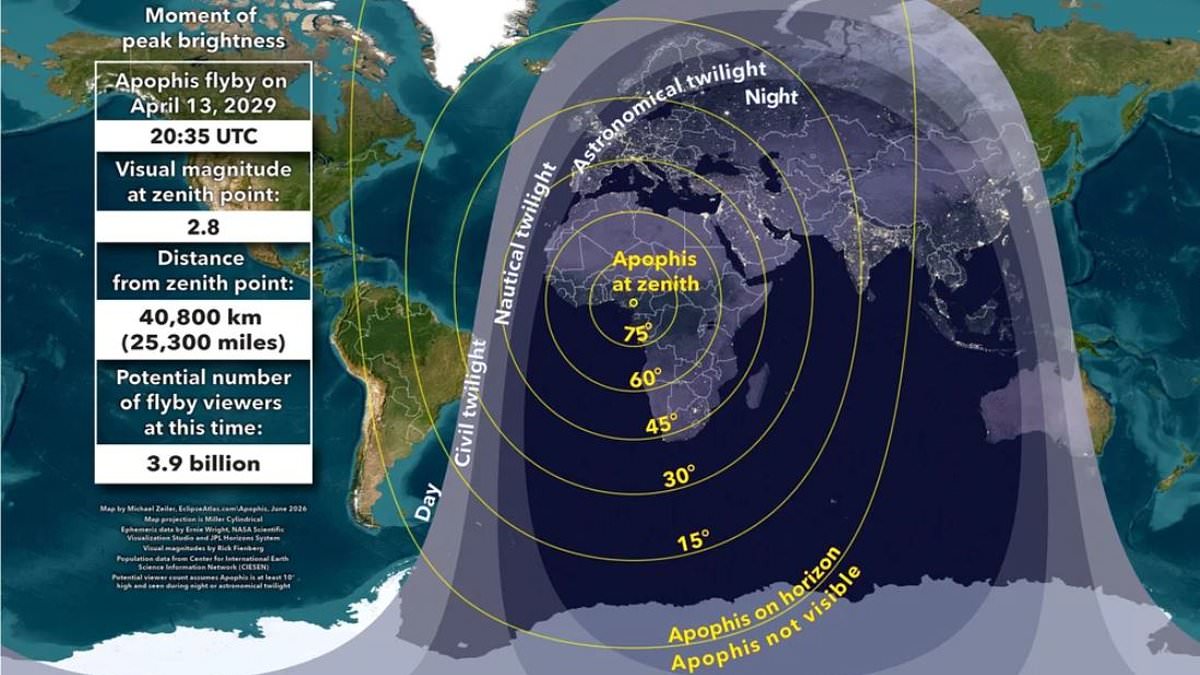
A 'potentially hazardous' asteroid will be visible with the naked eye for 90 per cent of the world's population, scientists have revealed.On April 13, 2029, a skyscraper–sized asteroid dubbed the 'God of Chaos' will make an 'ultra close' flyby of our planet.At its closest point to Earth, the asteroid Apophis will pass within 19,000 miles (30,600 km) of our planet's surface.That will put this 450–metre–wide (1,500 feet) space rock closer than the orbits of some geosynchronous satellites. According to new maps, revealed at the Apophis T–3 Years workshop in Padua, Italy, this is close enough for most of the planet to see the asteroid with the naked eye. As the asteroid, officially named 99942 Apophis, passes by, an estimated 7.6 billion people will be in line for a once–in–a–millennium stargazing spectacle.Scientists say the asteroid will look like a bright star slowly travelling across the sky and will be visible for hours to some lucky stargazers in the Northern hemisphere. And it's good news for Brits, as the UK is in line to get a nearly perfect view of this otherworldly visitor. A 'potentially hazardous' asteroid will be visible with the naked eye for 90 per cent of the world's population, new maps have revealed On April 13, 2029, a skyscraper–sized asteroid dubbed Apophis after the Egyptian God of Chaos will make an 'ultraclose' flyby of planet EarthUnlike a meteor, which glows as it burns in the atmosphere, Apophis won't produce any light of its own as it skims by Earth.Instead, the rock will be lit up by reflecting the rays of the sun and will only be visible to observers at twilight or night. Luckily, due to the rock's trajectory and timing, almost the entire planet will still get a great chance to see the God of Chaos asteroid as it passes harmlessly by.The flyby will begin around 15:00 GMT when Apophis is at its furthest distance from Earth, giving roughly 4.5 billion people in Australia and most of Asia their first glimpse of the asteroid.At its very closest point to Earth, which will occur at roughly 21:45 GMT, Apophis will be visible to 1.9 billion people in eastern South America, northern Africa and parts of Europe.Finally, the asteroid will reach its zenith over the North Atlantic and start to fade from view at about 22:00 GMT.However, the best time to see Apophis' close call will be at the moment of maximum brightness, which researchers predict will occur at 20:35 GMT.At this point, the asteroid will look like one of the bright stars in the Big Dipper and travel the width of a full moon across the sky every minute. The best time to see Apophis' close call will be at the moment of maximum brightness, which researchers predict will occur at 20:35 GMT. Apophis: Key facts Name: 99942 ApophisDiameter: 440 metres (1,500 feet)Closest approach: 19,000 miles (30,600km) above EarthFlyby: April 13, 2029Estimated speed at closest approach: 7.4 km/sRotation period: 30.6 hoursDiscovery: 2004 In the UK, viewers will start to see Apophis just in time for this spectacle, with the first glimpse coming with the arrival of twilight at 20:00 GMT.As night falls, British stargazers will then be able to see the asteroid passing until it fades out of view. Professor Richard Binzel, a planetary scientist from MIT who helped compile the maps, wrote in a blog post: 'This event will be a special opportunity to clearly see an asteroid perceptively move against the starry background. 'This event is also a science bonanza for astronomers who study asteroids in our solar system, yielding important information about their composition and how a planet’s tidal forces affect them.'In more good news, Professor Binzel and his co–authors are also keen to stress that there is 'absolutely no risk of a collision with Earth'.Scientists from around the world have been keeping a careful eye on Apophis since it was discovered in 2004.Astronomers believe the peanut–shaped rock came from the solar system's main asteroid belt between Mars and Jupiter before something knocked it into its current orbit.The asteroid now inhabits a region between Venus and Earth, circling the sun once every 10.5 months. Overall, researchers estimated that 7.6 billion people will be able to see Apophis as it passes by Earth. Illustrated: the path of Apophis through the sky depending on your viewing location Scientists insist that there is no chance that the 450–metre–wide (1,500 feet) space rock (pictured) will collide with Earth at any point in the next 100 yearsOminously named after Apep, the Egyptian serpent god of darkness and disorder, this 'city killer' asteroid was briefly considered one of the greatest threats to Earth. After its initial discovery, scientists suggested that there was a one in 37 chance that the asteroid could collide with Earth.However, as more observations were made and its trajectory was recalculated, the probability of an impact in the next 100 years fell to zero.As the asteroid passes Earth's gravitational pull, scientists will be watching closely to see if this close call disturbs its orbit.Research has suggested that the 2029 ultraclose pass could provide enough kick to knock Apophis off its current path, upsetting astronomers' predictions and making a collision in the future more likely.Apophis will be watched by telescopes on Earth and several spacecraft, including NASA's OSIRIS–APEX mission, will attempt to fly past it to look for any changes in structure or trajectory. Professor Binzel adds: 'This science will be crucial should a future asteroid ever threaten Earth. 'Knowledge of the structure of small asteroids like Apophis will help guide the best strategy for deflecting an Earth–bound object of this kind.'WHAT COULD WE DO TO STOP AN ASTEROID COLLIDING WITH EARTH?Currently, NASA would not be able to deflect an asteroid if it were heading for Earth but it could mitigate the impact and take measures that would protect lives and property.This would include evacuating the impact area and moving key infrastructure.Finding out about the orbit trajectory, size, shape, mass, composition and rotational dynamics would help experts determine the severity of a potential impact.However, the key to mitigating damage is to find any potential threat as early as possible.NASA and the European Space Agency completed a test which slammed a refrigerator-sized spacecraft into the asteroid Dimorphos.The test is to see whether small satellites are capable of preventing asteroids from colliding with Earth.The Double Asteroid Redirection Test (DART) used what is known as a kinetic impactor technique—striking the asteroid to shift its orbit.The impact could change the speed of a threatening asteroid by a small fraction of its total velocity, but by doing so well before the predicted impact, this small nudge will add up over time to a big shift of the asteroid's path away from Earth.This was the first-ever mission to demonstrate an asteroid deflection technique for planetary defence.The results of the trial are expected to be confirmed by the Hera mission in December 2026.
'Potentially hazardous' asteroid will be visible to 90% of Earth's population during an 'ultra close' flyby, new maps reveal
Full Article
Original Source
Read the full article at Dailymail →KhanList aggregates and links to publicly available news content. We do not host full articles from third-party sources. Always verify important information with original sources.