
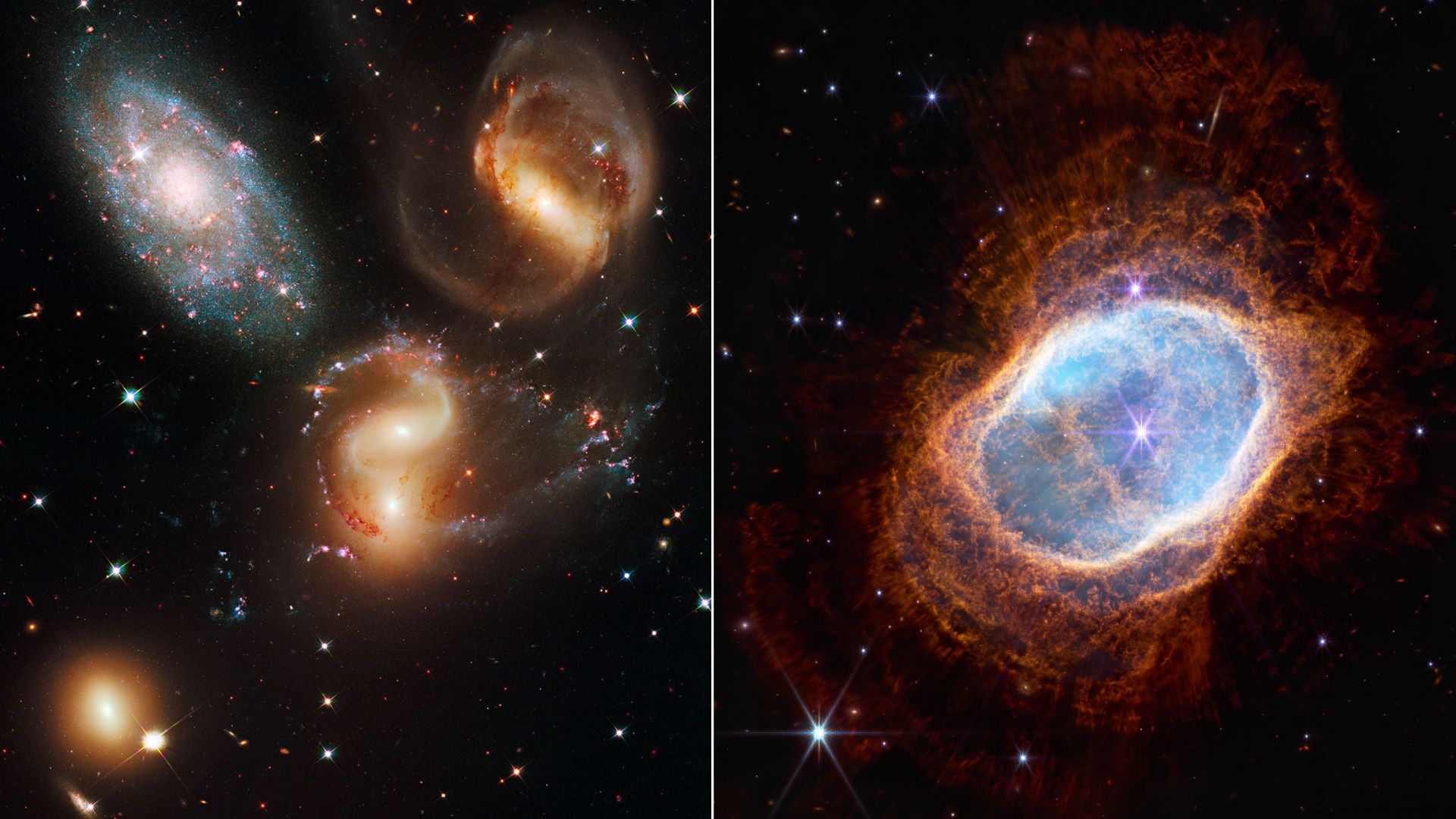
Some astronomical images become famous because they are beautiful. Others are important because they fundamentally changed how we understand the universe. A few manage to do both. Space telescopes have given us views that ground-based observatories cannot easily obtain, observing wavelengths blocked or distorted by Earth’s atmosphere and collecting incredibly faint light from distant objects. Here are seven images that stand out—not simply for how spectacular they look, but for what they reveal. 1. The Pillars of Creation – Hubble and James Webb Pillars of Creation (Hubble and Webb Images Side by Side) – NASA Few astronomical images are as recognizable as Hubble’s Pillars of Creation, captured in 1995. The enormous columns of gas and dust sit inside the Eagle Nebula, about 6,500 light-years away, and stretch roughly five light-years. They are being sculpted by intense radiation from nearby young stars, while new stars are forming inside the dense clouds. Webb later revisited the region in infrared, seeing through more of the dust and revealing stars hidden inside and behind the pillars. Together, the two views demonstrate why observing the same object at different wavelengths can reveal entirely different aspects of it. 2. Hubble Ultra Deep Field – Thousands of galaxies in a tiny patch Taken over the course of 10 days in 1995, the Hubble Deep Field captured roughly 3,000 distant galaxies varying in their stages of evolution. – NASA The Hubble Ultra Deep Field looks almost like a photograph of random stars scattered across black space. Almost none of them are stars in our own galaxy. The image contains nearly 10,000 galaxies, packed into an area of sky only a tiny fraction of the apparent size of the full Moon. Hubble built the image from hundreds of exposures collected over many days, allowing extremely faint objects to emerge. Some of the smallest, reddest galaxies in the image existed when the universe was only about 800 million years old, turning one seemingly empty patch of sky into a window through cosmic history. 3. Webb’s First Deep Field – SMACS 0723 Thousands of galaxies flood this near-infrared image of galaxy cluster SMACS 0723. – NASA When NASA released Webb’s first deep-field image in 2022, the picture showed thousands of galaxies in a patch of sky roughly the size of a grain of sand held at arm’s length. But there is more going on than simply an extremely powerful telescope. The galaxy cluster SMACS 0723 acts as a gravitational lens: its mass bends and magnifies light from galaxies behind it, making otherwise faint and distant objects easier to study. Webb’s near-infrared observations revealed galaxies as they appeared billions of years ago, including some of the faintest infrared objects observed at the time. 4. The Cosmic Cliffs – Webb’s view of star birth Cosmic Cliffs are the edge of a gigantic, gaseous cavity within NGC 3324, roughly 7,600 light-years away. – NASA What looks like a glowing alien mountain range is actually the edge of a gigantic cavity inside the Carina Nebula, around 7,600 light-years away. Webb’s NIRCam revealed the “Cosmic Cliffs” in extraordinary infrared detail, showing previously obscured areas where stars are forming. The cavity has been carved into the nebula by ultraviolet radiation and stellar winds from massive young stars. Webb’s infrared vision is particularly useful here because infrared light can penetrate dust that blocks much of the visible light, giving astronomers a better look at the processes taking place inside stellar nurseries. 5. The Southern Ring Nebula – A dying star’s final act Glowing, expanding shells of gas and dust ejected into space by a dying star at the center of NGC 3132. – NASA The Southern Ring Nebula looks like a glowing cosmic eye, but its structure is the result of a dying star shedding layers of gas and dust. Webb’s observations revealed that the nebula’s central system actually contains two stars. The fainter star is responsible for ejecting material, while its brighter companion helps shape the resulting nebula as the pair orbit each other. Webb’s NIRCam and MIRI instruments produced dramatically different views of the object, showing how different infrared wavelengths can reveal different components of the same stellar death scene. 6. Stephan’s Quintet – Galaxies caught in a gravitational brawl Stephan’s Quintet, or Hickson Compact Group 92 (HCG 92), is a visual grouping of five galaxies in the constellation Pegasus located roughly 290 million light-years away – NASA Stephan’s Quintet is a striking collection of galaxies that appear to be gathered in the same region of the sky. Webb’s combined NIRCam and MIRI image reveals enormous amounts of detail within the interacting system, including structures shaped by gravitational encounters between galaxies. The image isn’t simply a beautiful collection of distant galaxies: it captures the consequences of galaxies interacting on immense scales. Webb’s infrared instruments allow astronomers to examine both stars and dust within the system, providing information that is difficult to obtain from visible-light observations alone. 7. The Crab Nebula – A supernova frozen in time NASA’s James Webb Space Telescope captured the Crab Nebula. A supernova remnant 6,500 light-years away in Taurus. – NASA The Crab Nebula is the expanding remains of a star that exploded as a supernova nearly a millennium ago. Hubble’s images reveal an intricate web of gas and dust spreading outward from the explosion’s center, where a rapidly spinning neutron star remains. NASA’s more recent Hubble observations have also allowed astronomers to compare the nebula’s appearance over decades and measure how its structure is expanding. The 2024 image traces different gases and their varying densities and energies, turning what looks like a colorful cosmic cloud into a record of an ongoing stellar explosion. These images show why space telescopes are more than extraordinarily powerful cameras. Hubble revealed galaxies across billions of years of cosmic history. Webb is allowing astronomers to see through dust and farther into the infrared universe, and observations across different wavelengths can reveal processes that would otherwise remain hidden. The spectacular images are therefore only the visible layer of what these observatories are doing. Each one is also a scientific dataset containing information about stars, galaxies, dust, radiation, gravity and the evolution of the universe. Get the latest in engineering, tech, space & science - delivered daily to your inbox.Kaif Shaikh is a journalist and writer passionate about turning complex information into clear, impactful stories. His writing covers technology, sustainability, geopolitics, and occasionally fiction. A graduate in Journalism and Mass Communication, his work has appeared in the Times of India and beyond. After a near-fatal experience, Kaif began seeing both stories and silences differently. Outside work, he juggles far too many projects and passions, but always makes time to read, reflect, and hold onto the thread of wonder.
7 incredible telescope images that reveal the universe in extraordinary detail
Full Article
Original Source
Read the full article at Interestingengineering →KhanList aggregates and links to publicly available news content. We do not host full articles from third-party sources. Always verify important information with original sources.