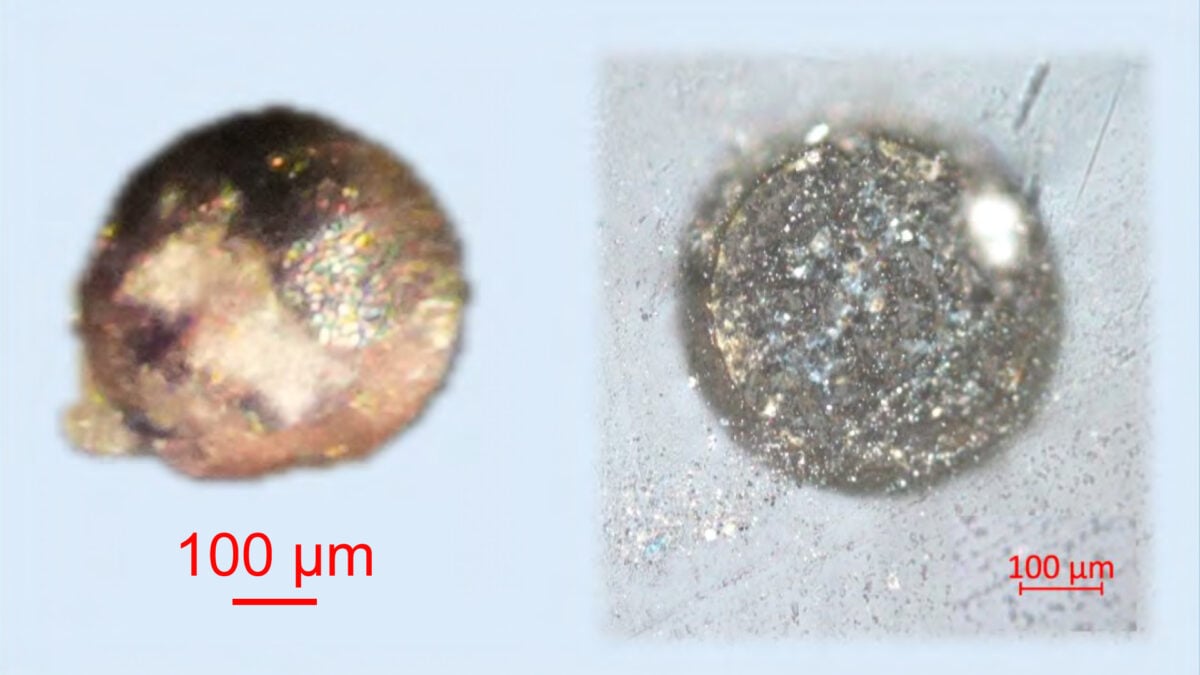
In the summer of 1945, atomic bombs struck the Japanese cities of Hiroshima and Nagasaki. Within seconds, the explosions turned into expanding fireballs that completely transformed the landscape—so much so that, 80 years later, scientists are still discovering the unexpected consequences of the explosions. A Science Advances paper published today details the discovery of a previously unknown, silicon-rich alloy that formed during the atomic bombing of Hiroshima. The crystalline compound was a multicomponent alloy, or a mix of five or more principal metallic elements, according to the paper. Luca Bindi, the study’s first author, also led a recent project that discovered a new crystal forged in the aftermath of the Manhattan Project’s Trinity test. These extreme events forged entirely new types of chemical compounds—not just simple deformations but complex structures with unique compositions. “We discovered a previously unknown, silicon-rich multicomponent alloy inside a microscopic spherule formed during the Hiroshima atomic blast,” Bindi, a geologist and crystallographer at the University of Florence in Italy, told Gizmodo. “Together with our earlier discoveries in Trinity debris, [the finding] suggests that extreme, rapidly quenched environments can systematically explore unusual regions of structural and chemical phase space.” High extremes Indeed, the Hiroshima bombings and the Trinity Test both represent extreme environments that are difficult to replicate, for obvious reasons of practicality and ethics. That said, it’s a historical fact that these two events did occur and generated conditions “comparable in nature to hypervelocity planetary collisions, meteor impacts, and lightning strikes,” as the team wrote in the paper. The mushroom cloud from the Little Boy bomb over Hiroshima Province, Japan, in 1945. © George R. Caron via Wikimedia Commons When the atomic bomb exploded over Hiroshima, the detonation generated a boiling fireball surpassing 12,600 degrees Fahrenheit (7,000 degrees Celsius), which then vaporized buildings, soil, metal, glass, and water into a chaotic swirl of plasma. But the destruction didn’t stop there. According to the paper, the event generated hot, metal “droplets” that permeated the air—called “hiroshimaites”—and eventually settled into every corner of the devastated city. An unusual relic After finding a novel crystal created by the Trinity tests, Bindi and colleagues wondered if the Hiroshima fallout might have resulted in something similar. For the latest study, the team examined 34 hiroshimaites with microscopy and chemical analysis. Then, the team used X-ray diffraction to determine the atomic structures of the selected samples, which were just about 10 micrometers across. (For context, human red blood cells are approximately 7.8 micrometers in diameter.) Among the samples, the team discovered a tiny alloy containing a variety of metals, including iron, nickel, silicon, and aluminum—in other words, elements from the vaporized remains of buildings caught in the nuclear blast. Despite the chemical complexity, the atomic arrangement was highly ordered—in a minuscule grain just a few micrometers across, too, Bindi explained to Gizmodo. He added that this demonstrates how “nuclear detonations can create complex, ordered crystalline alloys—not merely melt or deform existing materials.” Nuclear forensics Compared to Trinity, the Hiroshima bombs were detonated at much higher altitudes, which resulted in physical differences between the crystals forged during each event. Bindi explained that, remarkably, the small compounds captured significant details about the explosions, which themselves only occurred over a couple of seconds. From the standpoint of “nuclear forensics,” the compounds “encode diagnostic information about device materials, local environment, and thermochemical conditions during detonation.” What’s more, alloys like these typically demonstrate remarkable mechanical strength, thermal stability, or corrosion resistance, according to the paper. So there could be some merit to considering “systematic, ethically, and legally managed” studies of these extreme events, as they could truly advance our understanding of both historical events and unknown chemical processes in nature, the team argued in the paper.
Physicists Discover Previously Unknown Substance Born From Hiroshima Atomic Bombing
Full Article
Original Source
Read the full article at Gizmodo →KhanList aggregates and links to publicly available news content. We do not host full articles from third-party sources. Always verify important information with original sources.