
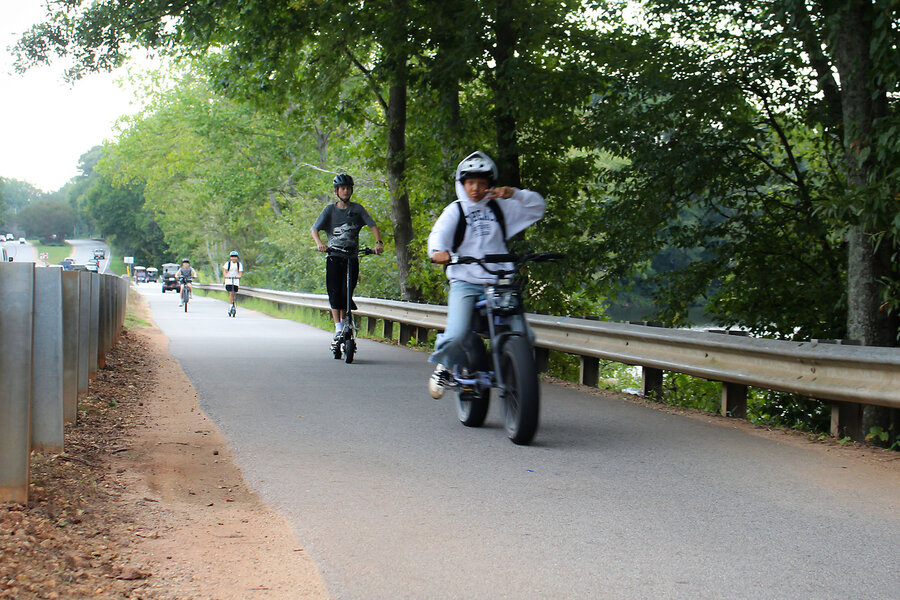
Peachtree City, Ga. | Sept. 24, 2026, 4:13 p.m. ET | 5 min read Done with school for the day, a troop of teens zipped by on their electric bikes, weaving and chirping as they rode around curves, exuding the confidence of acrobats. After gathering for a “Where next” chat, they took off down another golf cart path, popping wheelies along the way.To some, that afternoon snapshot near the Peachtree City, Georgia, library looked like an idyll of childhood, only with a twist. To others, such e-powered teen groupings are more of a menace, endangering pedestrians and other bicyclists.“One part of me, the old geezer, says to call the cops,” says Kevin Pfeifer, a retired government employee who rides a non-electric, single-speed Schwinn that’s pushing 30 years old. “The other side of me says, at least they’re not in the basement playing video games.” It’s not just the Peachtree City folks who are second-guessing e-bikes and how to integrate them safely with existing infrastructure. Americans of all ages are hopping on e-bikes and electric scooters, two-wheeled machines with 750-watt electric motors that can propel them beyond 30 mph. (Some faster models can reach 80 mph.)Elsewhere, in England, police regularly seize “illegal” bikes – or ones that, as the kids say, have been “jail-breaked,” or hacked to loosen their speed governors. And Paris officials decided to pick winners and losers. The French capital banned rental e-scooters but has encouraged e-bikes. Patrik Jonsson/The Christian Science MonitorKevin Pfeifer, a retired government employee, talks about his beloved 30-year-old single-speed Schwinn, in Peachtree City, Georgia, Sept. 22, 2026. Meanwhile, the pro-car Trump administration over the summer ordered the government to stop granting money for what the transportation secretary called grants that support “DEI” bike paths.“Technology adoption is uneven, and there’s a learning process,” says Clinton Andrews, a lifelong cyclist and director of the Center for Urban Policy Research at Rutgers University.Slow down, you move too fastPeachtree City is a unique American experiment. Planned in the 1950s, it began in the early 1970s to construct its now 120-mile-long ribbon of “shared-use paths” weaving around five villages. It’s a snapshot of what some call the potential of micromobility, offering a slower but sometimes quicker-to-destination alternative to the family car. But here, as in many parts of the U.S., fast-moving technology is crashing into outdated ordinances and upsetting, if not the social order, then neighborhood social media pages. “Someone is going to get killed” is a common refrain as lithium-powered contraptions overtake paths. “Where are the parents?” is another.“It’s exciting to see more and more people involved” in recreational bike riding, says Jeff Long, a salesperson at Atlanta Trek, a local bike shop. “But [the boom in e-bike usage] is causing a lot of headaches” for policymakers.A boom with echoesThe United States imported 8.54 million traditional bikes last year, 21% fewer than in 2024, and the lowest number in at least a decade, according to the latest import figures. The Trump administration’s import tariffs, combined with years of oversupply following a COVID-19 pandemic sales boom, caused the industry to curtail imports sharply.Still, there is strong momentum for e-bikes. An estimated 2.2 million e-bikes are now sold in American markets each year (making up as much as 12% of the total bike sales), often through direct-to-consumer deals. That means bikes are bought straight from a brand’s website – such as Lectric eBikes or Canyon – and shipped to the customer’s home.Those numbers don’t include sales of other new modes of electric travel, including increasingly elaborate golf carts, one-wheel boards, and e-motos.Middle-schoolers aren’t the only ones who dig the pumped-up rides. Boomers looking to make their weekly riding groups a bit easier are snapping them up. Immigrants who can’t finagle driver’s licenses are hopping on. Urban office workers are using them to solve the “last-mile” problem of urban transit – getting to and from the bus or train stop. Patrik Jonsson/The Christian Science MonitorA teen bicyclist listens to music after school next to Lake Peachtree in Peachtree City, Georgia, Sept. 22, 2026. Peachtree City, an early proponent of alternative transportation, used to have a simple rule for its shared-use paths – a 20 mph speed limit and no ATVs. But in March, the city council passed a new ordinance to address an influx of e-bikes and other new electrified machines. Officials found it difficult to balance the new public safety issues with citizens’ demands that often lean toward more open use of the paths. When the city proposed helmets for all riders, older riders pushed back. Now, only those under 15 need them. Dangerous behavior, such as popping wheelies on bike paths, part of the city’s park system, is considered reckless and is, thus, forbidden.But the truth is, “we can’t keep up” with enforcing the new rules, says Tim Maret, the city’s senior code enforcement officer.From horses to electric skateboardsConcerns that have emerged with the new electric bikes and scooters are not just about zooming kids. They are also about a spike in wrecks, often made far more serious by speed. The U.S. saw a more than sevenfold increase in e-bike injuries between 2022 and 2026, according to Truveta, a data and analytics company.“Where before you had collisions between cars and micromobility, now you have collisions between micromobility and people who are walking,” says Chris Wyczalkowski, co-founder of the Micromobility Lab at Georgia State University in Atlanta. “They’re zipping through pedestrians, hitting pedestrians, and falling off here and there.”The rush to regulate e-bikes has left communities across the U.S. scrambling to enact local ordinances that jibe with local safety concerns and neighborhood values while acknowledging the freedom and popularity of life on two wheels.“Everybody and their dog” on e-bikesAs e-bike technology advances and usage increases, transit experts say both social and civic learning are at play – communities setting standards of behavior while lawmakers set rules of the road.“It’s part of a clear evolution from a world where we had horses and then bikes and then automobiles,” says Dr. Andrews at Rutgers. “We are experimenting once again and desiring to knock the auto off its pedestal,” he says. “[But] how do we reclaim the roadway? Is it even possible?”The push for bike lanes began in the 1960s, and the U.S. now has 4,400 directional miles of bike lanes. Yearly spending for bike and pedestrian projects topped $1.5 billion in 2026, according to the League of American Bicyclists.Peachtree City is driving an expansion of paths at a fast clip, pushing coverage into the nearby towns of Newnan, Tyrone, and Fayetteville – potentially connecting more than 100,000 people with the option to take the skateboard to the grocery store. Deepen your worldviewwith Monitor Highlights.Politics with respectGet political stories with respectful analysis.There‘s a world of new ideas in everyBooks newsletter.There‘s more to life, enrich yours withCulture & Learning weekly.Follow humanity‘s discoveries withScience & Nature stories in your inbox.Gain a spiritual perspectivefrom the stories in your inbox.Want to understand the deeper impact of critical events? Learn the Monitor‘s insight.Already a subscriber? Log in to hide ads. But policing that growth for now is falling mostly to golf-cart-driving code enforcers – city-employed civilians without police powers to chase or detain wheelie-poppers. For them, they are stuck in the middle of a suburban tug-of-war between parents who are ecstatic to see their kids playing outside and others who are growing tired of looking over their shoulders for high-speed joyriders.At the end of the day, says Mr. Maret, the code enforcer, “what we’re dealing with is the fact that, all of a sudden, everybody and their dog is on e-bikes.” ALREADY A SUBSCRIBER? LoginReal news can be honest, hopeful, credible, constructive.The Christian Science Monitor was founded in 1908 to lift the standard of journalism and uplift humanity. We aim to “speak the truth in love.” Our goal is not to tell you what to think, but to give you the essential knowledge and understanding to come to your own intelligent conclusions. Join us in this mission by subscribing.
One city thought it had e-bikes all figured out. Not so fast.
Full Article
Original Source
Read the full article at Csmonitor →KhanList aggregates and links to publicly available news content. We do not host full articles from third-party sources. Always verify important information with original sources.