
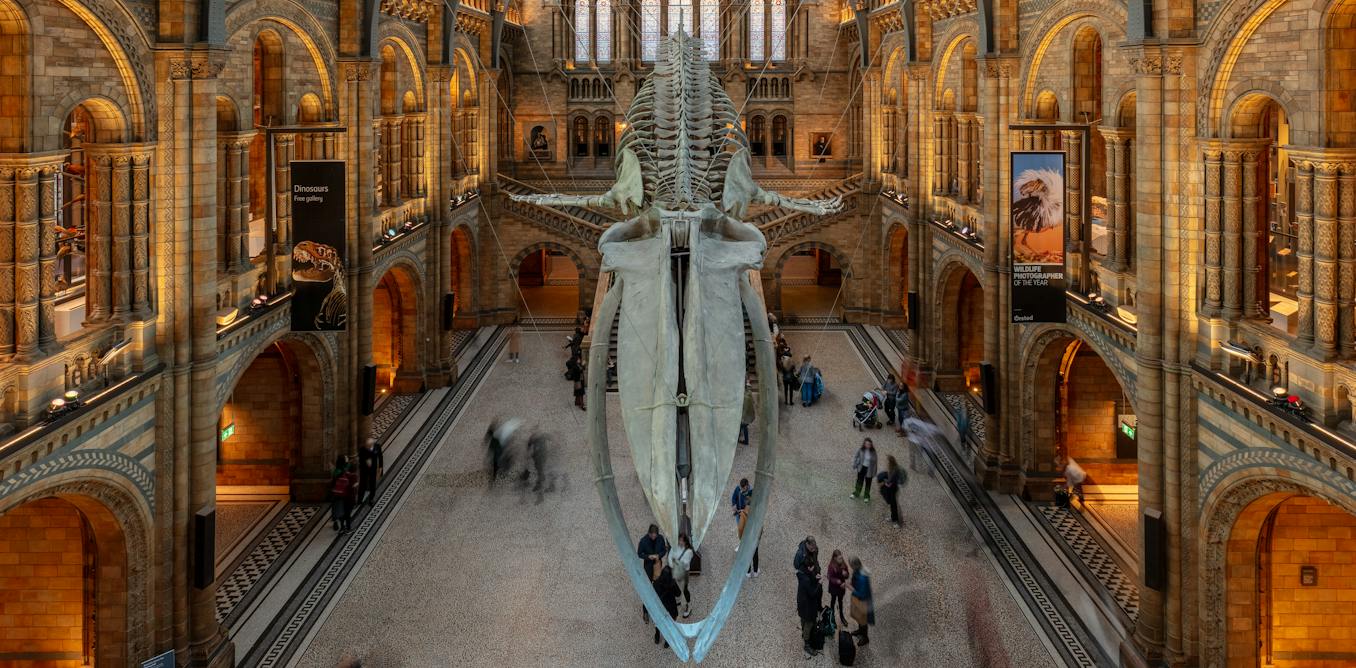
Like the Galapagos Islands, New Zealand’s unique isolation makes it an iconic natural history location of global importance. Already famous for its flightless birds and their story of evolution on a mammal-free archipelago, New Zealand is home to many other, less well known but equally important plants and animals. This includes horopito, which has the most primitive flower of any plant alive today, or the hihi/stitchbird, which is the only member of an entire avian family. I often wonder why New Zealand doesn’t have a dedicated natural history museum (like those in London, Paris, Vienna or New York) to celebrate its unique biodiversity, geology and fossil record. With ongoing changes in leadership at the Museum of New Zealand Te Papa Tongarewa, it might be time to have this conversation. The gallery of palaeontology and comparative anatomy in Paris is dedicated to natural history. Te Papa, CC BY-SA The case for a natural history museum The research of natural history scientists at Te Papa is world class. But in terms of public-facing displays, the museum cannot do New Zealand’s geological and biological heritage justice. It has to be too many things to too many people, leaving too little space for natural history. Some treasures are currently on display, including New Zealand’s first dinosaur fossil discovered by famed palaeontologist Joan Wiffen. But this and other fossils of national and global significance remain mostly confined to a small exhibition area. Only a tiny fraction of any museum’s collections is on display. Notable examples missing from display at Te Papa include reconstructions of New Zealand’s dinosaurs and many fossils of recently discovered species such as the eight-million-year-old giant crab from Taranaki. Apart from Te Papa’s collections, Wellington holds others of national importance, including of fossils, marine species and rocks at Earth Sciences New Zealand. Around the country, other collections also exist, including of arthropods and fungi as well as the Allan Herbarium at the Bioeconomy Science Institute. The University of Otago’s geology museum is an example of a collection held by an academic institution. But these collections aren’t protected by an act of parliament like Te Papa, and they don’t have the same level of public accessibility or funding the national museum has. I propose they should all be combined to form the basis of a new museum. Current public displays on New Zealand’s biodiversity don’t always put it into a global or evolutionary context. For example, New Zealand is the cradle of penguin evolution and the ancestors of many now endemic birds came from Australia, South America, the northern hemisphere and in some cases, places unknown. Biodiversity displays could be further strengthened by showcasing New Zealand’s geological heritage. Rock and mineral displays can be popular attractions and it would be a prime opportunity to put pounamu in a global context. Pounamu is the Indigenous Māori name for nephrite jade and bowenite, which is a taonga (treasure) for carving. From contested to globally relevant spaces The Victorian concept of a museum has a colonial history. This has led to collections containing numerous contested objects such as the Parthenon marbles in the British Museum and Indigenous human remains stored in collections worldwide. By being open about this history and working with mana whenua (local Māori groups), a new museum could help heal these rifts. This would enable exhibitions with a global focus, for example about the evolution of life on Earth, to be told through the fossil record and living biodiversity. A prime example is the fossil of one of the first dinosaurs ever described (Iguanodon), held by Te Papa, which helped start the world’s ongoing interest in dinosaurs. Currently Te Papa does not display any biodiversity from outside New Zealand. Imagine seeing a whole gallery of fossil and living whale skeletons to illustrate their remarkable evolutionary journey from land to sea, similar to displays in the gallery of palaeontology and comparative anatomy in Paris. Like the incredible, almost complete Triceratops skeleton Museums Victoria acquired for AU$3 million, a dedicated natural history museum in New Zealand should source specimens and loans ethically to promote collaborative research and public outreach. The Triceratops skeleton at Museums Victoria. Nic Rawlence, CC BY-NC-ND Scientists and their research could also be showcased. This would keep the museum relevant and in the public mind. As part of its public exhibitions, the Swedish Museum of Natural History has displays of their researchers explaining the importance of their work. Location, support and funding Core activities of a natural history museum include growing, caring for and researching collections as well as providing access to the public. Most of these are not financially viable. A natural history museum would therefore require core funding from central government to avoid closure such as what recently happened at the Philadelphia Academy of Natural Sciences. Public-private partnerships are a funding option but have raised ethical issues such as the London Science Museum’s past relationship with the oil company Equinor. A new museum may seem expensive, but it could generate significant tourism income to reinvest into curation and research. Museums in New Zealand contributed at least NZ$1.1 billion to New Zealand’s GDP in 2023. High-quality international touring exhibitions, such as Te Papa’s successful Whales Tohora, could further showcase the global importance of New Zealand’s biological heritage. Gareth Nelson, who was the curator of fishes at the American Museum of Natural History before retiring to Australia to work on plant taxonomy, once famously said: Explain New Zealand and the world falls into place around it. This could be the guiding principle for a new museum dedicated to New Zealand’s biological heritage.
NZ has unique stories of evolution and geology. Is it time for a natural history museum?
Full Article
Original Source
Read the full article at Theconversation →KhanList aggregates and links to publicly available news content. We do not host full articles from third-party sources. Always verify important information with original sources.