
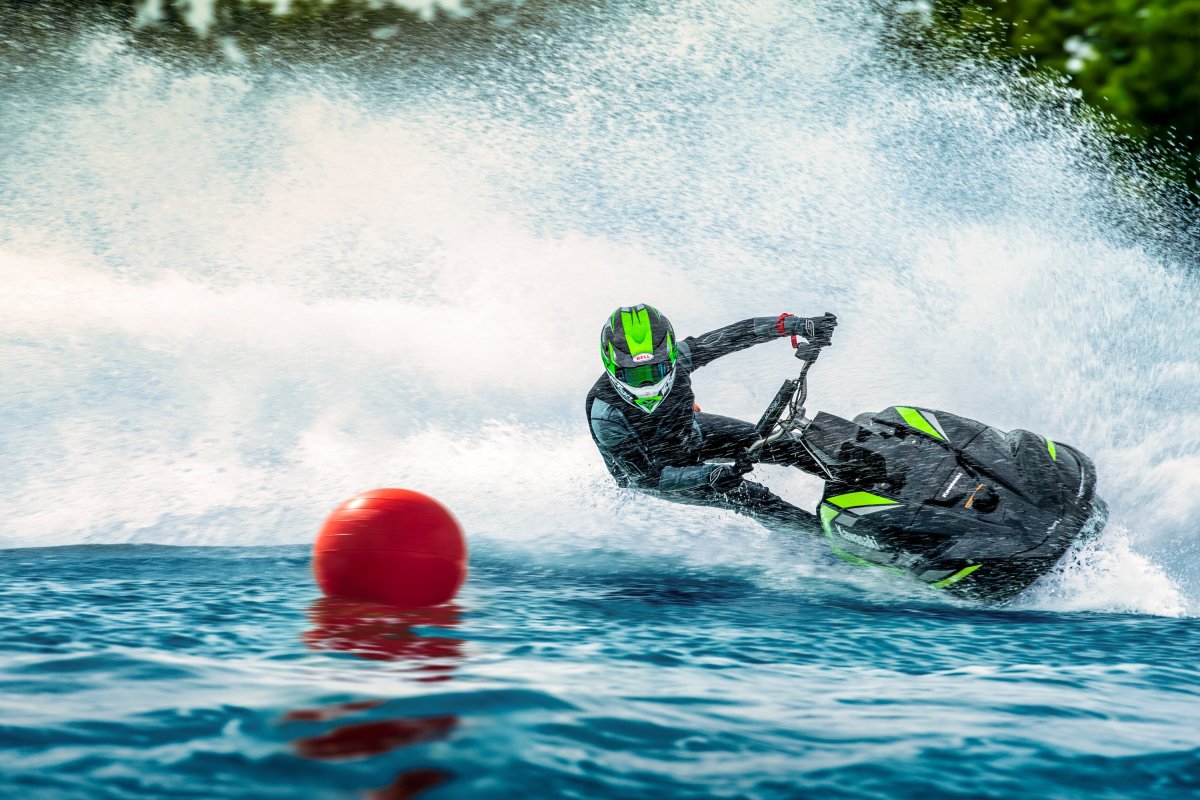
In 1964, then-Pontiac division president John Z. Delorean (yes, that Delorean, of Back to the Future movie car fame) invented the muscle car category by bolting the big-block V8 engine from the company’s full-size cars into its lighter intermediate-sized chassis to create the legendary Pontiac GTO. Kawasaki has done the same thing for its Jet Skis for the 2027 model year by installing the 310-horsepower supercharged 1.5-liter engine from its bigger Ultra models into the sporty, agile Jet Ski STX hull. The result is a truly eye-opening performance with what the company says is its quickest Jet Ski yet. Kawasaki established the personal watercraft industry with the 1973 introduction of the 27-horsepower JS400 Jet Ski. Since that time, however, the one-time industry leader has slipped in popularity compared to its rivals in the market. The company’s 2027 plan to recapture customers includes an embrace of high performance. Kawasaki has rolled out five new models for 2027, but the stars of the show are the high-performance Jet Skis meant to excite customers. Image: Kawasaki The original Jet Ski employed a smokey 400 cc 2-stroke engine that grew to 800 cc over time. Those early Jet Skis were tricky stand-up models that delivered responsive handling but presented a learning curve that saw newcomers falling off repeatedly as they learned to master the machine. The solution was the introduction of the more stable sit-down models that traded responsiveness for stability. It was a trade that so many riders were willing to make that eventually Kawasaki phased out the stand-up models entirely. The industry shifted to cleaner 4-stroke engines in the ‘90s, and 1999 saw the arrival of the 1.5-liter engine based on Kawasaki’s sport motorcycle powerplants in its Jet Skis, packing 150 horsepower. In 2007, the engineering team bolted a supercharger to the same engine, producing 250 horsepower. Now, thanks to the technology of Eaton’s Twin Vortices System supercharger design (which debuted on the 2009 Chevrolet Corvette ZR1), power has reached 310 horsepower. Packed into the agile STX sit-down hull to create the STX 310 model, the big motor lets riders rip across the water at 65 mph. Image: Kawasaki This drivetrain employs a 4-into-2-into-1 exhaust with dual water mufflers to minimize backpressure, maximizing the engine’s power and efficiency. The 160-mm jet pump has a three-blade impeller whose blade angles are optimized for peak acceleration and thrust. Kawasaki let us ride the top-of-the-line STX 310RX, which lists for $20,199. There is a slightly less-well-equipped STX 310R that goes just as fast for $18,799. The test unit featured a 7-inch display panel containing the speedometer, tachometer, supercharger boost level, fuel level, trim setting, power mode setting, and compass. The rear-view camera on the STX lets the rider keep an eye on skiers, wakeboarders, or tube riders behind the watercraft. We’ve gotten familiar with electronically controlled modes in modern cars, trucks, and motorcycles, and they are also present here in the Jet Ski STX 310RX. They are Smart Learning Operation (SLO), Lower Power Operation (LPO), Middle Power Operation (MPO), and Full Power Operation (FPO). I started riding in MPO, thinking that would be a good get-acquainted scenario and I was pleasantly surprised at the STX 310’s speed. I guess I shouldn’t have been, considering that it has 310 horsepower. After a bit of that, I switched to FPO, and found the throttle response much touchier and acceleration quicker–perfect for big fun. MPO limits peak power to 80 percent, while FPO unleashes all 310 horses. LPO makes the throttle response even more sluggish and further restricts maximum power to 60 percent. SLO mode requires a special yellow key and is aimed at true beginners, who, realistically, probably should be learning on something other than this supercharged beast. Other gadgets include the Launch Control system, which automatically adjusts the jet pump’s trim over the course of an acceleration run, keeping it optimized as the boat’s attitude changes during the run. There’s also a handy one-touch 5-mph cruise control, good for complying with no-wake zones. The author takes a spin. Image: Kawasaki Hot-dogging on the STX is a good time, thanks to a hull design that was created for corner carving, without much risk of pitching the rider into orbit mid-corner. There are also some nice practical features, like a Neutral that preserves some degree of steering capability. Jet Skis have no rudder, relying on thrust from the engine to steer them, so when the throttle is released, or the boat is shifted to neutral, you’d expect it to be adrift. But Kawasaki employs a thrust reverser that lets the STX simultaneously have no forward thrust while also having some steering capacity. That reverser also provides for a Reverse position that lets the ride back the STX. Reverse is one of the amenities that led to the demise of original-style stand-up Jet Skis, which aren’t suited to such features. Kawasaki tried briefly to revive the format in 2017, but says that its new stand-up 2027 models are Back to the Future to stay this time. I was pleasantly surprised to find that long-dormant stand-up riding skills were still sufficient for me to take off on the first try without falling. Kawasaki offers two versions of its classic stand-up model for 2027, the Jet Ski SX-R 160 and SX-X 160. These are powered by 160-hp naturally aspirated versions of the 1.5-liter engine, with the difference between them being that the SX-R has a traditional-style moveable handlebar that starts off lying flat and the rider lifts it as they stand. The SX-X has a fixed motorcross-style handlebar, giving riders a choice between the two styles. The test model was the SX-X motocrosser. I’d never ridden one like that before, but I found the fixed bar seemed to make it easier to pull myself up as the ski got underway. However, after falling off, as one does on these things, you have to reach up from the water to reattach your wrist lanyard to the ignition interlock. This is the thing that shuts the ski off when you fall so that it doesn’t leave you behind, and you have to reconnect it to restart the machine. Image: Kawasaki But with the fixed bar up there pretty high from the water, I was happy to have my 35-inch sleeve length. Someone with more normal-length arms might find it hard to reach the switch while floating in the water alongside. Just as I’d remembered stand-ups, the SX model is tremendously agile and fun for turns and jumps. And just as I remembered, it is easy to fall off in the process. Once it starts to roll onto its side, adding power might get you to ride out of it, or, as in my case, it might just make you hit the water while going even faster! It doesn’t matter which handlebar style you prefer because both the SX-X 160 and SX-R 160 are $11,999. Getting one of these would allow you to cultivate some old-school riding skills while taking advantage of some throwback value. That was another key component of the original Pontiac GTO’s muscle car legend, so it is good to see in the Kawasaki showrooms for 2027. 2026 Popular Science Home of the Future Awards 39 products that will improve your everyday life.
2027 Kawasaki Jet Skis deliver a supercharged, eye-opening performance
Full Article
Original Source
Read the full article at Popsci →KhanList aggregates and links to publicly available news content. We do not host full articles from third-party sources. Always verify important information with original sources.