
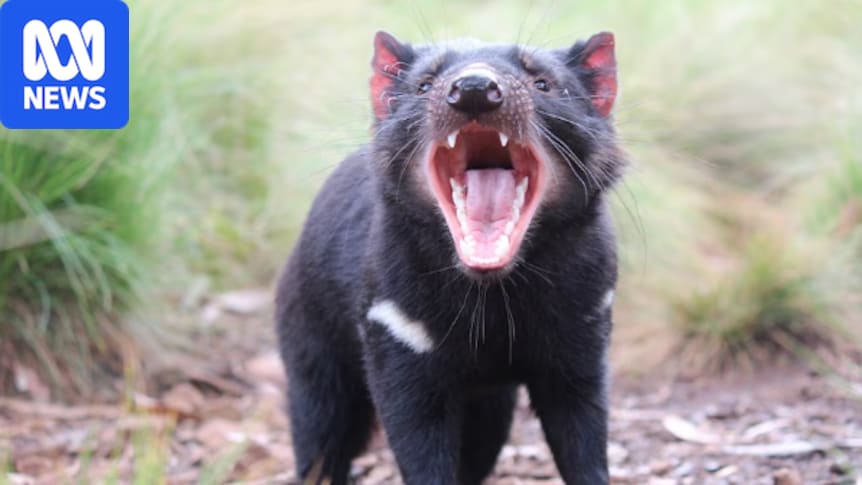
A newly developed test that can immediately detect the deadly devil facial tumour disease (DFTD) affecting Tasmanian devils could become a weapon to combat declining population numbers around the state.WARNING: This story contains images of the disease affecting Tasmanian devilsResearchers at the University of Tasmania's Menzies Institute for Medical Research developed the portable field test, which uses oral swabs to detect the disease in wild populations.DFTD is transmitted through direct contact, such as biting, and causes the animal to starve to death.Tasmanian devils pass cancer cells to each other through biting. (Supplied: Rodrigo Hamede )In some parts of the state, the disease has reduced devil populations by about 80 per cent.The current testing method relies on visible tumours, and results take days to return.It is hoped the new tests may be able to detect the disease earlier and help inform the development of an oral vaccine.The contagious cancer-like facial tumour disease has decimated Tasmanian devil populations. (Department of Natural Resources and Environment Tasmania)Death by starvationDFTD causes tumours to grow on the devils' face and body, typically killing the animal within several months of the tumour becoming visible.As the tumour grows in size, it becomes more difficult for the devil to eat, leading to the animal starving to death.Lead researcher Anuk Kruawan said there are two strains of the disease, with strain one — called DFTD 1 — more prevalent."[The second strain is] still quite confined to the [D'Entrecasteaux] Channel region, so that's why it's important to do neural monitoring testing to see whether the second type of tumour is spreading," he said.It's hoped that in the future, devils that return positive tumour tests will be treated in the field with a vaccine. (Supplied: University of Tasmania)As part of the trial, researchers conducted 33 tests on 10 Tasmanian devils and three spotted-tailed quolls.Half of the devils, and none of the quolls, returned positive test results.Researchers worked alongside Tasmania's Department of Natural Resources and Environment, which trapped and handled the animals, before oral swabs were taken.Researchers are working to develop an oral bait vaccine to combat the disease. (Supplied: Anuk Kruawan)Detecting tumours in the fieldDr Kruawan hopes the new test will detect the disease in its early stages before the tumours become visible."It is capable of detecting the tumour out in the field so you wouldn't need to take samples back into the lab," he said.Dr Kruawan said the idea was that the test would pick up a small amount of DNA where the tumour would develop.Dr Anuk Kruawan with the new portable test for Tasmanian devil facial tumour disease. (Supplied: UTAS/Peter W Allen)The DNA causes a reaction that makes the test "glow green", indicating an immediate positive result, rather than waiting days for samples to be returned."One of our biggest questions is, can we actually detect the tumour before we can actually see the tumour? And if we can, that could give us a very valuable insight into the immune system," he said."Then we can reverse engineer that and then we can try to come up with better therapeutics or effects."A field test displays its results. (Supplied: Anuk Kruawan)Emaciated devils 'just a skeleton'Alice Carson, a wildlife carer in the state's north-west, said the Tasmanian devil population in the region had practically "disappeared" in the past year.She puts this down to the deadly disease."When [DFTD] goes through a population, what is left is between 10 and 20 per cent," Ms Carson said.Alice Carson says that devils with the facial tumour experience a "horrific" death. ( ABC News: Meg Powell )She described caring for the animals affected by the disease as "some of the most horrific stuff you will ever see in your life"."These animals are emaciated to the point where they are just a skeleton with a bit of a covering of hair over them," Ms Carson said."It is absolutely the most soul-destroying thing to find a devil with facial tumour disease because it is just a horrific, horrific death."Dr Kruawan said the focus now was on working with the government to develop a management action plan, as well as continuing to develop a vaccination trial."Currently, we don't normally do anything [after we detect the disease], so we release the animals back into the wild because we don't typically do immunotherapies to treat the animal," he said."Our team is working on developing an oral bait vaccine. That study is ongoing."
New field test picks up deadly tumour disease in Tassie devils
Full Article
Original Source
Read the full article at Abc →KhanList aggregates and links to publicly available news content. We do not host full articles from third-party sources. Always verify important information with original sources.