
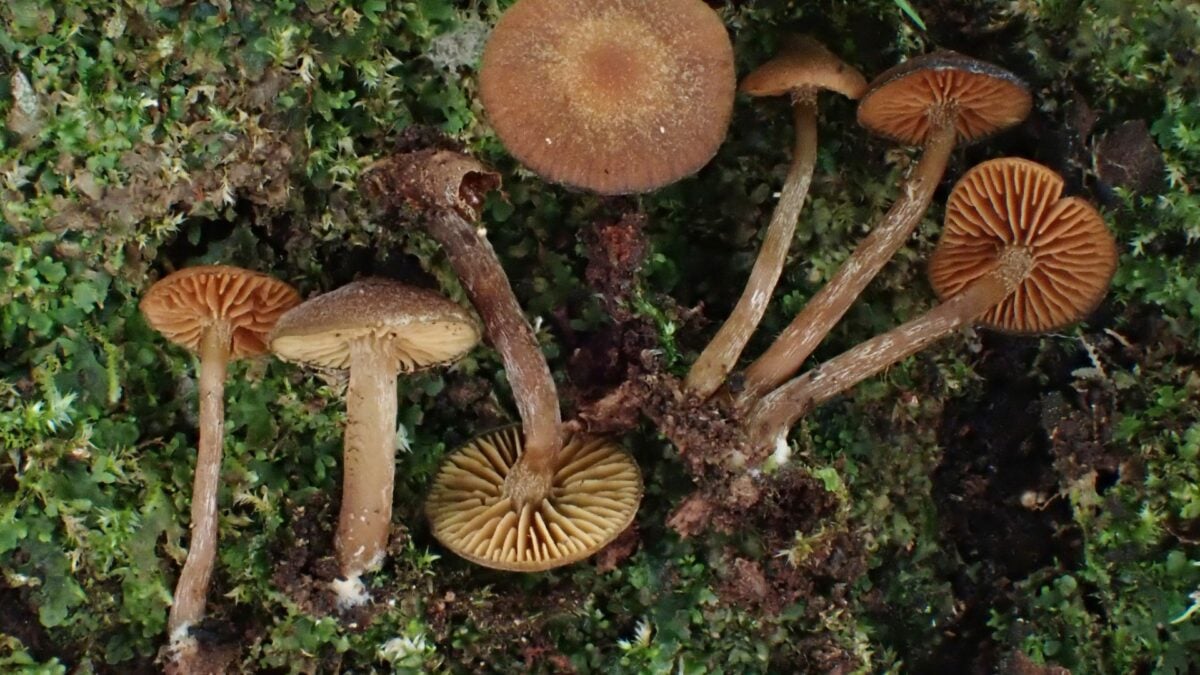
In the swamps of Florida, there exists a tiny brown mushroom quite unlike anything humans have seen before: one that’s toxic and trippy at the same time. In a study out today, researchers at the University of Florida and other institutions describe a mushroom that can pump out both deadly amatoxins and psilocybin, the active ingredient responsible for the psychedelic effects of recreationally used magic mushrooms. The genetics of this species—nicknamed the “dark magic mushroom”—may tell us something important about fungi and their evolution, the researchers said. “Humanity’s cultural infatuation with mushrooms has long been bookended by two categories: mushrooms that induce psychedelic experiences and mushrooms that are deadly toxic. Our discovery of the ‘dark magic mushroom’ represents an unusual convergence of worlds, where we now know of this rare and unusual species that produces the chemistry responsible for both properties,” lead author Andrew Kunik, a fungal biologist at the University of Florida, told Gizmodo. The dark magic mushroom As is often the case in science, Kunik and his team’s discovery was more fortuitous than intentional. The team originally set out to learn more about a broad and hard-to-distinguish group of fungi known as little brown mushrooms; they were specifically hoping to find species belonging to the genus Galerina that could produce amatoxins, one of the main compounds that make some mushrooms especially deadly to consume, including the aptly-named death cap mushroom (Amanita phalloides). Between January 2024 and September 2025, they collected various specimens of Galerina in the southeastern U.S. One of these specimens was an example of Galerina indica, a known but understudied species, and that’s when things got weird. Scientists had previously characterized G. indica, but little was known about it until now. © Andrew R. Kunik “We noticed that this mushroom’s flesh turned blue when handled, which is sometimes associated with psilocybin production. When Michael Christopher and I performed the chemical analysis, it confirmed the presence of psilocybin, which helped explain the unusual blue bruising we had observed in the field,” Kunik said. The team also found another previously unknown species of Galerina that only produced psilocybin. There is at least one other Galerina species thought to produce psilocybin, but Galerina indica is the first mushroom known to make both amatoxins and psilocybin. The team’s findings were published Wednesday in the journal Current Biology. An acquired magic trick and more to learn The team also conducted a genetic analysis of the mushrooms they found, which yielded further discoveries. For one, it’s likely the ancestors of these mushrooms didn’t inherently learn how to make psilocybin; rather, they picked up the genes for doing so the same way you might copy a recipe from a friend’s cookbook. “Interestingly, it appears to have acquired this ability through horizontal gene transfer from an unrelated fungus rather than having evolved the ability itself,” Kunik explained. Horizontal gene transfer is commonly seen in bacteria and other microbes and is one reason why bacteria can easily learn how to dodge our antibiotics. But scientists have learned that more complex organisms like fungi can pull off this trick as well, and the genes for making psilocybin seem to be one of these traded commodities. It’s likely the ancestor of G. indica picked up this ability sometime in the Miocene, Kunik said, which occurred between 23 and 5 million years ago. There are still plenty of mysteries left to resolve about the dark magic mushroom and its cousins. It’s possible that the other psilocybin-making Galerina species acquired these genes at a later point than G. indica, for instance, but it’s also possible that the same ancient ancestor learned this trick, had many different lineages descend from it, and that all but two of these lineages eventually lost the genes for some reason. Scientists also don’t fully understand why mushrooms evolved to produce either amatoxins or psilocybin. They do suspect these compounds help ward off fungi-eating predators, but there are still a lot of gaps to be resolved there. If that’s true, though, then G. indica‘s mix of chemical cocktails might represent a unique defense strategy. “It would be interesting to experimentally investigate how fungivorous animals, such as snails and nematodes, respond to these compounds and whether they provide the mushroom with some advantage in its natural environment,” Kunik said. Kunik and his team aren’t planning to directly follow up on their research, but they do hope others can explore some of these questions and possibly find other species that might have the same dual ability. Just in case you’re wondering, though: By no means should anyone try to personally dabble in this particular dark magic. “Do not eat this mushroom!” Kunik said.
Mushrooms Tend to Be Deadly or Trippy. This One Is Both
Full Article
Original Source
Read the full article at Gizmodo →KhanList aggregates and links to publicly available news content. We do not host full articles from third-party sources. Always verify important information with original sources.