
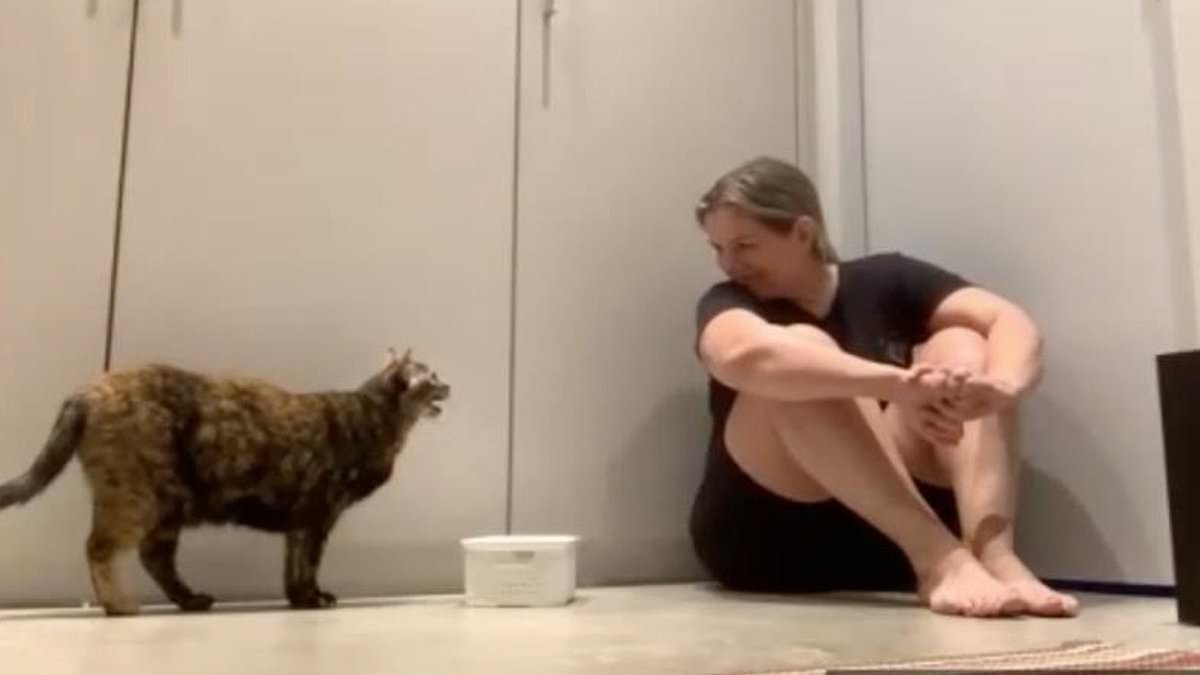
Many cat owners like to think they share a special bond with their pet, with meows often interpreted as signs of affection.But a new study suggests you've probably been reading these signals all wrong.Researchers from the University of São Paulo gave cats an unsolvable task involving their favourite food, both with and without their owner present.When their owner was there, the cats meowed much more frequently, often standing still and staring directly at them as they did so.In contrast, when their owner was absent, the cats tended to stare silently at the door.The findings suggest that cats use meowing as a way to communicate their needs and get what they want from humans, rather than necessarily as a sign of affection. Researchers from the University of São Paulo gave cats an unsolvable task involving their favourite food, both with and without their owner present When their owner was there, the cats meowed much more frequently, often standing still and staring directly at them as they did soIn the study, the researchers set out to assess the 'audience effect' in cats.'A signal is considered socially communicative, rather than simply a reflection of a motivational or emotional state, when it is influenced by the presence of other individuals, the so–called audience effect,' the team explained in their study, published in Animal Behaviour.'In contrast, motivational or emotional responses are primarily linked to internal states and do not necessarily vary with audience presence.'The team enlisted 38 cats, who were given an unsolvable task in their homes under two conditions – with and without their owner present. The cats' favourite food was placed inside an inaccessible box, before they were observed for around one minute. The results revealed that the cats produced significantly more meows when a human was present compared to when they were alone. '[This] is consistent with meowing functioning as a socially directed signal rather than a purely motivational response,' the team explained. In addition, a greater proportion of meows were produced while the cats' heads were pointed towards their humans. When their owner was absent, the cats tended to stare silently at the doorAccording to the researchers, this suggests that cats use meowing as a way of getting what they want, rather than conveying emotion. They concluded: 'These findings are therefore consistent with meowing functioning as a communicative signal rather than just an expression of internal motivation or emotion.' The news comes shortly after a study found that cats can't understand human voices, and think all our various vocalisations sound exactly the same.While cats do react to humans' emotional outbursts, they don't seem to be able to distinguish those emotions.That means your cat likely thinks your laughter, sobs, screams, and shouts all sound pretty much identical.Almost all domesticated animals, from dogs to goats, have developed some ability to react to the emotional tone in a human voice.Yet, while human voices almost always put the cat in a state of heightened alertness, the emotion behind the noise made absolutely no difference.The researchers, therefore, suggested that cats aren't able to distinguish humans' moods by listening to their voice alone.Likewise, the scientists found no evidence that cats process different emotions in different parts of their brains – as dogs and horses are able to.HOW WELL DO YOU KNOW YOUR CAT? THE SECRET SIGNALS FELINES GIVE THEIR OWNERS Cats are often branded aloof and solitary creatures who spend their days plotting their human owner's demise, but such characterisations could not be further from the truth.In fact, our feline friends constantly communicate their feelings of affection to us, whether it be through their whiskers, tail, face or body language.In her eye-opening new book Kitty Language: An Illustrated Guide to Understanding Your Cat, author Lili Chin - with the help of animal behaviourists - explains how to interpret your pet's movements.Below are some of the most common behaviours and what they could signal. Our feline friends constantly communicate their feelings of affection to us, whether it be through their whiskers, tail, face or body language
Face it, your cat doesn't care about you! Felines only meow at their owner when they want something, study finds
Full Article
Original Source
Read the full article at Dailymail →KhanList aggregates and links to publicly available news content. We do not host full articles from third-party sources. Always verify important information with original sources.