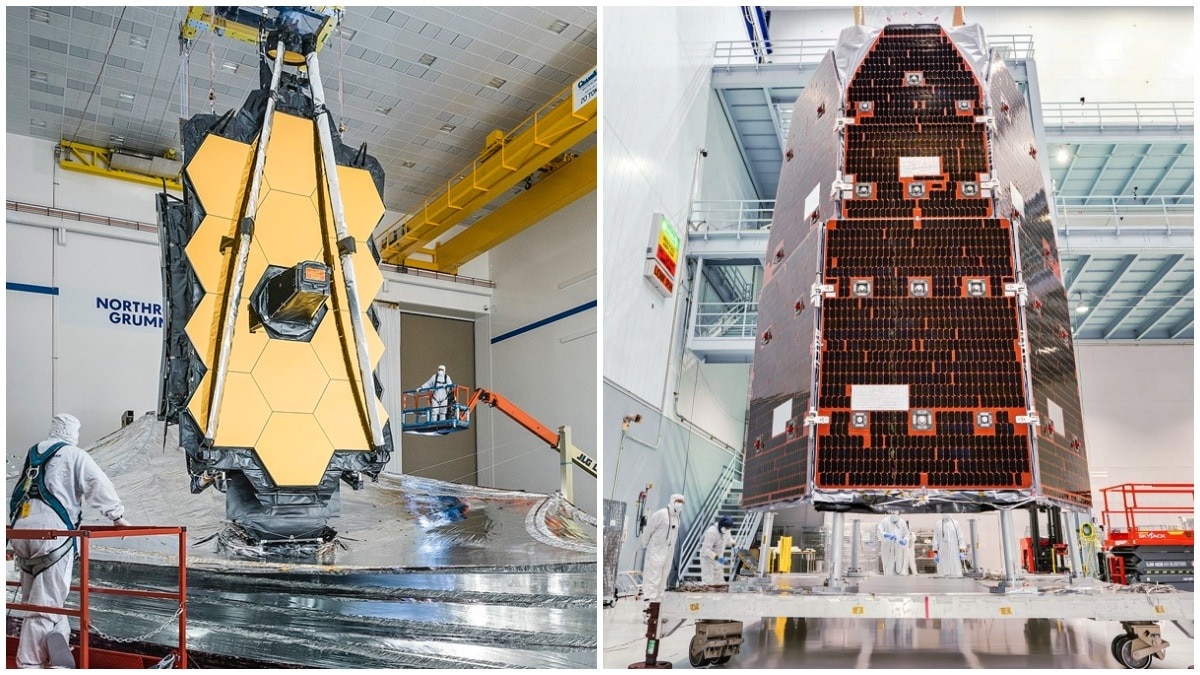
Nasa is preparing to launch its next flagship space observatory, the Nancy Grace Roman Space Telescope, on August 30, 2026, marking the beginning of a mission that aims to answer some of astronomy's biggest questions.While the James Webb Space Telescope has captivated the world with breathtaking images of distant galaxies and detailed studies of alien worlds, Roman is designed to do something very different. Technicians are seen working on the Nancy Grace Space Telescope. (Photo: Nasa) The new space tool will scan vast stretches of the universe to uncover the cosmic mysteries that Webb can later investigate in greater detail.The telescope is scheduled to lift off aboard a SpaceX Falcon Heavy rocket and will travel to the Sun-Earth L2 Lagrange point, about 1.5 million kilometres from Earth, which is the same destination where the James Webb Space Telescope has been operating since 2022. WIDE-ANGLE VIEW OF THE UNIVERSEThe biggest difference between the two telescopes lies in how they observe the cosmos.The James Webb Space Telescope is often compared to a powerful telephoto lens. Equipped with a 6.5-metre primary mirror, it focuses on relatively small regions of space to capture incredibly detailed observations of the earliest galaxies, star-forming regions, black holes and exoplanet atmospheres. Roman, by contrast, is built as a wide-angle survey telescope. Although its 2.4-metre mirror is much smaller than Webb's, its Wide Field Instrument can image an area roughly 100 times larger than Hubble's field of view in a single observation. (Source: India Today Digital) This allows it to rapidly map enormous portions of the sky while still delivering high-quality resolution.In simple terms, if Webb zooms in, Roman zooms out.A CHANCE TO WORK TOGETHERAlthough the new telescope is expected to fly to the stars in coming weeks, it is also expected to work in tandem with a veteran space telescope already in orbit.Rather than replacing James Webb, Roman is expected to work alongside it. An image of two massive galaxy clusters captured by Nasa's James Webb Space Telescope. (Photo: Nasa) Over its planned five-year primary mission, Roman will map around one billion galaxies, helping scientists investigate the nature of dark energy and dark matter, two invisible components that together make up most of the universe.It is also expected to discover thousands of exoplanets through a technique known as gravitational microlensing, offering the most comprehensive census of planetary systems beyond our solar system.Many of these discoveries will become targets for Webb, whose infrared instruments can then study them in remarkable detail.Named after Nancy Grace Roman, Nasa's first Chief of Astronomy and widely regarded as the "Mother of Hubble", the telescope also carries a Coronagraph Instrument that will demonstrate technologies capable of directly imaging planets around nearby stars.The @NASAWebb and Nancy Grace Roman space telescopes are two extraordinary observatories. Once Roman launches, they will work in tandem to change our understanding of the universe.If you missed any of the other videos in this series or want to learn more about their future pic.twitter.com/4oiF9HBTVU— Nancy Grace Roman Space Telescope (@NASARoman) January 29, 2026Together, Roman and Webb represent two halves of the same scientific strategy; one to find the universe's hidden treasures, and the other to examine them closely.- EndsPublished On: Jul 31, 2026 13:18 IST
Nasa to launch Nancy Grace Telescope. How it's different from Webb Telescope
Full Article
Original Source
Read the full article at Indiatoday →KhanList aggregates and links to publicly available news content. We do not host full articles from third-party sources. Always verify important information with original sources.