
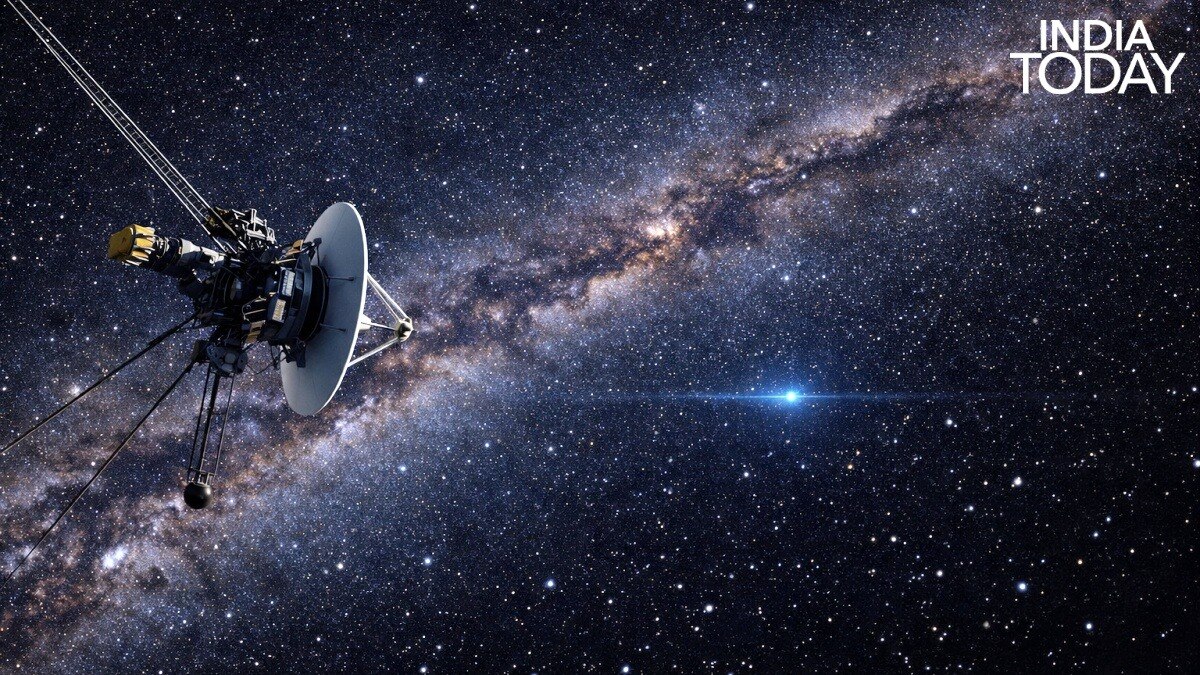
Nasa engineers replaced three power-hungry devices aboard Voyager 1 and restored contact after a 48-hour silence. The intervention could preserve its remaining instruments as it approaches the one-light-day milestone.To keep the mission alive, the team has been systematically shutting down non-essential systems. (Photo: Generative AI by India Today)New Delhi,Oct 30, 2026 12:22 ISTNearly 49 years after leaving Earth, humanity's most distant spacecraft, Voyager 1, has received another lifeline from Nasa engineers, allowing it to continue exploring the mysterious region beyond the Sun's influence for longer than previously expected.Nasa's Voyager team has successfully completed a major power-saving operation on the ageing spacecraft, switching off three devices and replacing them with lower-power alternatives.Nicknamed the 'Big Bang', the operation was completed in early September and is expected to extend the operational life of Voyager 1's remaining science instruments.The development comes as the spacecraft faces dwindling power supplies after decades in deep space. Launched in 1977, Voyager 1 relies on radioisotope thermoelectric generators (RTGs), which convert heat released by the radioactive decay of plutonium into electricity. However, as the plutonium gradually decays, the spacecraft loses approximately four watts of electrical power every year. Engineers have therefore been shutting down non-essential systems and instruments to conserve the limited energy available. Voyager 1 is now travelling at approximately 61,155 kilometres per hour through interstellar space. (Photo: Nasa) The Big Bang operation was particularly challenging because it involved simultaneously replacing three devices responsible for keeping different sections of the spacecraft warm. Engineers had to ensure that the new configuration reduced electricity consumption without allowing critical components to become dangerously cold. The same power-saving operation was successfully carried out on Voyager 2 approximately six weeks earlier. Without these changes, Voyager 1 would have faced the possibility of shutting down another scientific instrument as early as summer 2027.A CLOSE ENCOUNTER WITH SILENCEThe achievement comes after another anxious moment for the Voyager team. On October 18 and 19, Nasa's Deep Space Network failed to detect signals from Voyager 1 during two scheduled communication attempts, raising concerns about the ageing spacecraft.However, communication was restored on October 20, after approximately 48 hours.Engineers are investigating the cause of the interruption. Preliminary findings indicate that one group of thrusters switched off and backup thrusters automatically activated after the spacecraft's onboard computers detected a possible problem.This automatic safety mechanism, known as fault protection, places the spacecraft in a stable configuration and pauses normal operations until engineers can investigate. This image, taken on April 27, 1977, shows one of the Voyagers in the 25-Foot Space Simulator thermal vacuum chamber at NASA’s Jet Propulsion Laboratory in Southern California. (Photo: Nasa) "This is the first time we've seen the spacecraft do something like this, but we are also at a point in the mission where we have to expect the unexpected," said Kareem Badaruddin, Voyager mission manager at Nasa's Jet Propulsion Laboratory.A SPACECRAFT APPROACHING A HISTORIC MILESTONEVoyager 1 is now travelling at approximately 61,155 kilometres per hour through interstellar space, beyond the heliosphere, the enormous bubble of particles and magnetic fields generated by the Sun.On November 18, 2026, it is expected to reach a distance of 16.09 billion miles (25.89 billion kilometres) from Earth, equivalent to one light-day.This means a radio message sent from Earth will take approximately 24 hours to reach the spacecraft, with another 24 hours needed for its response to return.Despite its ageing systems and diminishing power supply, Voyager 1 continues to deliver scientific observations from a region no other human-made spacecraft has directly explored.For Nasa, keeping it alive is not just about extending a mission. It is about preserving humanity's only direct window into interstellar space.- Ends
Nasa pulls off another life-saving miracle to keep Voyager-1 alive
Full Article
Original Source
Read the full article at Indiatoday →KhanList aggregates and links to publicly available news content. We do not host full articles from third-party sources. Always verify important information with original sources.