
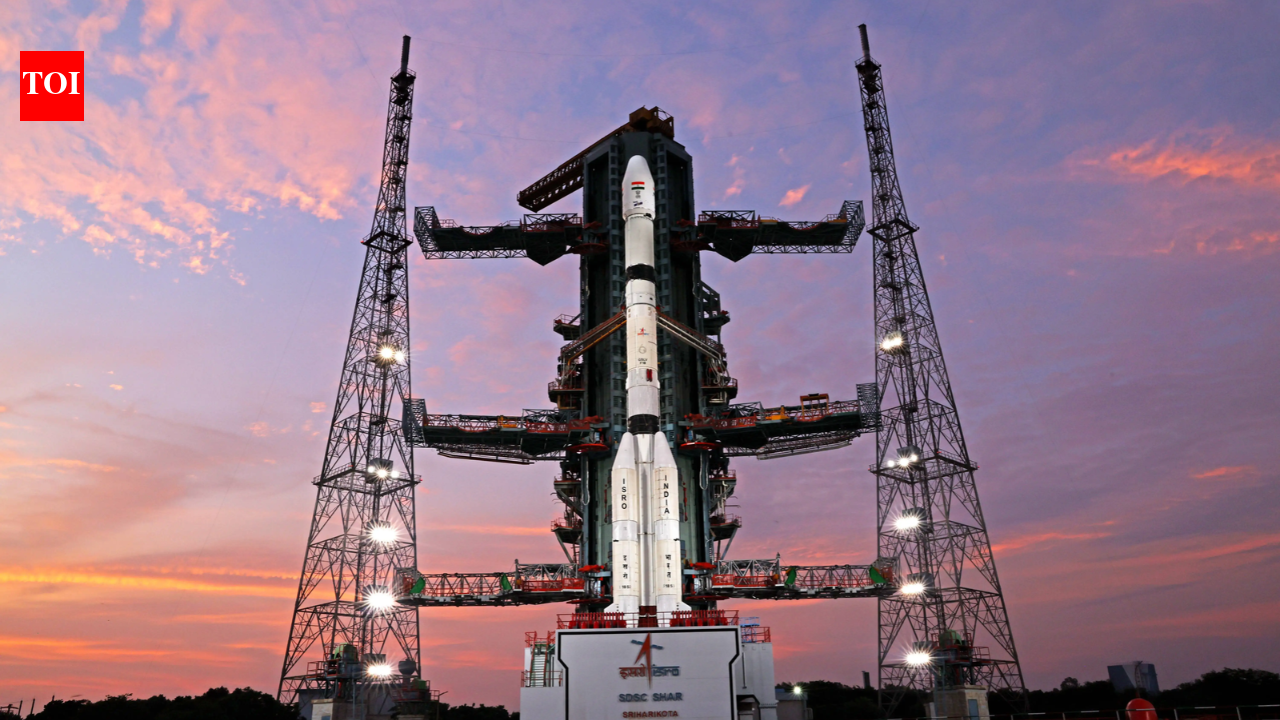
Geosynchronous Satellite Launch Vehicle (GSLV)-F18.The Indian Space Research Organisation (Isro) is scheduled to launch its NVS-03 satellite aboard the GSLV-F18 rocket on Friday night, carrying another indigenous atomic clock into space to strengthen India's satellite navigation capabilities and time sovereignty.The launch is scheduled for 11.51 pm from the Second Launch Pad at the Satish Dhawan Space Centre (SDSC SHAR), Sriharikota. The mission will mark the 20th flight of India's Geosynchronous Satellite Launch Vehicle (GSLV)-F18 and place the third indigenous atomic clock in space as part of the country's next-generation navigation satellite programme.NVS-03 mission carries multiple atomic clocks, featuring one indigenously developed Rubidium atomic clock alongside a set of procured atomic clocks.The satellite is part of India's efforts to ensure continuity and strenghtening of navigation services under the Indian Regional Navigation Satellite System (IRNSS), now known as NavIC (Navigation with Indian Constellation).Regional navigation satellite systemThe Indian Regional Navigation Satellite System (IRNSS), now NavIC, is an indigenous regional navigation satellite system being developed to provide accurate position information services to users in India and a region extending up to 1,500 km beyond the country's boundary.India built NavIC after the 1999 Kargil conflict, when it reportedly couldn’t get GPS data from the US for the region. The lesson was that depending on a foreign system (GPS, Glonass, Galileo, BeiDou) is a strategic risk, especially for the military.The first seven IRNSS satellites were launched between 2013 and 2016.The programme is aimed at strengthening India's independent navigation capabilities through an indigenous satellite system.NVS satellites are meant to replace and extend the older IRNSS satellites.The addition of NVS-03 is expected to support these services while further developing the country's ability to maintain its own navigation infrastructure.What is the NVS-03 satelliteNVS-03 is the third satellite in the next-generation navigation satellite series. Its predecessors, NVS-01 and NVS-02, carried the other two indigenous atomic clocks.Isro said the satellite's coverage would include India's landmass and a region extending 1,500 km around the country's geopolitical boundary.In addition to the existing L5 and S signals, NVS satellites add the civilian L1 signal, which most consumer devices and smartphones use for GPS.An indigenous space atomic clock?An atomic clock is among the most accurate timekeeping devices. Unlike conventional timekeeping systems that rely on a pendulum or a vibrating quartz crystal, it measures time by monitoring the natural vibrational frequency of atoms, most commonly cesium-133.These atomic vibrations provide a highly stable reference for measuring time. This precision is important for satellite navigation systems, which rely on accurate and synchronised timing to provide position information.Atomic clocks are placed in space primarily to provide ultra-precise timekeeping and frequency references.Because light and radio waves travel at roughly 300,000 kilometres per second, even a tiny timing error of a billionth of a second (a nanosecond) translates to a massive positional error of about 300 meters on the ground.Satellites calculate a user's exact position on Earth by measuring the time it takes for radio signals to travel from multiple satellites to a receiver. Accurate clocks keep the entire constellation synchronized.NavIC’s first-generation satellites used imported rubidium atomic clocks. Several of them failed, starting around 2016-17, which degraded the constellation, prompting Isro to develop its own atomic clocksThe launch also aligns with the government's 'One Nation, One Time' vision, which seeks to establish Indian Standard Time (IST) as a common and reliable time reference across the country.On August 29, the central government notified the Legal Metrology (Indian Standard Time) Rules, 2026, as step towards establishing IST as the common, legally recognised and traceable time reference for the country. They will come into force 180 days after their publication in the Official Gazette.According to the ministry of science and technology, accurate and synchronised time is fundamental to modern digital and critical infrastructure. Telecommunications, financial transactions and digital payments, power grids, transportation, data centres and government information systems depend on accurate time synchronisation and reliable timestamps.The development of indigenous atomic clocks for satellite navigation is part of India's broader effort to strengthen its control over critical timing and navigation infrastructure.
'One Nation, One Time': Why Isro is sending atomic clocks into space
Full Article
Original Source
Read the full article at Timesofindia →KhanList aggregates and links to publicly available news content. We do not host full articles from third-party sources. Always verify important information with original sources.