
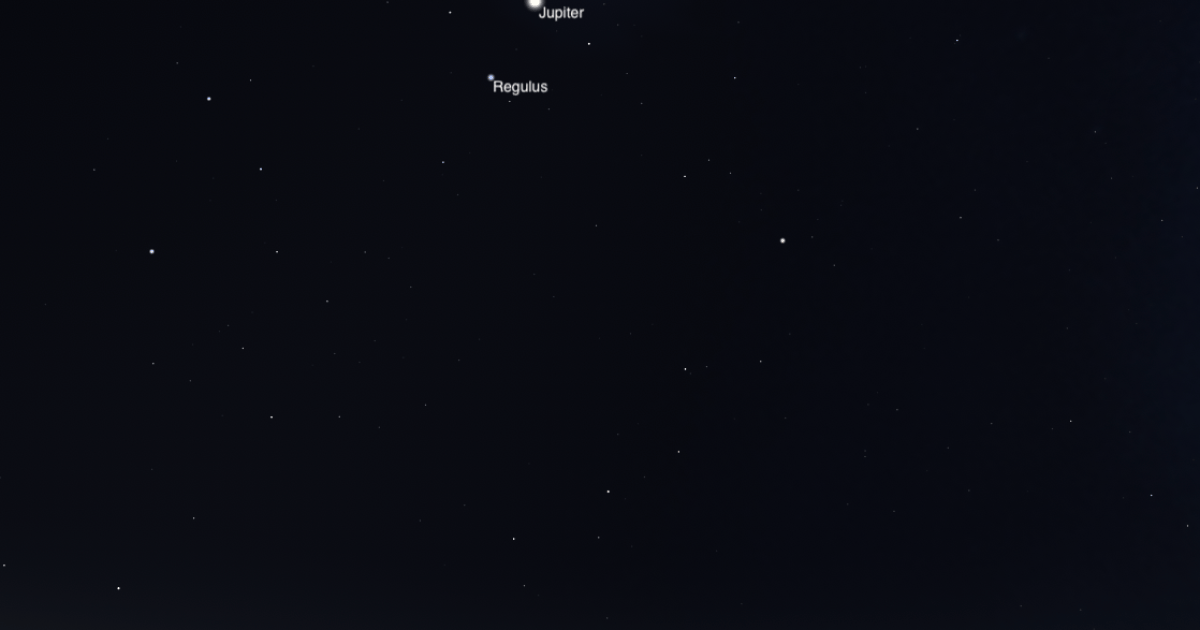
The Moon is sliding east along the ecliptic this week; on November 2, it lies less than 2° from Mars in the early-morning sky. Credit: Stellarium/USGS/Celestia/Clementine Friday, October 30Take a peek over at Pisces this evening before moonrise to look for its famous Circlet asterism of stars. You can find this star pattern easiest by first finding Saturn, the brightest point of light in this part of the sky, which stands about 30° high in the southeast by 8 P.M. local daylight time. With Saturn in sight, cast your gaze to the planet’s upper right and look for a large, circular formation roughly 7° wide, consisting of seven stars that stand out among the fainter points of light. The northernmost star in this grouping is 4th-magnitude Theta (θ) Piscium. From this star, moving clockwise, the Circlet contains 7, Gamma (γ), Kappa (κ), Lambda (λ), 19, and Iota (ι) Psc. The Circlet’s easternmost star, 19 Psc, is also called TX Psc. Study this star with binoculars or a telescope and note its deep red color. This is an aging red giant star, but that’s not the only reason for its color. TX is also known as a carbon star, in which carbon in its atmosphere scatters bluer wavelengths of light, allowing only the red to reach our eyes. Sunrise: 7:27 A.M. Sunset: 6:00 P.M. Moonrise: 9:53 P.M. Moonset: 12:45 P.M. Moon Phase: Waning gibbous (69%) This deep image of the Phantom Galaxy (M74) was taken over 20 nights in November and December 2024. Credit: Eric Smith (Flickr, CC BY-SA 2.0) Saturday, October 31Let’s send off spooky season on a high note this Halloween with M74, also known as the Phantom Galaxy. The best time to catch this ghostly galaxy is after darkness falls but before moonrise. Located in eastern Pisces, M74 reaches an altitude of 45° in the east by 9 P.M. local daylight time. You can find it just over 1° northeast of 4th-magnitude Eta (η) Piscium, or by skimming 6.6° southwest of brighter 3rd-magnitude Beta (β) Arietis, also called Sheratan. Ninth-magnitude M74 spans roughly 11’ in diameter — that’s quite big, because this galaxy is so nearby, just 24 million light-years away. Because it is so large, its light is spread out over a significant area, lowering its overall surface brightness and making this galaxy harder to spot than its magnitude would imply — hence its “phantom” moniker. Once you do find it, you’ll see that M74 is a lovely face-on spiral with a bright core wrapped in fainter arms, the latter of which are best seen in 8-inch and larger scopes. The arms are mottled with bright regions of star formation, and a nebula filter can help improve the view. You may also notice the arms are not quite symmetric: the western arm is much longer than the stubby eastern one. Sunrise: 7:28 A.M. Sunset: 5:59 P.M. Moonrise: 11:08 P.M. Moonset: 1:33 P.M. Moon Phase: Waning gibbous (58%) Sunday, November 1Daylight saving time ends at 2 A.M. local daylight time this morning, when clocks fall back one hour to 1 A.M. local standard time. Early this morning, the waning gibbous Moon is in Cancer, just west of the naked-eye Beehive Cluster (M44). The cluster might be hard to catch today without optical aid due to the nearby light of our satellite, but should show up nicely in binoculars or even your telescope’s finder scope. Its stars are spread so widely — across nearly 100’ of sky — that observing them through a telescope at higher magnification only shows the cluster’s central regions. East of the Moon, Mars and Jupiter shine brightly in western Leo, to the upper right of the bright star Regulus. Brighter Jupiter should be particularly easy to spot, located halfway between the Red Planet and the blue-white star. The Moon will reach Last Quarter phase this afternoon at 3:28 P.M. EST. Sunrise: 6:29 A.M. Sunset: 4:57 P.M. Moonrise: 11:23 P.M. Moonset: 1:11 P.M. Moon Phase: Waning crescent (47%) Monday, November 2The Moon slides 1.1° south of Mars at 9 A.M. EST, then passes 0.5° south of Jupiter at 6 P.M. EST. Some parts of the world will see these planets disappear behind the Moon, although this is not visible from North America. Instead, we’ll focus on the trio’s appearance before this in the early-morning sky, where they dominate in the hours before sunrise. By 5 A.M. local time, western Leo is more than 50° high in the southeast. The Moon lies just to Mars’ upper right, roughly 1.5° southwest of the Red Planet’s position and 6.3° west-northwest of Jupiter. The gas giant is by far the brightest light here, shining at magnitude –2.0. This morning it lies halfway between the Moon and Regulus to its lower left (east), Leo’s alpha star and the base of the Sickle asterism. This view offers a great opportunity to see just how far the Moon travels through our sky in a day. By tomorrow morning at the same time, Luna will have moved some 14° to the east, passing close to Regulus and standing southeast of the star in the early-morning sky at the same time. Make sure to check out the view tomorrow for comparison. Sunrise: 6:30 A.M. Sunset: 4:56 P.M. Moonrise: — Moonset: 1:41 P.M. Moon Phase: Waning crescent (36%) Our satellite has skimmed east across the sky over the past few days, now sitting just south of the luminary Regulus in Leo the Lion. Credit: Stellarium/USGS/Celestia/Clementine Tuesday, November 3The Moon now passes 0.8° south of the bright star Regulus in Leo at 4 A.M. EST. Some regions of the world will see our satellite pass in front of Regulus in an occultation, but again, the event is not visible from North America. The pair rises together shortly after midnight on the 2nd, following Jupiter and Mars by roughly an hour. By 5 A.M. local time on the 3rd, the Moon-star pair is nearly 50° high in the southeast. Despite its brightness (it is ranked as the 21st brightest star in the sky), magnitude 1.4 Regulus will be the faintest object in this region, as magnitude 0.8 Mars and magnitude –2.0 Jupiter to its west (upper right) far outshine it. The waning Moon has shrunk from roughly 43% lit yesterday morning to 33% lit today. It is just under a week from New phase, which occurs on the 9th. Between now and then, the phase will continue to diminish and the Moon will rise later in the morning each day, until it travels across the sky in tandem with the Sun when it is New. Venus passes 2° south of Spica at 8 A.M. EST this morning — they’ll be in the same configuration tomorrow, so we’ll make sure to highlight them then. Sunrise: 6:31 A.M. Sunset: 4:55 P.M. Moonrise: 12:34 A.M. Moonset: 2:07 P.M. Moon Phase: Waning crescent (26%) Catch the waning Moon high above a close conjunction of Venus and Spica the morning of November 4. The bright star Arcturus in Boötes should also remain visible as twilight brightens. Credit: Stellarium/USGS/Celestia/Clementine Wednesday, November 4Mercury reaches inferior conjunction this morning at 9 A.M. EST. It will remain difficult to spot for another week, then reappear in the morning sky after the 11th. Instead, let’s check out the other inferior planet: Venus, which sits 2° south of Virgo’s brightest star, Spica, in the early-morning sky. The pair is joined by a lovely crescent Moon high above them in Leo, creating a gorgeous sight that early risers won’t want to miss. By 6 A.M. local time (roughly half an hour before sunrise), the sky is growing bright and Venus and Spica are about 8° high in the east. Venus, at magnitude –4.4, far outshines the magnitude 1.0 star, which sits just to the planet’s upper left. A waning crescent Moon, just over 20% lit, hangs high above the pair, to their upper right. Through a telescope, Venus’ large, 58”-wide disk is also a crescent, now 5% lit. In the coming days, Venus’ phase will start to grow as its diameter slowly shrinks. Also glance to Venus and Spica’s upper left, where you’ll spot magnitude –0.1 Arcturus, the brightest star in Boötes the Herdsman, which borders Virgo to the north. Sunrise: 6:32 A.M. Sunset: 4:54 P.M. Moonrise: 1:44 A.M. Moonset: 2:30 P.M. Moon Phase: Waning crescent (17%) Thursday, November 5Tonight’s target is a bit of a test: How far south can you see? At a latitude of 40° north, NGC 55 in Sculptor — also called the Southern Cigar Galaxy or the String of Pearls Galaxy — only rises about 10° above the southern horizon at its highest, which occurs around 9 P.M. local time. Observers farther south will see it higher in the sky, while those farther north will see it closer to the horizon or be unable to make it out at all. For those observers who can catch it, NGC 55 is a bright, 8th-magnitude edge-on barred spiral located just under 4° northwest of magnitude 2.4 Alpha (α) Phoenicis in Phoenix, which sits below the galaxy as you look south around this time of night. This galaxy is not only bright, it’s quite large, stretching roughly the width of the Full Moon (½°) at its longest. It is quite thin, however, only some 6’ wide along the other dimension. You’ll immediately see that its nucleus is not in the center, but offset to the west. Several other bright knots of star formation may also be visible within the galaxy’s plane — particularly if you drop in a nebula filter. Sunrise: 6:34 A.M. Sunset: 4:53 P.M. Moonrise: 2:50 A.M. Moonset: 2:53 P.M. Moon Phase: Waning crescent (10%) The North America Nebula (NGC 7000; left) is a great small scope target, named for its resemblance to the continent of North America. To its west (right) is the smaller Pelican Nebula (IC 5067/5070). Credit: KPNO/NOIRLab/NSF/AURA/Adam Block Friday, November 6As fall gets into full swing, we are seeing less of the summertime stars. By 6 P.M. local time, the Summer Triangle — which flies high overhead on short summer nights — is now starting to set in the west. Lowest of its three points is Vega in Lyra; to Vega’s upper left is Altair in Aquila, while Deneb in Cygnus is almost directly above Vega and the highest of the three. With no Moon in the sky, let’s use Deneb to find a favorite deep-sky object: NGC 7000, the North America Nebula. It’s a great small scope target, and its location just 3° east of Deneb makes it easy to center in the eyepiece. However, this huge emission nebula stretches about 2° across, so note that it requires a larger field of view to capture all in one go. It definitely benefits from a nebula filter if you have one. On the sky, the nebula’s western side looks like the eastern coast of the continent for which it is named, and vice versa. The curve that mimics the Gulf of Mexico is particularly prominent, so start there if you’re having trouble seeing the shape. Look also to NGC 7000’s west — across a dark gulf, you’ll see a fainter, more compact patch of nebulosity. This is IC 5067/5070, also known as the Pelican Nebula. Sunrise: 6:35 A.M. Sunset: 4:52 P.M. Moonrise: 3:56 A.M. Moonset: 3:16 P.M. Moon Phase: Waning crescent (5%) Alison Klesman is senior editor of Astronomy magazine. She holds a Ph.D. in astronomy and has studied a variety of topics, from minor planets to supermassive black holes.
The Sky This Week from October 30 to November 6: The Moon jockeys with Jupiter and Mars
Full Article
Original Source
Read the full article at Astronomy →KhanList aggregates and links to publicly available news content. We do not host full articles from third-party sources. Always verify important information with original sources.