
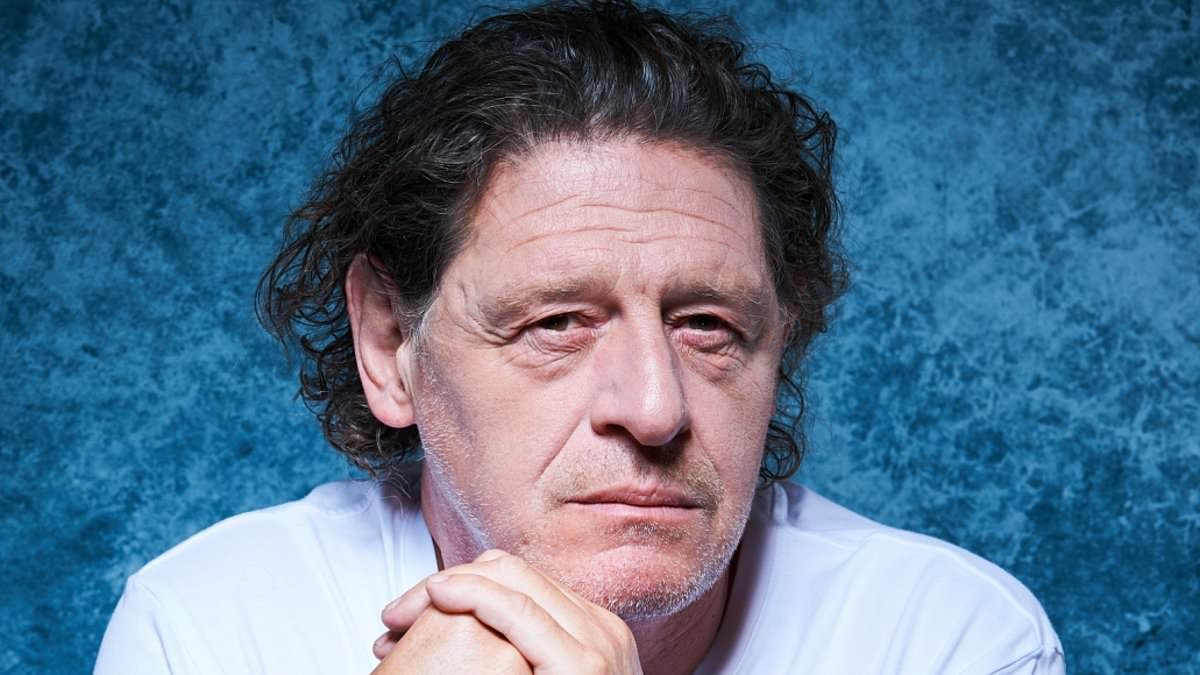
Amid all the machismo, the kitchen fistfights, the sexual exploits, swearing and screaming matches, one moment in BBC2’s portrait of superstar chef Marco Pierre White struck a very different chord.The man his rivals call ‘the Great White’ touched, with pained briefness, on the source of his anger and his drive. ‘When you watch your mother die at six,’ he said on Rise Of The Rockstar Chef, ‘and learn to accept that – to dissolve that pain from within me took years.’Tragic though it is, White’s story of childhood loss is surprisingly common among exceptionally successful and creative people.One psychological survey, by Dr Marvin Eisenstadt, of towering figures from history found that almost half had lost a parent before they reached 21, and the same awful bereavement has fuelled many modern musicians, artists and other chefs.Few have addressed it as openly as White, though. In his autobiography, The Devil In The Kitchen, he writes of a lingering memory of his mother a few days before her death in 1968 – ‘a recurring image, flashing in and out of my head when I worked my way up the ladder, sweating and toiling for those Michelin stars’. It pressed in too, he wrote, when each of his own four children was born.He and his older brother were watching from the window of their council house in Leeds as their mother was carried, wrapped in a blanket, into a waiting ambulance.He didn’t understand then, but Maria Rosa White had suffered a brain haemorrhage shortly after giving birth to her fourth child. His father Frank, holding the baby, climbed into the ambulance behind her and the doors slammed shut. Marco never saw his mother again: Doctors switched off her life support three days later.Perhaps inevitably, given how crucial cookery became to him, what he remembers most vividly about her is the food she made: ‘Simple but delicious pasta dishes, throwing in the olive oil, sweating onions, adding tomato puree and creating the comforting scent of those combinations.’ Marco Pierre White, the man his rivals call ‘the Great White’ touched, with pained briefness, on the source of his anger and drive – the death of his mother when he was just six years oldHis co-author James Steen, who has worked with White on several books, said: ‘I think there’s a sense of abandonment, which is natural. He has told me: “You don’t really come to terms with it, you don’t get over it, you’re living with it every day, but you learn to live with it.” ’Living with that unresolved grief fuelled a single-minded determination in the young chef that caused frequent explosions of unpredictable and sometimes violent behaviour.His acclaimed restaurant Harveys in Wandsworth, south-west London, was as notorious in the early 1990s for his outbursts as it was celebrated for its food.White worked 100 hours a week or more and demanded the same dedication from his employees, who included Gordon Ramsay. The stories told about him, on the first episode of the documentary, which continues on Thursday, revelled in his bad-boy raunchiness. Ramsay claimed that, after flirting with a female customer in front of her boyfriend at the table, White followed her upstairs to the bathroom and had sex with her in a toilet cubicle.As she returned to the restaurant, the chef climbed out of the window and back into the kitchen below through a skylight, landing feet-first on a stove.He gloried in his reputation for throwing out any customer who dared ask for salt and pepper. Actor Nigel Havers was banned for grumbling about a three-hour wait for his starter. When one customer barged into the kitchen to moan that his main course had arrived cold, White told him there’d be no charge for the food – then ordered him to spend the money he’d saved on a better outfit for his wife. A punch-up ensued.Though no other chef can match MPW’s reputation for delirious eruptions, several of the best-known celebrity cooks also lost a parent during childhood.Food journalist Nigel Slater’s mother Kathleen died from an asthma attack when he was nine years old, and his father Tony eight years later of a heart attack.Angela Hartnett’s father Patrick, a sailor, died when she was seven: ‘It’s the kind of thing that makes you more independent,’ she has said, with marked understatement.John Torode lost his mother when he was four, and was brought up by his grandmother, who was herself a widow.The drive that marks all of them out appears to be an age-old phenomenon. Dr Eisenstadt’s study, published in 1978 by the American Psychological Association, found that of 699 figures from history 45 per cent lost a parent before the age of 21.Among them were Julius Caesar, Napoleon Bonaparte, Charles Darwin and Abraham Lincoln, whose mother died when he was nine years old from consumption – exacerbated by drinking milk from cows that had been grazing on the poisonous white snakeroot plant. Abraham Lincoln lost his mother when he was nine years oldThe 17th-century physicist Isaac Newton’s father died before he was born and his mother remarried when he was three, leaving him to be brought up by her own mother. Newton, who despised his stepfather, went on to formulate laws of physics that underpin much of modern science.Many writers were on Eisenstadt’s list: Leo Tolstoy, Virginia Woolf, Mary Shelley and the three Bronte sisters – Charlotte, Emily and Anne. The youngest of them, Anne, was just one year old when their mother Maria died, probably from cancer.The girls retreated into a world of make-believe, which has given us some of the greatest novels in all literature including Wuthering Heights and Jane Eyre.Equally remarkable is the number of rock musicians who also lost at least one parent as children. They include Ray Charles, who was 14 when his mother Aretha died, and Leonard Cohen, who lost his father when he was nine.U2’s singer Bono was also 14 when his mother died from a brain aneurysm, a few days after burying her own father. Madonna was just five when her mother, also called Madonna, succumbed to breast cancer.Perhaps the most telling example is that of Lennon and McCartney, the songwriting geniuses who reinvented pop music with The Beatles. Mary McCartney died aged 47, also from breast cancer, when Paul was 14. Her memory inspired many of his songs, particularly Let It Be.Freddie Lennon abandoned his son John in infancy and, because his mother Julia was unable to cope, the boy was brought up by his Aunt Mimi. He was 17 when Julia was hit by a car and killed.While desperately sad, it seems impossible to doubt that much of the world’s great art and most brilliant achievements have their genesis in childhood tragedy.
Marco Pierre White puts his drive to succeed down to his mother's death when he was six... How losing a parent in childhood can create a superstar
Full Article
Original Source
Read the full article at Dailymail →KhanList aggregates and links to publicly available news content. We do not host full articles from third-party sources. Always verify important information with original sources.