
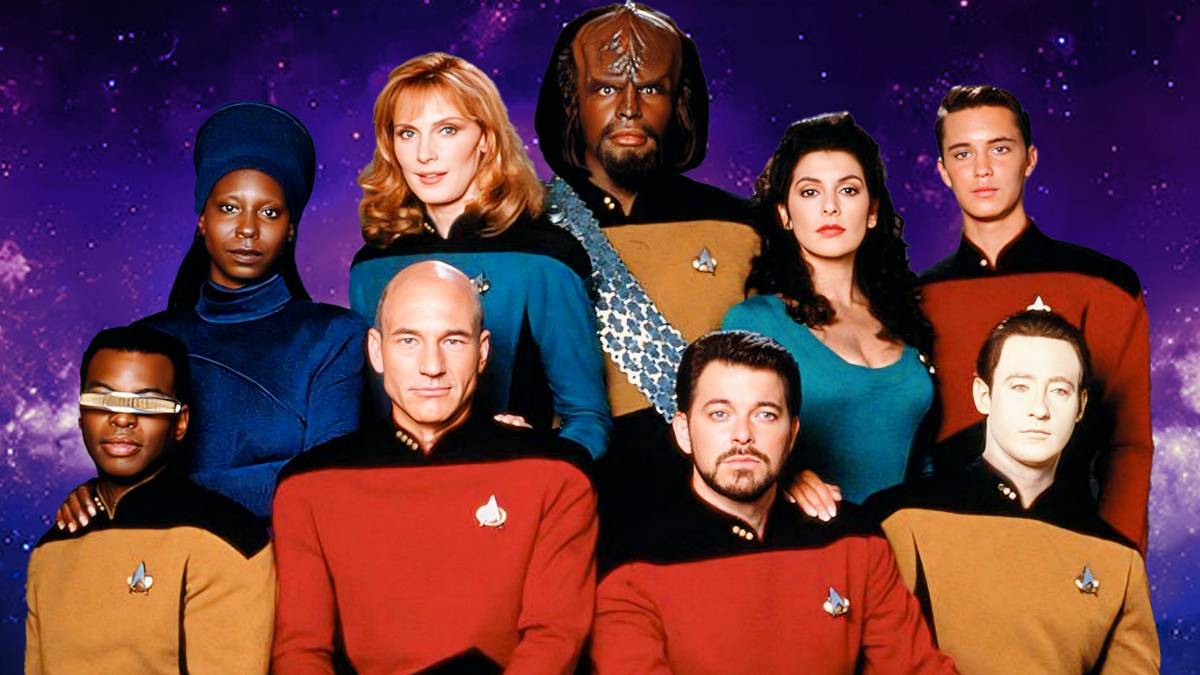
Custom image by Tania Hussain, Paramount Domestic Television Published Nov 8, 2026, 8:46 PM EST Kelcie Mattson is a Senior Features author at Collider. Based in the Midwest, she also contributes Lists, reviews, and television recaps. A lifelong fan of niche sci-fi, high fantasy, Gothic horror, elaborate action, and witty detective fiction, becoming a pop culture devotee was inevitable once the Disney Renaissance, Turner Classic Movies, BBC period dramas, and her local library piqued her imagination. Rarely seen without a book in one hand and a cup of coffee in the other, Kelcie explores media history (especially older, foreign, and independent films) as much as possible. You'll also find her enjoying video games, amateur photography, geeking out over all music genres, admiring birds from her porch, trying to overcome her meager baking skills, and attending fan conventions with her Trekkie family. Sign in to your Collider account Even though hundreds of notable actors have graced Star Trek with their presence, only one cast member can claim the distinguished title of "most prolific Trek contributor." With 288 onscreen appearances to his name, Michael Dorn's franchise résumé eclipses even his equally legendary Star Trek: The Next Generation co-stars and their Star Trek: The Original Series predecessors. One exquisite Season 3 episode heralds a crucial turning point for both Lieutenant Worf's evolution and Trek's approach to the Klingons — even though Dorn's record-setting, career-defining portrayal faced behind-the-scenes interference from the start. Gene Roddenberry Initially Rejected Worf's Character Despite Worf's immediate intrigue as the first main Klingon character and the lone Klingon to join Starfleet, he spends Season 1 as an isolated background figure — a symbol of the Federation's peaceful alliance with their former antagonists. Once Worf replaces Tasha Yar (Denise Crosby) as the Enterprise's chief of security, he assumes a pivotal role and demonstrates perhaps the most substantial growth out of the entire ensemble. Fond of prune juice, Klingon opera, romantic poetry, and cosplaying American Westerns, Worf survives The Next Generation's seven-season run and its quartet of feature films, joins Star Trek: Deep Space Nine, and reunites with his original crew in Star Trek: Picard's final season as an elite Starfleet Intelligence agent — complete with white hair and a new propensity for witty retorts, meditation, and imbibing tea. COLLIDERInteractive Long-range scan active Movies/Science Fiction/Survival Assessment Collider Survival Assessment Which Sci-Fi WorldWould You Survive? 8 questions · 5 worlds · one honest verdict Five of the great screen futures, and not one of them is built for comfort. Answer eight questions about instinct, loyalty and the line you would cross, and the scan will tell you which one you would still be standing in. Worlds in range ▦︎The Matrix ◈︎Mad Max ◑︎Blade Runner ▲︎Dune ✦︎Star Wars Begin the scan Question 01 of 08INSTINCT The world as you know it ends overnight. What is your first move? No wrong answer. There is a wrong hesitation.AFind out what is really going on behind all of it BGrab a vehicle and as much fuel as you can carry CKeep your head down and show up to work anyway DLearn the rules of whoever is in charge now EFind other people and start organizing ← Back Keys 1 to 5 or A to E · Enter to advance Next Question 02 of 08RESOURCE You can stockpile exactly one thing. What is it? Choose carefully. You are not getting a second run.AInformation nobody else has BFuel CClean money and cleaner documents DWater EA ship that can get you off-world ← Back Keys 1 to 5 or A to E · Enter to advance Next Question 03 of 08THREAT Which kind of enemy scares you the most? Be honest about what keeps you up.AOne that can be anywhere, wearing anyone's face BA convoy of people who want what you are carrying CSomeone who looks exactly like you DA rival family that has been planning your downfall for generations EAn empire with unlimited resources and no patience ← Back Keys 1 to 5 or A to E · Enter to advance Next Question 04 of 08AUTHORITY How do you handle the people in charge? Every world has them. Even the ones that pretend otherwise.AAssume they are lying and work around them BNobody is in charge where I am CFollow the orders, file the report, stay invisible DStudy them, get close to them, outlast them EJoin whoever is fighting them ← Back Keys 1 to 5 or A to E · Enter to advance Next Question 05 of 08ENVIRONMENT Pick the place you would rather wake up in: You will be there a while.AA grey city that feels slightly too perfect BAn endless desert highway CA rainy neon street at three in the morning DA dune sea with a fortress on the horizon EA crowded spaceport full of strangers ← Back Keys 1 to 5 or A to E · Enter to advance Next Question 06 of 08ALLIANCE Who do you want standing next to you? Pick one. You only get one.AA guide who knows far more than they are telling you BOne person you trust and nobody else CNobody. You work alone DA loyal circle you grew up with EA crew of misfits who argue the whole way ← Back Keys 1 to 5 or A to E · Enter to advance Next Question 07 of 08MORALITY Which line would you cross to survive? Everybody crosses one.ALying to the people closest to you BTaking what you need by force CLooking the other way DPlaying a long game that costs other people dearly EBlowing something very expensive up ← Back Keys 1 to 5 or A to E · Enter to advance Next Question 08 of 08PURPOSE What are you really fighting for? Last question. Make it count.AThe truth, whatever it turns out to be BTomorrow. Just tomorrow CSomething that finally feels like a real life DYour family's name EEveryone who cannot fight for themselves ← Back Keys 1 to 5 or A to E · Enter to advance Run the scan Scan completeYou would survive ▦︎ The Matrix The Resistance, Zion You take the red pill, you stay in Wonderland, and I show you how deep the rabbit hole goes. You would survive The Matrix because you were never fully sold on the version of reality you were handed. You notice the seams. You ask the second question. In a world built to keep people comfortable and incurious, that instinct is the whole fight, and it is why Morpheus would have found you long before you found him. From the Collider file The Wachowskis' 1999 film won four Academy Awards, including Visual Effects and Film Editing. Bullet time was shot with a rig of roughly 120 still cameras firing in sequence around the actors. Keanu Reeves trained in martial arts for about four months before a frame was shot, recovering from neck surgery the whole time. It opened the same year as Fight Club and eXistenZ, in a run of films about not trusting the world in front of you. Red pill energy Pattern spotter Built to question ◈︎ Mad Max The Wasteland Oh, what a day. What a lovely day. You would survive the Wasteland because you do not waste energy mourning the world that ended. You move, you improvise, and you are very good with whatever is bolted to the thing in front of you. Furiosa would let you drive. That is not a compliment anybody earns easily. From the Collider file Mad Max: Fury Road won six Academy Awards in 2016, more than any other film that year. George Miller storyboarded the entire film as roughly 3,500 panels before there was a script. The chase was shot almost entirely practical in the Namib Desert, with real vehicles and real stunt performers. Anya Taylor-Joy and Chris Hemsworth carried the prequel, Furiosa: A Mad Max Saga, in 2024. Keeps moving Improviser Good with engines ◑︎ Blade Runner Los Angeles, 2049 All those moments will be lost in time, like tears in rain. You would survive 2049 because you know how to be small in a very loud city. You keep your head down, you do the job, and you hold onto one private thing that belongs only to you. That quiet stubbornness is exactly what both Deckard and K run on, and it is what keeps either of them going when the case stops making sense. From the Collider file Blade Runner 2049 won Roger Deakins his first Oscar for cinematography, on his fourteenth nomination. The film also took Best Visual Effects, 35 years after Ridley Scott's 1982 original. Villeneuve shot it on large-format film and kept the fog and rain practical on set wherever he could. Three short films by Luke Scott and Shinichiro Watanabe bridge the 30-year gap between the two movies. Keeps her head down Private Noir soul ▲︎ Dune Arrakis Fear is the mind-killer. Fear is the little-death that brings total obliteration. You would survive Arrakis because you think in decades while everyone around you thinks in weeks. You read the room, you learn the customs, you wait. The desert does not reward speed. It rewards people who understand that patience is a weapon, which is the one lesson the Fremen never had to be taught. From the Collider file Denis Villeneuve's Dune won six Academy Awards in 2022, including Cinematography and Original Score. Hans Zimmer turned down Christopher Nolan's Tenet so he could score Dune instead. Dune: Part Two arrived in 2024 and brought in Austin Butler, Florence Pugh and Christopher Walken. David Lynch's 1984 version and Alejandro Jodorowsky's unmade one are both their own legends by now. Plays the long game Reads the room Patient ✦︎ Star Wars A Galaxy Far, Far Away Rebellions are built on hope. You would survive the galaxy because you never try to survive it alone. You collect people. You end up in the middle of other folks' problems and you stay anyway. Every version of this story, from the Falcon's crew to the Ghost's, runs on somebody exactly like that holding the group together. From the Collider file The 1977 original won six Academy Awards plus a special achievement award for sound effects. John Williams' score was recorded by the London Symphony Orchestra and became the best-selling symphonic film soundtrack ever. Andor took the galaxy somewhere colder and earned Emmy nominations for drama series in both seasons. The saga now runs across eleven feature films and a growing shelf of series on Disney+. Collects people Shows up Hope merchant Compatibility readout · top three 1 2 3 ↻ Retake the quiz Copied to your clipboard Scan filed byCOLLIDERCollider.com · The Sci-Fi Desk Yet Star Trek's architect, Gene Roddenberry, almost prevented this austere, enthralling, and multifaceted fan favorite from walking onto the Enterprise bridge. According to interviews collected by Mark A. Altman and Edward Gross for their book The 50-Year Mission: The Next 25 Years, Roddenberry wasn't interested in developing the Klingons beyond their restrictive origins as recurring foils whose aggressive nature employs racially-coded stereotypes. This sentiment led Roddenberry, in the words of creative consultant David Gerrold, to "adamantly" resist "[my suggestion of a Klingon first officer]. Gene vetoed it for four months." Even after Roddenberry conceded, executive producer Rick Berman revealed that "Michael Dorn wasn’t even guaranteed all episodes in the first season." 'Star Trek: The Next Generation's "Sins of the Father" Episode Gives Worf the Focus He Deserves Image via Paramount Television Six decades after The Original Series premiered, the Klingons are regarded as one of the canon's most prominent, recognizable, and sublimely realized alien species. Before The Next Generation Season 3 — the first installment to hit its creative stride — the spin-off had already opened the door for a more sensitive, if still imperfect, depiction. The character beats and plot threads established in the third season's seventeenth episode, "Sins of the Father," written by Ronald D. Moore and W. Reed Moran from a story by Drew Deighan, reverberate for years to come. Moore displayed an early aptitude for crafting engrossing Klingon-oriented stories. Moore's collective influence and his collaboration with Moran on "Sins of the Father" expands the Klingon Empire into a culture thrumming with vibrant life. Their spiritual practices, feudalistic government, home planet (seen for the first time in "Sins of the Father"), language, and the immense value they place on battle prowess and warrior honor code surpass archetypal words. Likewise, "Sins of the Father" grants Worf's underutilized potential a narrative purpose beyond the metaphorical. His upbringing as an orphan separated from his civilization and adopted by doting human parents exacerbates his conflicted duality. Worf strives to prove his worth by honoring his biological heritage and fulfilling his duty to Starfleet, and refuses to accept that he can't unify that contradictory schism. His Enterprise colleagues gradually accept him, while the Qo'noS-born Klingons dismiss him as a weakling who willingly betrayed his birthright. 'Star Trek: The Next Generation's "Sins of the Father" Episode Gives Worf the Focus He Deserves In "Sins of the Father," Kurn (Tony Todd), the younger brother Worf believes had perished alongside their parents during the infamous Khitomar Massacre, visits the Enterprise to disclose their connection and employ his sibling's aid. Duras (Patrick Massett), the leader of a rival house and a prominent member of the Klingon High Council, has accused the brothers' late father, Mogh, of forming a treasonous alliance with the Romulans. What befalls an ancestor taints their entire bloodline, so Worf vows to prove his father's innocence. If his claim fails, then the sons of Mogh will both die by execution. Assisted in person by an unwavering Captain Picard (Patrick Stewart) and from afar by the loyal, evidence-scouring Enterprise crew, Worf uncovers a nefarious conspiracy. Duras is framing Mogh to deflect suspicion from his own father, the real traitor, and Chancellor K’mpec (Charles Cooper), the High Council’s leader, has advanced the lie to avoid sparking a civil war. Worf's challenge was doomed long before he issued it. Worf can’t fathom betraying his familial responsibility, let alone a major legal body condoning such injustice. Nevertheless, he understands the preventative reason behind their cover-up and accepts discommendation (a non-lethal ceremony where individuals endure public dishonor) as long as the Council spares Kurn's life. As Worf's fellow Klingons declare him a coward and turn their backs, leaving him abandoned and shunned, the outlier who studied his culture from afar models a far deeper comprehension of honor, sacrifice, integrity, and courage than the rulers who spout such values but fail to walk the talk. Worf's Character Development Is One of 'Star Trek's Best Image via Paramount+ Between the meaty material and Les Landau's direction, Dorn's magnetism, gravitas, and pathos enjoy their richest opportunity to shine to date. Roddenberry gave Dorn leeway to develop Worf as he saw fit, and the incisive actor-character synergy that elevates Worf into a series-stealing standout is on full display through Worf's dignified resolve, his steely determination, the strength of his principles, and Dorn's extensive range. Since Worf tends to be a man of few words, the ones he does utter carry lethally significant weight. Meanwhile, his wordless micro-expressions carry enough gravity to sustain multiple planets. Dorn carries Worf through an array of demandingly complex emotions: repressing his fury over Kurn's needling comments, grappling with the appearance of his lone living relative, solemnly yet proudly shouldering the weight of his parents' legacy, his profound gratitude and admiration for Picard, and reconciling with how the Empire's corrupt leadership has shattered the idealized vision of his people Worf carries. History repeated itself when The Next Generation's production group defended Season 4's "Redemption," a two-part finale following up on "Sins of the Father." In Moore's 2021 interview with the Hollywood Reporter, he shared: "[Gene] didn’t really see Worf as a primary character. [...] And this was going to be the series' 100th episode on top of it. So, we had to fight somewhat to get the episode going." In true warrior fashion, the team's commitment ensured Worf's victory against every obstacle in his path. "Sins of the Father" guides Worf toward his endgame – an assured and complete identity — as an ethical soldier, a diplomatic ambassador, a father, a devout friend, and a widower. A defining moment in Star Trek history, it's a focus for Worf and Dorn that was long overdue.
One of Star Trek's Best Characters Almost Didn't Exist Because of Gene Roddenberry
Full Article
Original Source
Read the full article at Collider →KhanList aggregates and links to publicly available news content. We do not host full articles from third-party sources. Always verify important information with original sources.