
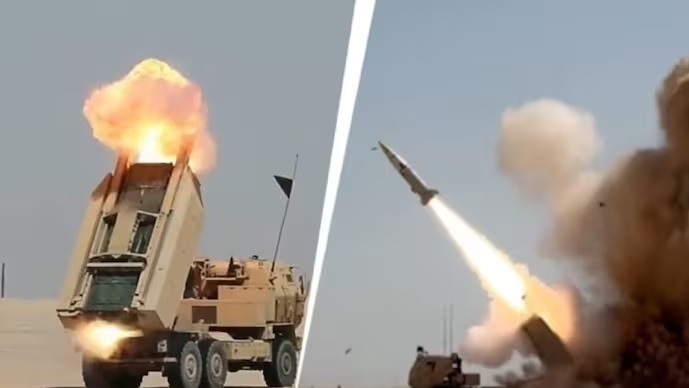
The assessment has raised fresh questions over the risks of using the weapon near populated areas as the US-Iran conflict enters another dangerous phase of escalation.US Central Command released the missile's launch video from the conflict's first 24 hours. (Image: X/@CENTCOM)A US Precision Strike Missile (PrSM) strike in the Iranian city of Lamerd appears to have caused civilian deaths and widespread damage across a significantly larger area than the immediate blast zone, according to an analysis by conflict-monitoring group Airwars, the Associated Press reported.The assessment has raised fresh questions over the risks of using the weapon near populated areas as the US-Iran conflict enters another dangerous phase of escalation.Three missiles struck Lamerd in southern Iran on February 28, hitting areas near a sports complex and two residential neighbourhoods, AP reported citing an Airwars statement.Its assessment found that civilians as far as 50 metres from the apparent detonation points were killed, while damage extended to areas more than three times that distance. Iranian officials said at least 21 civilians, including seven children, died in the strikes. Airwars mapped the damage using publicly available photographs, videos, satellite imagery, social media material and other evidence.Images from the aftermath, which were also reviewed and verified by The Associated Press, showed buildings, roads and vehicles marked by numerous impact points. Weapons specialists consulted by AP said the pattern was consistent with the effects expected from a PrSM. The missile, developed by Lockheed Martin, is intended as a long-range precision weapon and is designed to detonate in the air.Its warhead can disperse tens of thousands of metal pellets at high velocity over a broad area. The Lamerd damage pattern has therefore prompted concern about the consequences of deploying the system close to civilian populations.Six weapons experts, including two former military officials, told AP they believed PrSMs were responsible for the Lamerd strikes.They also considered the use of Israeli or Iranian weapons less likely. Michael Meier, a former US Army adviser on the laws of war, said, "You would be hard-pressed to find a reason to use the PrSM in a densely populated area".The US military has acknowledged using PrSMs against Iran but has denied carrying out attacks on Lamerd.The intended target in the city also remains unclear. An Islamic Revolutionary Guard Corps compound is situated nearby, but satellite imagery reviewed by Airwars showed no apparent damage to the facility.MAJOR MILITARY ESCALATIONThe findings come as the conflict faces renewed military escalation. Washington recently struck Iranian missile launchers on Larak Island after alleging that Iranian forces were preparing to deploy rockets and sea mines in the Strait of Hormuz.Iran subsequently launched missiles at US military facilities in Jordan. President Donald Trump said US defences intercepted all but one of the missiles and warned Tehran of further retaliation."We're going to hit them hard," Trump said. "There will be a response".Iranian President Masoud Pezeshkian has meanwhile said Tehran remains prepared to return to the June ceasefire understanding if Washington does the same.With military exchanges resuming and tensions around the Strait of Hormuz continuing, the Lamerd findings are likely to intensify scrutiny of US targeting decisions and the potential civilian consequences of advanced precision weapons.- EndsWith AP inputsPublished On: Sep 1, 2026 21:36 IST
Lethal, long-range, pinpoint: How a US missile killed civilians 50 metres from blast
Full Article
Original Source
Read the full article at Indiatoday →KhanList aggregates and links to publicly available news content. We do not host full articles from third-party sources. Always verify important information with original sources.