
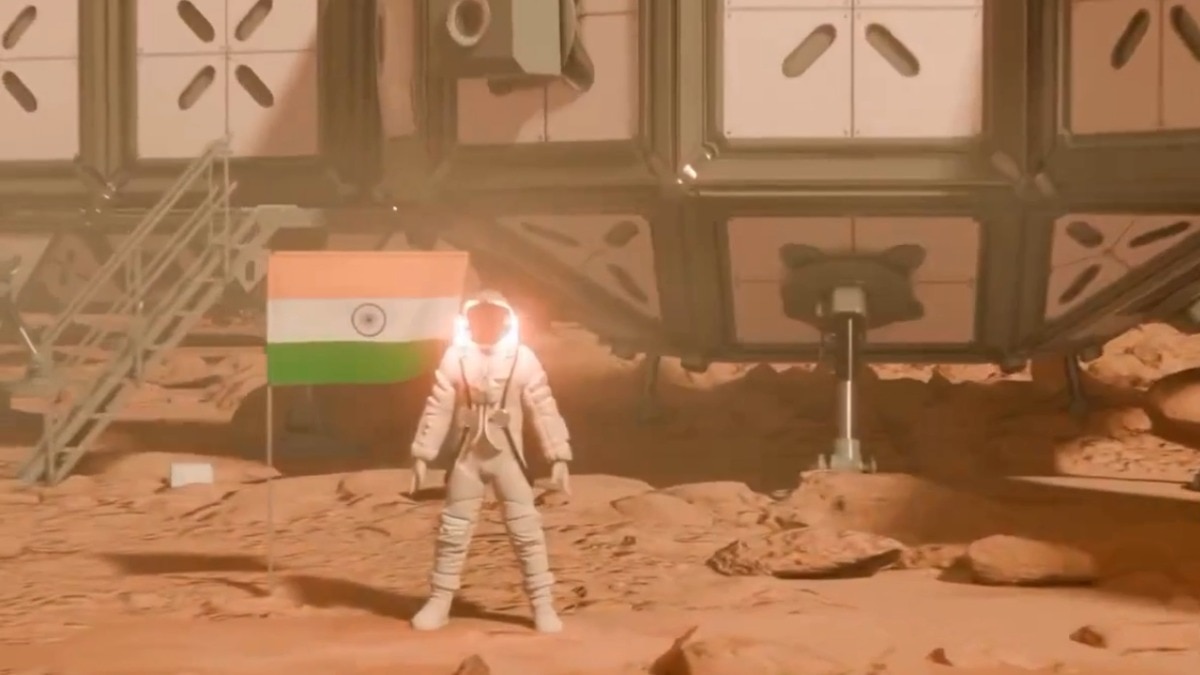
India's human-spaceflight ambitions are beginning to extend beyond the spacecraft itself to what comes after landing.An artist's concept shows an Indian on an extra-terrestial surface. (Photo: Screengrab)Indian astronaut Group Captain Shubhanshu Shukla has shared details of an academic research project exploring how future astronauts could live beyond Earth, proposing a concept called Bharatiya Habitable Expandable Extraterrestrial Habitat (BHEEM).The habitat concept emerged from research undertaken during the Indian leg of Shukla’s astronaut training, following his return from Russia.Shukla said the training programme involved learning the systems of India’s launch vehicle and orbital module, alongside extensive physical conditioning and spaceflight preparation. However, astronauts were also encouraged to pursue academic research related to the future of human space exploration.B.H.E.E.M. — Bharatiya Habitable Expandable Extraterrestrial Habitat.When we returned from our training in Russia, we began the Indian leg of our astronaut training. This involved learning the systems of the launch vehicle and orbital module, along with extensive physical and pic.twitter.com/2Ubt0FiVbj— Shubhanshu Shukla (@gagan_shux) September 1, 2026“I decided to look beyond the spacecraft we were training to fly in and think about where humans might live after we land,” Shukla said while sharing details of his research. His work focused on extraterrestrial habitats and the technologies that could eventually allow humans to live and work on destinations such as the Moon and Mars.The research eventually resulted in B.H.E.E.M., or Bharatiya Habitable Expandable Extraterrestrial Habitat, developed at the Aloke Lab at the Indian Institute of Science in Bengaluru. The concept addresses one of the biggest challenges facing the next era of human spaceflight: establishing a sustained human presence away from Earth. The concept art of a single module part of an entire settlement. (Photo: Screengrab) While rockets and spacecraft can transport astronauts to distant worlds, keeping humans alive and productive after landing presents an entirely different technological challenge. Future extraterrestrial habitats will need to protect astronauts from intense space radiation, extreme temperatures and potentially hazardous environments.They will also require reliable life-support systems, energy generation and storage, as well as practical methods of construction and expansion.“The simple question of where do we live?” remains one of the fundamental challenges of future exploration, Shukla said. A top view of an artist's concept of a settlement away from Earth. (Photo: Screengrab) The astronaut stressed that research into such technologies must begin decades before humans are expected to establish permanent settlements beyond Earth.“If we want humans to live beyond Earth 20 years from now, the work cannot begin 20 years from now. It has to begin today,” he said.India is currently expanding its ambitions in human spaceflight and deep-space exploration, with the Gaganyaan programme expected to lay the foundation for future missions involving Indian astronauts in low-Earth orbit and eventually beyond.Shukla’s B.H.E.E.M. research reflects a growing focus on technologies that could support India’s longer-term ambitions in lunar and planetary exploration. A conceptual art shows how these housing structures could be transported aboard existing spacecrafts. (Photo: Screengrab) “The first step towards building a habitat on another world may not be laying its first brick,” Shukla said. “It may simply be daring to imagine what that habitat could look like.”As nations increasingly look toward the Moon and Mars, the race to build the homes that will sustain future explorers may be beginning just as importantly in laboratories in India.- EndsPublished On: Sep 1, 2026 21:56 IST
Indian astronaut Shubhanshu Shukla unveils Bheem concept for houses outside Earth
Full Article
Original Source
Read the full article at Indiatoday →KhanList aggregates and links to publicly available news content. We do not host full articles from third-party sources. Always verify important information with original sources.