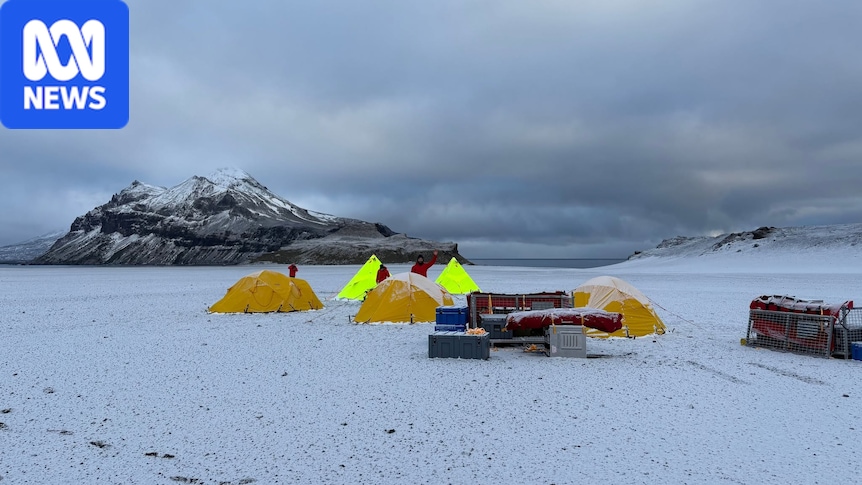
The Australian Antarctic Division (AAD) says there are "lessons to be learnt" after internal documents revealed expeditioners were issued with "substandard" clothing and leaking tents during extreme weather events on Heard Island in the Southern Ocean.More than 50 scientists onboard the RSV Nuyina spent a total of 35 days at the Australian external territory during two voyages between October last year and January this year.The trips were the first dedicated research and environmental management expeditions by the Australian Antarctic Program in almost two decades.RSV Nuyina pictured at Heard Island in 2025. (Australian Antarctic Division: Simon Payne)They yielded important outcomes, including Australia's first detection of H5 bird flu and the removal of historical toxic waste from the World Heritage-listed area.But the expeditions were not without problems.Most notably, the Nuyina's hull scraped the sea floor during a brief "grounding" incident that damaged scientific equipment and triggered a transport safety investigation.But documents released to the ABC under Freedom of Information laws show several other previously undisclosed issues that left staff exposed to the region's challenging conditions."Some of the gear provided by the division proved to be substandard," a February report to the AAD's Major Projects Board stated."The outer shells failed in a number of ways: they were not waterproof and the zips failed on multiple jackets."The warm layers were not sufficient, to the extent that some teams relied on borrowing synthetic down from other teams that had independently purchased alternative clothing."The AAD says weather conditions in the area were "extreme" and presented "difficult challenges". (Australian Antarctic Division)The board was also told of problems with the tents used by expeditioners to camp on the island."The polar pyramids were not seam sealed, which led to the comment that 'when it was raining outside, it was also raining inside the tent,'" the report stated."These created additional hazards for expeditioners who were working at a location known for its challenging weather."Minor injuries after team hit by strong windsAdverse weather conditions limited the amount of work that could be done on the island during the second voyage, with teams deployed only for 11 of the 23 days the ship was there.During that period, there were two significant weather events, the report said.For the first event, all expeditioners were removed from the island as a precaution.But they remained on site for the latter because it was forecast to be less severe."In true Heard Island fashion, the second event proved to be the more damaging of the two with wind gusts exceeding 85 knots (157 km/h)," the report said."This resulted in the collapse of multiple tents at all three camps and the distribution of camp gear across the surrounding areas."The incident also caused several minor injuries, according to the report.Most of the items that had blown away were retrieved.The AAD said it had "learnt lessons for future operations". (Australian Antarctic Division: Doug Thost)Multiple achievements despite weather hurdlesAmid the challenges, the report noted many successes, including:Over 39 hours of drone flights to look for signs of H5 bird fluRemoval of more than one tonne of waste from an old station, including 800 kilograms of general waste and 300 kilograms of asbestosOn-island surveys for invasive species assessments and the deployment of environmental monitoring equipmentMarine science activities, including mapping, imaging and trawls to support the development of a marine reserve management planAn AAD spokesperson told the ABC the data and information collected during the campaign would inform management and research outcomes for years to come.They said weather conditions in the area were "extreme" and presented "difficult challenges" for operations."The safety of expeditioners is always our highest priority," they said."Working in an extreme environment presents new challenges with every new voyage and requires extensive planning and governance as well as problem solving on the ground."As with any campaign of this scale and complexity, there are lessons to be learnt, which the Australian Antarctic Division takes seriously."The important thing is that expeditioners were returned safely, important research and management was undertaken, and we have learnt lessons for future operations."
Leaking tents, 'substandard' gear given to sub-Antarctic expeditioners
Full Article
Original Source
Read the full article at Abc →KhanList aggregates and links to publicly available news content. We do not host full articles from third-party sources. Always verify important information with original sources.