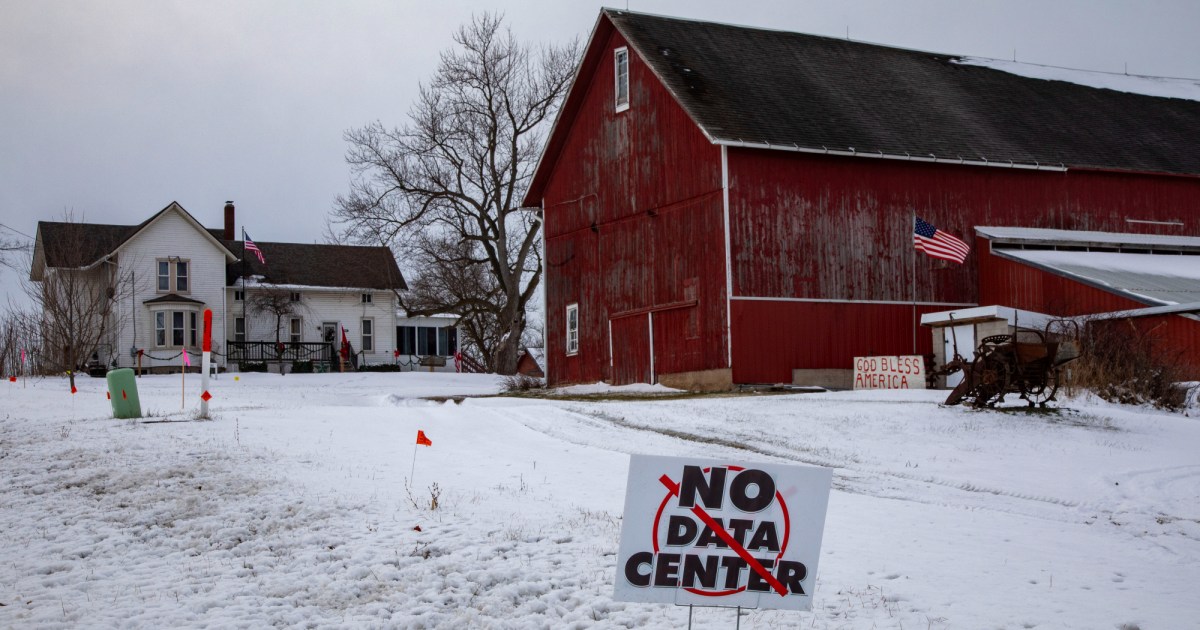
A sign on a rural Michigan road opposes a planned billion data center on southeast Michigan farm land, December 2025.Jim West/ZUMA Get your news from a source that’s not owned and controlled by oligarchs. Sign up for the free Mother Jones Daily. When Donald Trump came to Michigan last week to speak at a General Motors vehicle-testing facility, he likely expected to find a friendly crowd. That wasn’t entirely the case. A group of protesters holding yellow signs that read “stop data centers” interrupted the president, chanting, “Data centers no, people pay the bill,” until they were removed by security. Will Lawrence, a progressive Democratic candidate in Michigan’s seventh congressional district—where that General Motors plant is located—was unsurprised by the protesters’ fury. “That’s what we’re tapping into,” he posted on social media. People across Michigan have pushed back on data center proposals in recent months, raising concerns about the facilities’ energy demands. In response, Lawrence, a climate activist turned politician, has made opposition to hyperscale data centers central to his campaign. And he’s betting that standing up to data centers will help him get votes from across the aisle, too. “Since I declared my candidacy last August, we’ve had four major data centers, including three hyperscalers, proposed in the district in Lansing, in Mason, in Howell Township, and in Lyon Township,” Lawrence said at a panel discussion earlier this month. He has been attending township meetings as Michiganders try to stop the often-secretive data center permitting process in its tracks. MAGA Republicans and true-blue Democrats all stood up to protest, Lawrence said. “It became very clearly obvious to me that this is a totally cross-partisan rebellion that’s happening from the bottom up.” America’s data center backlash refuses to stick cleanly to partisan boundaries, with opposition to data center buildout nearly as high among Republicans as it is among Democrats. In his first major TV ad, Lawrence took aim at “tech billionaires” who he said want to turn Michigan’s farms into data centers that will “jack up our energy bills and ruin our home values.” Lawrence is just one of a growing crop of progressive candidates who see, in opposing AI data center buildout—and condemning the tech oligarchs behind it—a path to victory. “Fights all over the country about AI data centers and AI more broadly are shifting the usual political lines,” said Saul Levin, a Michigan community organizer who runs a podcast about data centers called The Hum. That political shift is happening in battleground states like Michigan, but also in more clearly Democratic states like Colorado. Melat Kiros, who recently won Denver’s Democratic congressional primary, credits her win in part to her ability to vocalize constituents’ anger about the data center permitting process, which can operate in near-total secrecy: companies often ask municipal decisionmakers to sign non-disclosure agreements, which can mean that people don’t find out a data center is moving into their neighborhood until the process is half-complete. That secrecy and anger can translate to votes. “There’s a lot of candidates that are making this a front and center issue and are winning as a result of it,” Kiros said. In Memphis, Tennessee State Representative Justin J. Pearson has made opposition to Elon Musk’s xAI data center, and its associated neighborhood-polluting gas turbines, a core part of his campaign for Congress. In his district, voters are worried about becoming sick thanks to Musk’s data centers—which Trump’s Justice Department has thrown its weight behind. The Department of Justice intervened in a lawsuit against xAI, saying they should not have to conform to the Clean Air Act—because Grok, which xAI powers, is being used to bomb Iran. “That’s the logic,” Pearson said. “Violate the Clean Air Act, allow the pollution to kill American citizens because we’re killing people overseas with this technology.” And even in communities less directly affected by data centers than Memphis, populist opposition to their construction is gaining strength. Candidates for governor in at least 12 states are running on data center moratoria, per Newsweek. Centrist Democrats, meanwhile, are more likely than ever to experience voter pushback when they’re perceived to be overly friendly to data center developers. Michigan Governor Gretchen Whitmer appeared onstage with OpenAI’s Sam Altman earlier this year, and was roundly condemned for doing so by Democratic and Republican constituents alike. Some, like Lawrence, blame the governor in part for bringing the data centers to Michigan. “Here in Michigan, the reason why this all started to arrive in late 2025 is because in late 2024 the state passed a set of tax breaks for data center development, and that was passed through the state legislature on a bipartisan basis and signed by our Democratic governor.” “I think people see that the ruling class is united behind this plan to push data centers in our communities,” Lawrence said. “That’s a place that you can fight from.”
Can Opposing Data Centers Help Progressives Win?
Full Article
Original Source
Read the full article at Motherjones →KhanList aggregates and links to publicly available news content. We do not host full articles from third-party sources. Always verify important information with original sources.