
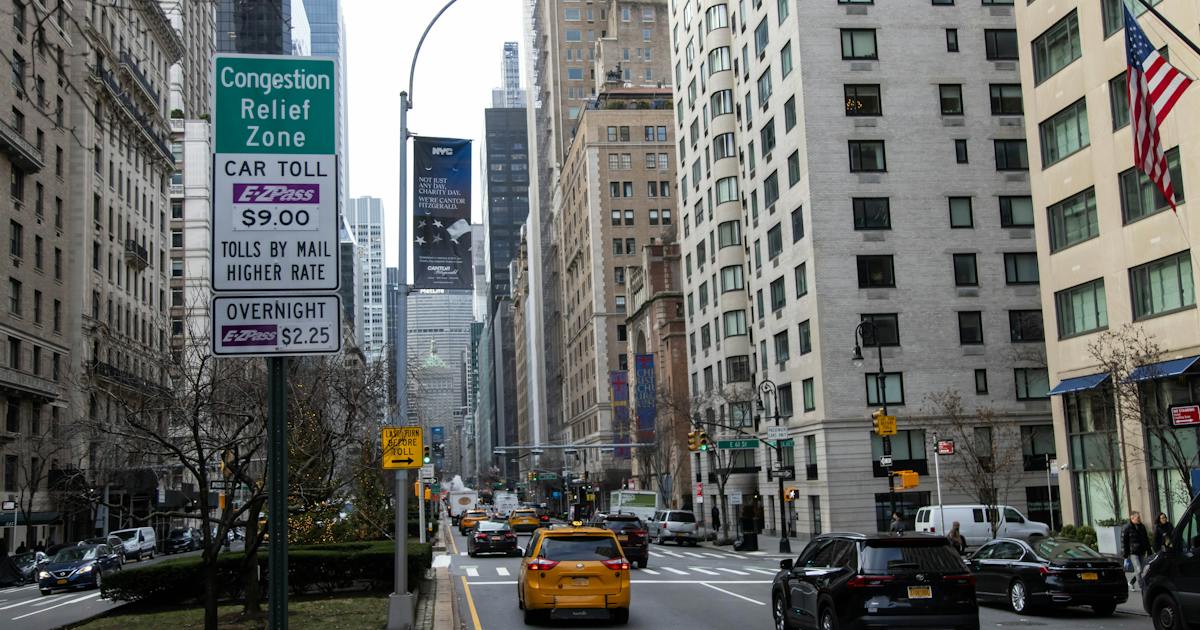
After years of trying to destroy New York City’s congestion pricing system, the Trump administration is now offering grants to take similar policies nationwide.The Federal Highway Administration announced Thursday that it would invest $100 million to target and eliminate congestion, including funds to implement “HOV toll lanes, as well as congestion, cordon and parking pricing programs,” Gothamist reported.Just hours after the announcement was made, that specific language was removed from the official online press release, according to Streetsblog NYC. Similar language describing congestion pricing can still be found in the description of the federal Congestion Relief Program.Trump first announced that he would challenge New York City’s new congestion pricing program in February 2025 by declaring himself king. In March, a federal judge ruled that the Trump administration did not have the authority to revoke the city’s pricing policy. The Department of Transportation appealed that decision in June, arguing that it was the judge who had overstepped the bounds of their authority, and that the FHWA officials could revoke policies whenever it pleased them. The appeals court has yet to rule on the matter.In August 2026, Trump again mocked congestion pricing, claiming that the program was being run by “Radical Left Jihadists,” referring to New York City Mayor Zohran Mamdani, who was elected after the policy was already in place.In a statement to Gothamist, DOT spokesperson Danna Almeida denied that the grants would possibly fund congestion pricing programs like the one in Manhattan.“As the statute is written, the grant program is nothing like New York City’s illegal cordon pricing program, nor does it impact the ongoing litigation,” Almeida said. “The Secretary has been clear, dollars collected from tolling should be reinvested back into roads and drivers should have access to free alternative routes.”Since the city first began charging drivers $9 during peak periods to drive south of 60th Street in Manhattan, New York’s Metropolitan Transportation Authority reports that traffic is down 15 percent.Thought that President Donald Trump’s so-called “Anti-Weaponization” slush fund was dead? Not quite.Trump administration officials intervened to secure a $2.5 million payout for five plaintiffs in a class-action lawsuit against the IRS, with each plaintiff getting half a million, ProPublica reported Thursday.The Department of Justice initially sought to dismiss the case, but in August it intervened before the final fact-finding period with a proposal that would pay 250 times the legal limit of $1,000 for such cases.The five plaintiffs included Shelby Lowman, a golf pro at Trump National Golf Club Hudson Valley, as well as Safe Harbor, a company connected to the president’s media business without a website or public presence. These plaintiffs alleged that the IRS and government contractor Booz Allen Hamilton had failed to securely safeguard their financial information—the same charges that Trump had levied against the IRS in his own $10 million lawsuit.That lawsuit had resulted in the creation of the president’s $1.776 billion slush fund, paving the way for government payouts to anyone the administration saw fit. The fund was supposed to have been killed by court order months ago.After these latest settlements, two more people connected to Trump businesses came forward to continue the litigation. Critics are concerned that even more plaintiffs could join in a backdoor attempt for Trump allies to receive massive payouts from the government. The president’s latest nominees aren’t even willing to describe what happened on January 6, 2021.Michael LoSapio, who currently heads security for the software company Palantir, has been tapped to run the Cybersecurity and Infrastructure Security Agency. He shocked lawmakers during his confirmation hearing on Capitol Hill Thursday when he refused to answer a straightfoward question about the MAGA-stoked insurrection.“Was there an attack on the Capitol on January 6, 2021?” asked Connecticut Democratic Senator Richard Blumenthal.“I—I don’t know,” LoSapio said.“You don’t know?” Blumenthal repeated, apparently stunned by LoSapio’s response. “I don’t know how you would classify—” LoSapio stuttered, when Blumenthal interjected to press him.“Really?” the senator asked.But by that point, LoSapio had decided to double down.“No, I don’t believe it was an attack, no,” he said.There was a long silence, and then Blumenthal—who was one of the many lawmakers in the Senate chamber when Donald Trump’s sycophantic followers attempted to break in that day—asked: “You’re giving us that answer?”“I wasn’t involved in politics,” LoSapio deflected.“You weren’t involved in politics? Were you alive on the planet?” asked Blumenthal.“I was,” LoSapio said.“Let me ask you again. I’ll give you another chance. January 6, 2021, was the Capitol attack—” Blumenthal said, to which LoSapio simply responded: “No, sir.”Then Blumenthal decided to ask the man seated beside LoSapio: Trump’s nominee for director of the Office of Government Ethics, Michael Chamberlain.“Mr. Chamberlain, January 6, was the Capitol attacked?” asked Blumenthal.“There were certainly some people who engaged in behavior they shouldn’t have,” Chamberlain said.“How do you expect to be the chief arbiter and adjudicator of ethics in the U.S. government when you cannot answer a simple, factual question? Do you really want this job?” asked the senator.But Chamberlain could barely muster a response about fairness and impartiality, ignoring the enormous political leverage that his and LoSapio’s revisionary answers had afforded the president.BLUMENTHAL: Was there an attack on the Capitol on January 6? LoSAPIO: I don't know BLUMENTHAL: You don't know? LoSAPIO: No, I don't believe there was an attack. No. BLUMENTHAL: Mr. Chamberlain, January 6, was the Capitol attacked? CHAMBERLAIN: There were certainly some people who engaged in behavior they shouldn't have BLUMENTHAL: How do you expect to be the chief arbitrator and adjudicator of ethics in the US government when you cannot answer a simple factual question? Do you really want this job?— Aaron Rupar (@atrupar) November 19, 2026 It has been nearly six years since Trump supporters rioted on the U.S. Capitol in an attempt to block the certification of what Trump claimed was a “stolen” election. In the time since, Trump has invariably tried to brush the events of the day under the rug or rewrite them entirely. Hours after his second inauguration, he granted clemency to nearly 1,600 individuals who faced criminal charges for storming the Capitol, and later tried to create a $1.776 billion slush fund to reward them for their participation.Read more about Trump’s nominees:After Republicans’ resounding defeat in the midterm elections, Elon Musk suddenly sees “positives and negatives in both parties.” “I’m not MAGA,” he said at The New York Times’ Dealbook Summit on Wednesday. “I’m not sure what MAGA means, but I don’t think I’m like—if that means a sort of blind adherence to a set of policies by the Republican Party, then I certainly don’t have that.”This is a dramatic reversal for the world’s richest man, who proudly proclaimed himself “dark MAGA” shortly before the 2024 presidential election. In the most recent election cycle, Musk threw away nearly $500 million trying to help Republican candidates at the ballot box in November. In Texas alone—where Musk relocated his massive Tesla and SpaceX operations from California in an attempt to avoid Democratic oversight—the tech CEO burned at least $212 million in support of Ken Paxton’s doomed bid for the Senate and another $12.3 million in funds for conservative political groups. “I feel pretty foolish about having spent so much money and not seeing much for it,” Musk said via Zoom at the Dealbook Summit. “Probably if I could rewind the clock, I would have spent less money.”Now that Texas has gone blue, the new Democratic Attorney General Nathan Johnson, Senator-elect James Talarico, and Governor-elect Gina Hinojosa (who campaigned directly against Musk and his artificial intelligence data centers) may make the billionaire’s life a whole lot tougher.“Data centers in space looking pretty appealing right now,” Musk posted on X in the early hours after the election.He also quietly deleted posts he’d made before the election in support of the Republican Party.On Wednesday, Musk had changed his tune further. “The new governor, actually, I think, is going to be quite moderate,” he said. “I don’t think she’s sort of a far-left governor. And based on everything I’ve heard about her, I think things will be fine in Texas with Gina as governor.”Musk has clearly seen the writing on the wall, according to CNN data analyst Harry Enten. “The Democratic brand is, simply put at this point, in a much better position than the Republican brand,” Enten said Thursday morning. “Elon Musk is reading the tea leaves. He’s no fool. He sees what’s going on. He saw the results just a few weeks ago. He sees the polling now.… That is why, all of a sudden, he wants to make friends with Democrats.”Musk can try to get cozy with the new Democratic majority in Congress all he likes, but the House is already gearing up to launch investigations into him and his businesses, starting with his role in the Department of Government Efficiency fiasco, his government contracts, and his AI chatbot Grok.“Lawyer up,” Representative Robert Garcia, soon-to-be chairman of the House Oversight Committee, wrote on election night.Homeland Security Secretary Markwayne Mullin can’t handle the heat.Mullin’s calamitous communication flubs earlier this week frustrated other Trump administration officials, to the point that White House chief of staff Stephen Miller intervened to yank Mullin off-air, according to White House insiders who spoke with Politico Thursday. Miller was across the Pacific Ocean with Donald Trump in Manila when he stepped in.“Despite the mixed messaging from Mullin, the administration was able to take the reins—even overseas—and put together a coordinated response to inform the American people,” a White House official told Playbook.Miller replaced Mullin with National Intelligence Director Jay Clayton and Secretary of State Marco Rubio, who are now jointly handling the White House’s messaging on immigration and Friday’s FAA ground stop.“This is a perfect example of why Stephen was put in the role as chief of staff—he knows all the different components, every member of the Cabinet trusts him, and he can quickly get them coordinated to deliver on a unified goal,” the official added.The issues began last week, when Mullin effectively reopened the doors to the Deferred Action for Childhood Arrivals, or DACA, program by telling reporters at the National Harbor in Maryland that he would be open to a policy that offered permanent legal status to immigrants who arrived in the U.S. as children.Days later, Mullin broke from the administration’s rhetoric on the emergency FAA ground stop during an appearance on Fox News, indicating that the nationwide disruption was potentially related to the recent implementation of AI systems. Making matters even worse for the White House, Mullin cited “one guy who is very smart with tech,” though he explicitly added that it was not Elon Musk.That interview sparked “WTF” reactions from White House aides, and moved Miller to strip Mullin of his communication duties.“We need to speak with one voice and the right voice, and the decision was made to put Jay out there,” a person close to the White House told Politico.Read about what Mullin has said:
Is Trump Flip-Flopping on Congestion Pricing?
Full Article
Original Source
Read the full article at Newrepublic →KhanList aggregates and links to publicly available news content. We do not host full articles from third-party sources. Always verify important information with original sources.