
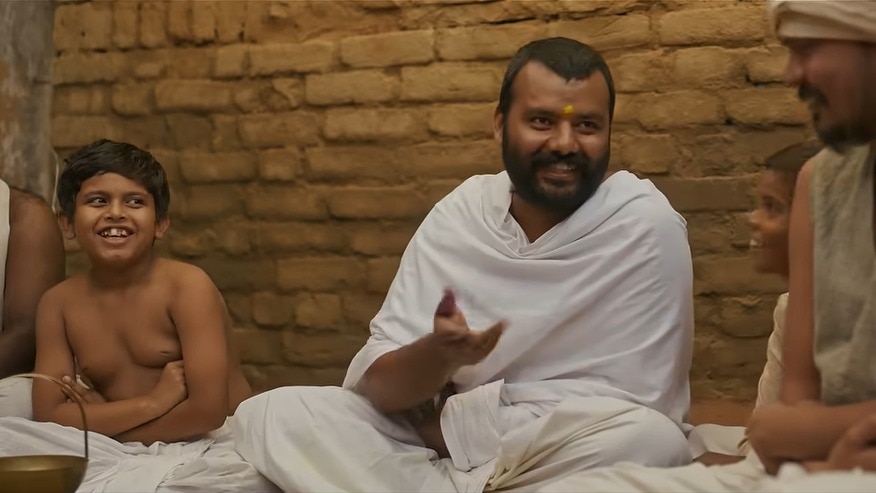
Is Hanuman Ansh about Lord Hanuman or Neem Karoli Baba? It is, surprisingly, about both, and that is exactly where the film’s biggest twist lies. The Vishal Chaturvedi directorial, which draws from stories of Neem Karoli Baba’s life and his devotion to Lord Hanuman, may carry the Hindu deity’s name in its title, but much of its spiritual world is rooted in the life of the man devotees came to know as Neem Karoli Baba. What begins as a story about a boy looking for his mother slowly turns into a story about finding God, and, eventually, finding one’s purpose in serving others.And the film has a rather beautiful way of bringing those two worlds together.When Lakshman, who would later become Lakshmi (because his father likes to use that name) and eventually Neem Karoli Baba, loses his mother as a child, he is told that she has gone to Lord Ram. For a grieving child, that is not an abstract spiritual idea. His mother is somewhere, and he wants to find her. But how does a child reach Lord Ram? Lakshmi arrives at his own answer: through Lord Hanuman, Ram's greatest devotee. If anyone can take him to Ram, it has to be Hanuman.That is the moment when the two ideas: Neem Karoli Baba and Lord Hanuman, become one. Lakshman's search for his mother becomes a search for Ram; his search for Ram takes him towards Hanuman; and that devotion eventually shapes the man he becomes. It is also why the title Hanuman Ansh - a particle, or part, of Lord Hanuman - doesn't refer to a deity, but feels more like a description of the man himself: someone who belongs to Him. That may be the key to understanding what Hanuman Ansh is really doing. Rather than presenting spirituality through complicated philosophy or grand theological explanations, the film brings it down to earth. Quite literally. It talks about mothers, hungry children, broken families, poor villagers, abusive husbands, forgiveness and the simple business of helping another human being.In the film’s telling, devotion to Lord Ram and Lord Hanuman is not just about prayer. That is not the conventional idea that the film is ready to explore. It is about what happens after the prayer, what you do when you walk back into the world and meet another person who needs help. That may also explain why the film, despite its modest scale and absence of a conventional superstar-driven spectacle, is finding a connection with contemporary audiences, including younger viewers. Its most interesting trick is that it doesn't really ask you to pick a side. Is this a film about Hanuman? Yes. Is it about Neem Karoli Baba? Also, yes. In fact, the film seems to suggest that one is the way into the other.A miracle walks into the storyIn 1943, under British rule, an Indian revolutionary hiding from the authorities is terrified that his disguise could be blown at any moment. He has also gone without food for 15 days. Then a saint living nearby arrives at his doorstep and offers him food - almost as if he knows exactly what this frightened, starving man needs.It sounds like the setup for a miracle. And this is the point where Hanuman Ansh could easily have gone big: divine intervention, dramatic music, a larger-than-life saint arriving like a superhero. Instead, the film is far more interested in the person behind the miracle.The film traces the formative years of 12-year-old Lakshmi, later known as Lakshman Das, and eventually Neem Karoli Baba, played by actor Shobhinav Satya. At the centre of his story is something deeply human: a boy who cannot accept that his mother is simply gone.His profound love for his late mother sets him on a spiritual path. His search for the blessings of Lord Ram and Lord Hanuman gradually becomes a journey in which faith and humanity begin to overlap. And that is where the film becomes more than a conventional faith story. The boy who begins by wanting to find his mother starts discovering something much bigger: perhaps the way to God is not always through looking upwards. It also could be through looking around. Bhakti, but make it practicalThat journey is told through small acts of service rather than grand declarations. From helping a widow exploited by a moneylender to reforming an abusive husband into a compassionate seeker, Neem Karoli Baba’s encounters with ordinary people become the emotional and spiritual core of the film.The film keeps returning to this idea almost like a refrain: if devotion does not change the way you behave, what good is devotion?This is also where Hanuman Ansh makes its most interesting choice. Lord Hanuman is not presented only as the distant, epic figure familiar from the epic Ramayana. Instead, the film uses Neem Karoli Baba’s lived devotion to show what following Hanuman and Ram could mean in everyday life.When he shares his alms, given by a Gujarati trader, with young boys marginalised by social hierarchy, or argues that true devotion lies in selfless service to one’s people, bhakti stops being something you simply perform and becomes something you practise.The same idea runs through its treatment of family relationships. A father-son relationship is presented through empathy rather than anger, while a man failing in his responsibilities as a husband is forced to confront his own behaviour.The message is hardly complicated: you cannot claim to love God and then be cruel to the people standing next to you. Faith, the film argues, has to show up somewhere – in your choices, your relationships and the way you treat people who have nothing to offer you in return.Not only for the HindusThat is where the film’s accessibility lies. You don't need to walk into Hanuman Ansh knowing the life story of Neem Karoli Baba. You don't need a crash course in Hindu philosophy either. The film gives you something much easier to recognise: a child missing his mother, a hungry man, a woman being exploited, a family falling apart, a person looking for forgiveness. Then it quietly connects all of those things to faith.Even its portrayal of Neem Karoli Baba forgiving the British officer who forcibly removed him from a train reinforces this idea of compassion extending beyond one’s own community or even one’s detractors. Again, the film refuses the easy route of making spirituality about who is good and who is evil. Its idea is simpler, and perhaps more difficult: can you remain compassionate even when someone has wronged you?The film repeatedly returns to the same uncomplicated proposition: spirituality has little meaning if it does not make a person more humane.For younger audiences in particular, that could be a big part of the film’s appeal. It doesn't begin by telling them what they should believe. It tells them stories they can feel. And somewhere between those stories of love, loss, kindness and service, it introduces them to faith.A different kind of faith filmThis makes the film an interesting outlier in the current wave of spirituality and faith-based cinema. At a time when stories about Indian gods and epics are increasingly associated with VFX-heavy spectacles, elaborate worlds and larger-than-life action, Hanuman Ansh takes a much more intimate route.There are no fireworks required when the film has a grieving child asking how he can find his mother. There is no need for a giant spectacle when the central transformation is happening inside a person. Its scale may be modest, but its emotional proposition is easy to understand: if you claim to love God, that love should show up in the way you treat other people.That could ultimately be the answer to the question the film’s title raises: Is Hanuman Ansh about Lord Hanuman or Neem Karoli Baba? The answer is hiding in the title itself.It is about Neem Karoli Baba because his life gives the audience a human entry point into the idea of Lord Hanuman. And it is about Lord Hanuman because it is that devotion – the devotion that began with a little boy trying to find his mother through Lord Ram’s greatest devotee – that shapes the man Neem Karoli Baba becomes.The two are not competing stories. They are two halves of the same one.'Hanuman Ansh, directed by Vishal Chatuvedi, was theatrically released on August 7, 2026. It is currently running in packed theatres.- EndsPublished By: Anurag BohraPublished On: Sep 1, 2026 06:30 IST
Is Hanuman Ansh about Lord Hanuman or Neem Karoli Baba? The twist winning audiences
Full Article
Original Source
Read the full article at Indiatoday →KhanList aggregates and links to publicly available news content. We do not host full articles from third-party sources. Always verify important information with original sources.