
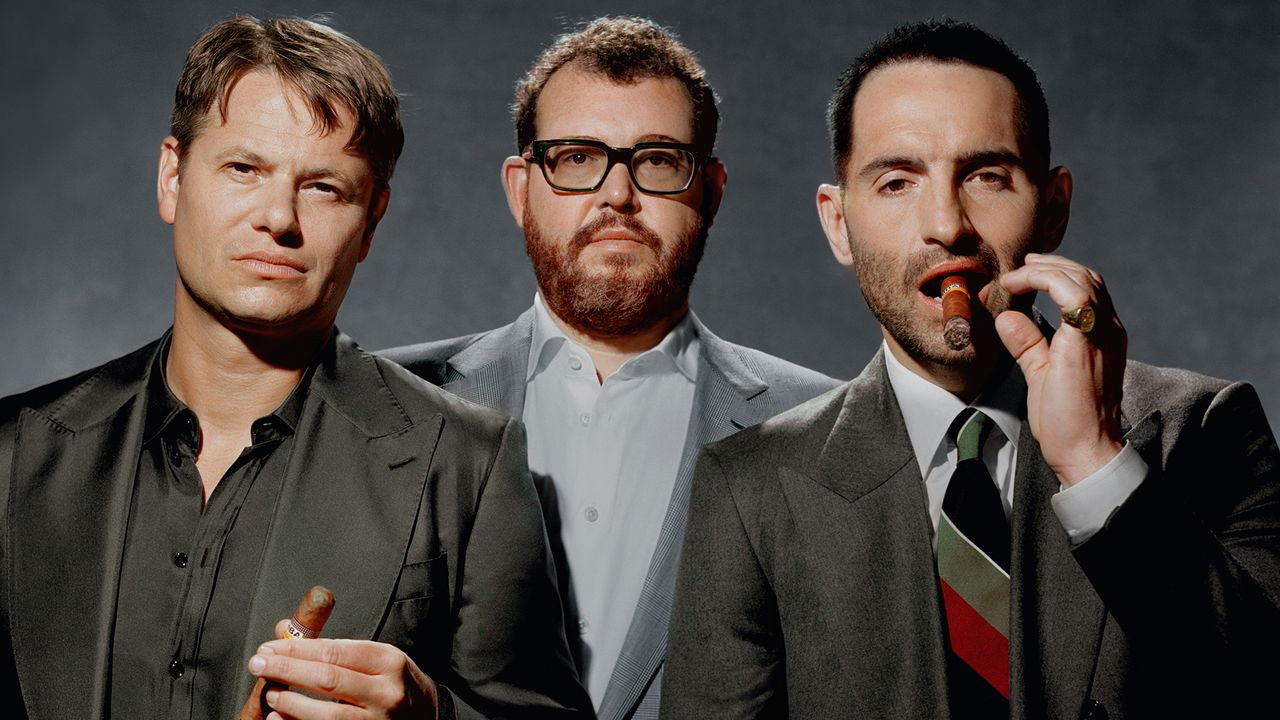
On a swaying-palms kind of night in January, I hopped into the back seat of Jeff Zalaznick’s Range Rover to accompany him on his evening rounds to seven of Major Food Group’s major Miami restaurants. Jeff, a born-and-raised New Yorker, had relocated to Miami at the start of the pandemic and instantly proved himself to be such a distracted driver—talking or texting as you might expect one of the three partners of a company with annual revenue in excess of $500 million to talk or text—that his wife and his partners, Mario Carbone and Rich Torrisi, were afraid he was going to kill himself, which would have been very bad for business. Thus Chris—the semiretired former member of the Miami PD SWAT team, who serves as Jeff’s driver, security detail, and advance man, all-in-one, was tasked with ferrying us back and forth across Biscayne Bay all night.Jeff and his two chef partners, Mario and Rich—who head up the empire behind Carbone, The Grill, and a rapidly expanding roster of restaurants, hospitality experiences, and bottled marinara sauces—have been celebrated and criticized, since Major Food Group’s founding in 2011, for cultivating a new brand of bombastic, delicious, high-priced, high-energy dining establishments, where, as the tagline for Carbone (and the sauce) likes to remind us: “Dinner is the show.” Over the last 15 years, Jeff, Mario, and Rich have harnessed and built upon that energy to create one of the most successful restaurant businesses of all time. If you think of Major Food Group as a New York phenomenon, it’s time to catch up. Since COVID, MFG has expanded with abandon beyond New York, nowhere more so than in Miami, where Jeff and Mario both moved, but also to many other countries, the dream of a Carbone on every continent (or at least in every emirate) not so distant. Beyond its dining establishments, MFG has also ventured into living establishments, like condos, clubs, hotels, and wellness pop-ups. The embodiment of an ethos—characteristic of a company known for appetite and indulgence—of more is more is more. The critical question at this juncture, though, is: Is it?Jeff’s and my first stop for our night in Miami was ZZ’s Club, the members’ club and private restaurant in the Design District that bears Jeff’s nickname (ZZ = Zalaznick). Inside, Jeff proceeded to check in with multiple members of the front-of-house staff, the head chef, and several diners. Each he greeted with a sort of benevolent insouciance, picking up their conversation on page 6 or 7, like they’d just seen each other last night, which they probably had. In a dining room of well-heeled patrons and staff, Jeff stood out for his height (he’s big), his gravity (he owns the joint), his voice (it’s booming), and his uniform (a black hoodie).We sat at a table where Jeff waited for the chef to deliver some dishes he was working on. Jeff is not a trained chef, but he is a trained eater, with a palate praised by Mario and Rich—making him, in many ways, the consummate proxy for a patron of an MFG establishment. We drank martinis, and Jeff told me how he’d spent his day—up in West Palm Beach, looking at a real estate opportunity being developed by Stephen Ross, the owner of the Miami Dolphins. These days, this is one of the primary functions of Major Food Group—to figure out when, where, and how to come in when people express interest, as they do constantly, in having an MFG restaurant in their ecosystem. Jeff described the 86-year-old Ross as “one of my closest friends.” This was not the only octogenarian billionaire Jeff described to me as being one of his closest friends. You have a lot of 80-year-old billionaire best friends, I told him. And he agreed he had a type.Jeff, who is a grandson of Paul Milstein (the financier and real estate developer after whom the Whale Room, a.k.a. the Milstein Family Hall of Ocean Life, is named at New York’s Museum of Natural History), ended up in Miami by accident. He and his family were on spring break that week when COVID hit and the world shut down. They decided to stay to weather the storm—and then, practically speaking, they just never went home. If you recall, COVID was experienced differently in Miami than in New York. In New York, Mario and Rich were on the ground figuring out ways to keep staff on the payroll. But in Miami, COVID was over in like three weeks—and Jeff recognized an opportunity they could’ve never anticipated. Several establishments had shuttered and their spaces were up for lease. They moved quickly to take over a space in a prime location on South Beach, at First and Collins—and Carbone Miami was born.They opened for family and friends in January 2021, and then proceeded to host what felt like a New Year’s Eve party every night through that winter. “It was the craziest juxtaposition: You’d leave New York wearing latex gloves and masks, and they were dangling from the chandeliers in Miami,” Mario said, reflecting back on that period. “It was like Prohibition, and Carbone Miami was the speakeasy.”Every night is like New Year’s Eve is how more than one Major Food Group restaurant was described to me. But whether this is your idea of heaven on earth or a waking nightmare probably depends on your feelings about New Year’s Eve. Who doesn’t like New Year’s Eve? Dogs. Old people. Those who love the quiet, subtle, and serene. Or who hate spending money just for the sake of spending money.And yet Major Food Group has built its entire existence on catering to those who do want to treat tonight as though it’s uniquely special. As with so many things in American life in 2026, the things that many people love about Major Food Group restaurants and the things that many people loathe about Major Food Group restaurants—they are the same. The maximally flavorful food. The theatrical “moves” of the servers and staff. The indulgent prices. The volume of the music. The volume of the wallpaper. The Schnabels for days. When Jeff described for me the check averages—that is the dollars spent per diner—of restaurants like ZZ’s Club Miami ($216), The Grill ($294), and Carbone Dubai (so high that Jeff asked, upon first hearing total receipts for the first month, if the number was in dirhams or dollars), it provoked a strong feeling in me, as it probably does for you. And whether that feeling is admiration for American-style entrepreneurship or aggravation at our new gilded age, what is undeniable is that Jeff, Mario, and Rich have built a beautiful business.On Carbone: his own suit and shirt by Cifonelli. His own tie and pocket square by Our Lady of Rocco. On Torrisi: suit by Dolce & Gabbana. Shirt by Tom Ford. On Zalaznick: all clothing and glasses, his own.From ZZ’s (initiation fee: $13,000; annual fee: $5,000), we continued our journey through Major Food Group’s Miami holdings, and stopped by Contessa, Sadelle’s, Dirty French, Carbone Vino, Chateau ZZ’s, and, eventually, Carbone. At Chateau ZZ’s, a Mexican restaurant in a French-style château built in Brickell in 1931, we had another drink, and ran into Mario, who eventually joined us at our table. Mario was not in any kitchen tonight, but was still managing kitchen staffs all over the world. He opened his WhatsApp and showed me the directive that had just been issued: All Carbone kitchens were required to post photos of three specific dishes for quality-control purposes. They were rolling in now, and the presentation was subjected to a group critique via WhatsApp. (While Mario worked from his phone, he and Jeff confessed to me that neither of them own a computer.)The server placed a tostada on our table. Mario and Jeff gleefully described the painstaking process of trying to create a tostada shell that wouldn’t crunch and shatter into a million pieces when you bit into it. (Mario: “It drove me crazy as a kid: If Cookie Monster loved cookies so much, why was he such a slob with them?”) I confess that this is not a problem I would’ve ever thought needed solving. But through the chemistry of cooking they’d done it, and judging by my look around the dining room, many late-night patrons were happy not only to order the dish but also to not spill down the front of their fanciest dresses and shirts. The tostada that maintained its structural integrity across multiple bites embodied the sort of Rorschach test that MFG seemed to administer at every turn: One finds this to be either a brilliant innovation, a solution to a problem we collectively didn’t even know we were bothered by, or another unnecessary indulgence that has less to do with food than the grand performance of eating.Jeff wanted to show me the area they were developing upstairs—an upscale cocktail bar where they intended to showcase their vast collection of tequila. It was cool. It would host events. And there is no business in restaurants like the events business, Jeff said. Some part of most of their restaurants is reserved at least some nights of the week for private events. For birthdays, business outings, weddings. The Pool, which opened concurrently with The Grill in 2017, is now solely used for events, and booked every night.This was absolutely going to work, Jeff told me, while standing in the bar. And then, in the glow of hundreds of tequila bottles, he added something I’ve been thinking about for months: “Right down the street, when Ken Griffin’s done building his fucking offices, you’re going to have a bunch of new guys making over a million dollars a year, and they need a place.” What he was saying was that when the new headquarters for Citadel opened, they would be ready. When he and Mario and Rich are considering the how, when, and what of a given opportunity, this is the sort of thing they consider. Jeff, among his many talents, was like a truffle pig for guys with their first millions burning a hole in their pocket. He knew how to find them and he knew how they wanted to spend their money. The Grill, in the Seagram Building on East 52nd Street in New York, is a perfect restaurant for its unmatched aesthetics, and also for its location. What some might regard as a liability—not in the downtown mix with its other restaurants—Major Food Group regards as ideal: They can play cafeteria to the banks. When I was there recently, I peered out through the bead-chain curtains that were dancing lightly on the windows and saw a sign on a lamppost: “Finance State of Mind.” In much the same way, the tequila bar at Chateau ZZ’s would be an inevitable success by simply being there, right down the street, convenient, exclusive, and invariably fucking fun.As we ventured from restaurant to restaurant throughout the evening, we crossed paths with, among others, several slightly nervy maître d’s (the boss had just walked in), a chef from one of NYC’s top-rated restaurants, a real estate developer that Jeff called “the true mayor of Miami,” a granddaughter of the president of the United States, a few more of Jeff’s closest friends, and many grown men to whom Jeff administered a sort of godfatherly embrace. As a restaurant-world outsider, I am not accustomed to seeing behind the scenes of so many establishments in succession. I am used to walking into the arena, into the show, as a customer and, consequently, a naif, where every dish, design choice, spiel from the server, and subjective experience feels unique, bespoke. Stacking them up, though, each successive restaurant faded somewhat, like xeroxing a vivid photograph, and then xeroxing that copy, and then that copy’s copy. Here, once again, another luxuriant dining room by Ken Fulk, another server rapping the daily specials while dressed like a croupier, another steaming plate of spicy rigatoni being dropped on the table for four thrilled patrons here for the night of their life, or at least their month. Yes, another martini. Yes, another bottle of wine. Yes, we’d love to hear about the desserts tonight. On and on it went all over town. New Year’s Eve, or at minimum a special occasion, for every table in every room on this arbitrary weeknight in winter. By the fifth or sixth spot, the hours growing later, someone would look at me and it’d be like a green-faced dancer in a Toulouse-Lautrec painting. A little haunted, a little overserved, a little how-much-was-all-that-again?Later, at Carbone, at what I sensed to be the restaurant reaching its climax, Jeff sort of wordlessly let me know that my night was over, while his was just beginning. Though Jeff was four martinis in, and though he would be up early, he needed to meet a chef—Kwame Onwuachi, of Tatiana in New York and Dōgon in Washington, DC (each named to the North America’s 50 Best Restaurants list)—for a drink in the dining room so that they could catch up, commiserate, and talk the business of food.Clockwise from top left: Rich and Jeff revel; under the big top at the inaugural Carbone Beach pop-up; Mario and LeBron James hug it out; Rick Ross rings in Carbone Dubai; cabaret fanfare at the Carbone London opening.Courtesy of Major Food Group; Getty Images; Moriarty EventsIn late 2009, Mario and Rich opened their first restaurant, Torrisi Italian Specialties, on Mulberry Street. I lived nearby and became a devotee of a $7 house-brined turkey sandwich served on a soft semolina roll with mayo, a spicy chili sauce, thin red onions and tomatoes, and a stack of shredded lettuce. It remains the best sandwich I’ve ever had.The sandwich was a side flex, something to peddle during the day while refining the evening’s $45 prix fixe menu. Original Torrisi—not to be confused with present-day Torrisi, opened in 2022 in the Puck Building, one block away—quickly became a showcase, a little bandbox diorama, of two Café Boulud alums riffing and remixing the New York classics of their youth aimed squarely at people in New York at that moment who loved food and wanted it simpler, straighter, tastier, and with less foam. Among them were famous diners like Jay-Z and Beyoncé, who came in often, and put the spot on the map. But also a 26-year-old food freak, former banker, and restaurant professional named Jeff Zalaznick. “I know food better than anyone,” Jeff told me. “And when I ate their food, it was so far beyond what I’d been eating for years that I was insanely inspired.” One night, Jeff convinced Mario to join him for a drink after service.Around midnight, Jeff and Mario took a cab across town to the Jane Ballroom, ordered cocktails, and sat by the heavy-draped windows. There, Jeff laid out a vision, and, Jeff recalled, Mario said: “That’s fucking crazy. That’s exactly what Rich and I want to do. That’s literally the exact same thing.” More or less: What if you took all the dishes, all the decor, all the music and movie references and “moves,” from beloved but tired Italian American red-sauce joints, but did them at the highest level possible? What if you took something people already liked but that wasn’t even that good—and made it great?When Mario, Rich, and Jeff opened Carbone in 2013, it had all the hallmarks of what would follow in each of their restaurants—the elevation of familiar food (Mario: “Why challenge guests with something they’ve never seen before?”), the central-casting staff (Jeff: “For Carbone, I put out a thing for only lifetime steakhouse waiters”), the theatrical nostalgia (Rich: “We love to live inside the movies, we love the texture of everything Old New York”), the nerve to make everyone pay full freight (Early days, Jeff had one exception to this rule: “If Michael Jordan comes, he will not pay.”), and an eye-popping price for a single dish—the $50 veal Parmesan—that was certain to spawn headlines and haters. (The veal Parmesan at Carbone is now $98.)The thing about that price, Mario told me recently, of the original veal Parm, is that they knew why it cost $50. “I could explain it. I could sleep at night. And I knew the quality was on the plate. I knew why ours cost what it cost, I knew why others’ didn’t, and that delta is where I wanted to live. I wanted to make my name in that delta.” Still, what kind of diner would stand for it? Today, as has always been the case, the prices at MFG restaurants, along with the celebrity clientele, are often the first thing anyone wants to talk about. Is the spicy rigatoni at ZZ’s really “worth” $44? Is a chopped salad at The Grill really “worth” $29? Saying nothing of any dish that involves a lobster, pig, or cow. (Okay, I’ll say one thing: The porterhouse for two at The Grill is $295.)The answer is as simple as glancing at the reservation sheet: Seemingly every restaurant in the MFG portfolio is almost always full—with many, many diners waiting in the wings for the opportunity to pay those prices. Since the opening of Carbone, Mario, Rich, and Jeff have often been the target of criticism for the prices they charge. I certainly find them high. But the scorn feels misguided. There are no tricks. There is nothing hidden. If you have a bone to pick, direct your questions to the diner who just ordered the $175 lobster fettuccine on the patio at Carbone Riviera, just as he’d dreamed of doing for months.Servers march a raw bar at The Grill.Courtesy of Major Food GroupIn June, I met up with Mario at ZZ’s New York, the members’ club in Hudson Yards. I asked Mario why he thought there had always been so much attention on the prices at MFG restaurants. And why it seemed the three of them and their group loomed so large in the minds of so many in the restaurant industry? “There’s plenty of sentiment out there against us because we make money, because we are a successful business. And that in order to do that, we must be taking advantage of the customer,” Mario said. “I like to believe that there’s virtually no price you could put on giving someone the very best iteration of something that can exist, if you indeed did that. If you didn’t, then shame on you. You failed. If you did do that, which we did, then you’re successful forever.”Jeff and Mario had both told me stories of revering London and many of its hotels and restaurants. London was special to them—and last fall they opened their first restaurant there, a Carbone in the former US Embassy on Grosvenor Square in Mayfair, on what Jeff described as “the greatest corner in Europe.” Before long, Carbone in London was pilloried by critics like very few restaurants I’ve ever seen. Having read many of the reviews, from food critics and online posters alike (one Reddit thread asks: “Is Carbone London’s most hated restaurant?”), I get the sense that Carbone was not their cup of tea—but also, perhaps, an opportunity for people to tee off on several other matters stuck in their craw: expensive restaurants, foreigners moving in, beautiful younger women dining with uglier older men, an over-obsession with Italian American culture and gangster movies, general decadence and depravity, oligarchs, billionaires, American foreign policy. Who among us? But I was curious how Mario and Jeff each took the ceaseless kicks in the nuts on this particular project.“They hated us,” Jeff said. “They were very abusive reviews that I kind of found humorous, honestly.”“I read those things and do sift through for anything that I should look into or that you can take as positive criticism,” Mario said. “This was just like: You don’t want me here, I get it. But the 300 people who are dining here say differently.”“The restaurant’s packed,” Jeff said. “Honestly the restaurant is so busy—it’s one of the few restaurants that I personally still get a lot of text messages about getting into.”This review, in The Spectator, summed up both of these dynamics—the antipathy and the popularity: “People say that Carbone is Jay Gatsby’s restaurant—Gatsby being the metaphor for moneyed doomed youth—but it is something more awful and, because people are asleep, no London restaurant has been this fashionable since the Chiltern Firehouse a decade ago.” Kinda makes you want to go, doesn’t it?“Listen, obviously we would rather get great reviews,” Jeff continued. “But for better or worse, in this case for better, the impact of critics is not what it was when we were building these restaurants—like, getting three stars [from The New York Times] at The Grill was critical. And that was kind of the end of that era.”“Journalists, in general, with these expensive price points,” Mario said, “there’s a resentment for this being a restaurant that they see as something they’re not welcome at: ‘This is for rich guys, bankers, hookers, this is not for me, and I’m going to come here and I’m going to write about it in that way.’ The guy that’s reviewing in Car and Driver, when he gets in the Bentley, isn’t pissed off about it because he can’t afford it.”The hiccup in reception in London seems to have not halted expansion in the slightest. In addition to Major’s in London (scheduled to open this fall), MFG has plans to open Carbone outposts in Mexico City, São Paulo, and Tokyo (next couple of years). In the meantime, Mario was busy this year opening a new restaurant and a bar, The Grand Grill and Bar Lelarge, in the new Four Seasons in Cartagena.That Mario and Jeff cooked up the concept for Carbone over cocktails at the Jane that night in 2010 is now lore for MFG. But what is more relevant in 2026 is what else they talked about that evening. Mario and Jeff had an idea for a restaurant, sure, even lots of restaurants. But they were thinking even bigger, even then. About food in hotels, about hotels themselves, about condo buildings, about members’ clubs, about New York City, but also the rest of America, and the rest of the world. They had a vision for a lifestyle, of the style of an entire life, that could be articulated through food and beverage and the shared environments in which food and beverage are happily consumed, that might extend well beyond the restaurant. “I know for a fact that we’re going to get diminishing returns if we just open hundreds of more restaurants,” Mario said. “So we’re spending a disproportionate amount of our time in: What’s the next tier of businesses that are adjacent? That make sense and where we can challenge ourselves?”Just as you turn over the keys to a dining experience to a restaurant, its chefs, its servers, its hospitality architects, the argument went, why wouldn’t that extend to turning over the keys to other elements of your life? Their first venture into luxury condos—Villa Miami—was already 80 percent sold through and due to open in about a year. The building will feature a boat dock, a helipad, a private club, and, of course, a couple of MFG restaurants.While Mario and Jeff relocated to Miami, Rich stayed in New York. Will he ever join them? “Never,” he said. “If you can’t go down to Miami for two to three days and enjoy yourself, then you need to go see a therapist. And I love that the guys love it. But Miami is definitely not a place that I would settle down. There’s not a lot of places that I can live. I’m a quintessential New Yorker.”While Mario and Jeff focused more of their efforts on expansion—in Miami, in Europe, in Mexico, in Asia; into hotels, condos, beach clubs, and wellness—Rich remained focused on New York, and, in particular, on his baby, Torrisi. “Pitching a flagship place that you’re going to pump a ton of money into is the riskiest thing you can do in our business,” Rich said about approaching Mario and Jeff with the idea. But given the spreading out of their resources across an ever vaster surface area, Rich felt they needed to remind people who they really were. Torrisi could serve as their “shield of excellence.”“Our last project in New York, we were on top of the industry, but the stuff we’re doing in Miami….” Rich caught himself. “If we want to still be the top dogs in this industry,” he argued, they needed to open the best restaurant in New York. “If someone said: They’re expanding like crazy, they’re doing all this stuff, it’s: ‘Yeah, but they run the best restaurant in New York. Who else does that? Nobody! Fuck off!’ ”Critics have largely affirmed the strategy. Torrisi, which opened in 2022, is regularly rated as one of the top restaurants in New York, was recently named to the North America’s 50 Best Restaurants list, and holds one Michelin star. “Torrisi is the only one that we play the game of those lists,” Jeff said.I asked Rich what he thought about the Times ranking this spring, which called Torrisi the third-best restaurant in the city. “It feels like they’re finally telling the truth,” Rich said. “She’s literally telling her readers, ‘Put aside that they cater to billionaires, put aside that it’s a loud company.’ Yeah, no shit put that aside! You’re supposed to judge the restaurant based on what that restaurant is, not all this other stuff in the company.”The reason I personally think Torrisi works so well is because it fuses Rich’s characteristic high-wire cooking with the two things all Major Food Group restaurants are known for: a room that many diners would be eager to return to month after month, week after week; and a clear and clever concept that any diner can appreciate. Torrisi’s is this: Every dish is an MFG take on and elevation of favorite foods of the melting pot of Lower Manhattan—Kosher pickles; Jamaican beef patties; Chinese bao buns. All foods that Rich was reared on when he’d tag along with his father, from Hastings-on-Hudson to Manhattan, to his work at the New York Supreme Court, where his father was an court officer (and where he met Rich’s mother, a stenographer), at the crossroads of Chinatown, Little Italy, Tribeca, and the Lower East Side. Rich described for me emerging from the subway station at Canal into a thrilling assault on his senses—and a day of eating in the neighborhood. I asked if he could still, decades removed from those day trips, taste those dishes: “One hundred percent,” he said.At one point, I asked Mario what single dish from the Torrisi Italian Specialties days defined that restaurant and that period for him. He didn’t hesitate: “Cucumbers New Yorkese.” With that dish, he said, “we created an entirely new language.” There was the dish itself—an elevated articulation of a familiar food (a deli pickle)—but also that nomenclature, which you can find on most Major Food Group menus today, that opened up a whole world for Rich, Mario, and eventually Jeff: Calamari Marco (Carbone); Caesar alla ZZ (Carbone); Capellini Cantonese (Torrisi); Familiar Food alla MFG, Classic Dish MFG-ese. Our town. Our twist. Our way. It started at original Torrisi, evolved through Carbone, and found its fullest voice yet at new Torrisi. The first generation (original Torrisi) learned to speak the strange new language, but it took the second generation (new Torrisi) to get fluent and fully express what it had to say.While Mario and Jeff work to plant the flag of MFG on other continents (and in other adjacent industries), Rich is drilling down ever deeper into Lower Manhattan. “I don’t want to be running to Miami and running around the world making beta concepts,” Rich explained. “I’m a high-level expert. I should only be doing high-level things. So I basically pivoted towards that. I’m focused only on scouting high-level, New York City, very relevant flagship projects.”For example, Major Food Group’s takeover of Robert De Niro’s famed Tribeca Grill. The three were involved in lengthy negotiations with De Niro. They were patient, stuck to their guns, and ultimately wound up with the prize. “It’s obviously a lot of fun because you feel like you’re in a movie,” Jeff said. “You recognize all his facial expressions, and see all these glimpses of different characters. And on top of being obviously one of the most incredible iconic actors of all time, he’s also the biggest restaurateur in the world—he owns Nobu!—making him a much bigger restaurateur than me.” (They’ll be changing the Tribeca Grill name but haven’t settled on a new one yet.)Another project in New York that encapsulates Rich’s desire to go smaller and deeper while the others go farther and wider, is The Mulberry Room, a one-night-a-week, invitation-only “restaurant within a restaurant” at Torrisi that Rich intends to introduce by early 2027. Over the years, the thing that would make guests, even the diners who have experienced everything, “go crazy,” Rich said, was when Jeff would lead them into the kitchen and Rich would present some new dishes that they were still developing, and he and Jeff would riff. That peek behind the curtain to glimpse the iterative creative process, that was something Jeff suspected that people would pay quite a lot to experience. And so: a new bespoke concept that will exist in what is currently Rich’s office at Torrisi, where Rich will cook all the ideas he’s developing and invite lucky diners into his lab for a sort of works-in-progress chef’s table.Rich’s wife is a painter, and he spoke often in the metaphors of an artist: “I think cooking is the definition of a limitless canvas.” Pure imagination. “I’ve always really gravitated toward just the infinite wonder of the ingredient,” he told me. “If you look at an onion or you look at a lemon, it’s not the ingredient that lacks imagination, it’s the human.”In June, I met up with Jeff again, this time at The Grill. When it opened, The Grill was a throwback to a midcentury chophouse, but with the eyebrow-arched silliness and swag—the “moves”—that had been a hit at Carbone. Many photos of Mario from that era feature him in his chef’s toque, so cartoonishly high on his head that it nearly touches the 20-foot ceiling of the landmarked dining room. What I remember about its earliest days was that the bombast, the bold pricing, and the over-the-top performances of everything from the Seussian dessert table to the squeaky trolley for the duck presse, wheeled ceaselessly across the carpeted floors, was balanced—yin and yang, dynamics—by the restrained elegance of the room itself. Designed by Philip Johnson in 1958, the dining room at The Grill was and is arguably the great room in New York City restaurants. You come up the carpeted steps, whether for the first time ever or the second time this week, and it’s hard to fuck up anything too badly after that.As Jeff sat, he apologized for the extensive schmoozing I’d just borne witness to. “You get going in this room,” he said, “you may never stop.” The Grill, Jeff said, was his favorite of all of their restaurants. His grandmother used to have her birthday dinner in the Pool Room, down the hall, every year, and, as the Four Seasons did for a lot of New Yorkers who lived in the city during its famed heyday, the restaurant loomed large.Jeff does not stop for long, but he paused in profound silence for a hilarious amount of time while he debated ordering oysters. “Listen, I love oysters. But oysters are the one food that…you’re not playing Russian roulette, but you have a higher percentage chance of having stomach issues, even if you’ve kept them perfectly. And this is probably the safest place you could eat oysters in the world, okay?!” But he couldn’t risk it. The next day, he was flying out early to San Antonio for Game 1 of the NBA Finals. Jeff and Mario and Rich had been at closeout games for the Knicks’ previous playoff series, and Jeff would be a fixture on TV all throughout the Finals, always just a few seats down from Spike. I asked him how the caravan worked, and Jeff described the fleet of “like 10” private planes—and “a million dollars of wine”—that traveled to playoff away games together. “I am a New Yorker,” Jeff said, “who just happens to live in Miami.”Suit by Giorgio Armani. His own shirt by Cifonelli. Stylist’s own tie by J.Crew.Jeff described for me the many projects Major Food Group has on the horizon. Including: a private food-focused golf club in Aspen (potentially million-dollar memberships); all those many, many future Carbones; a Carbone Riviera in Saint-Tropez; a Greek concept (potential name: Aegean) at their Villa Miami residences; a hotel in Abu Dhabi (ZZ’s club on top, Carbone on the bottom, with a Contessa and Sadelle’s nearby) and Sunny Isles Beach; the development of the new Tribeca Grill; the opening of Major’s in London; opportunities in Athens, Milan, Spain, Brazil, India, and Puerto Rico (“Puerto Rico is on fire; every day I get a call about it, because of all the tax stuff,” Jeff said); and MFG’s hard-won takeover, with a key partner, of Nikki Beach in Miami.Major Food Group was a character in the story of post-COVID Miami, the influx of people and businesses. I marveled at the way that Jeff had, in six short years, come to function like a fourth-generation Florida real estate mogul. “Miami is the most business friendly environment I could imagine being in,” Jeff said. “I never thought there was an environment like this.” In their grandest room, I asked Jeff if he thought money really did flee New York for Miami or if that was overblown. “A lot of money did leave. But not because of some Mamdani thing—I thought that narrative was really stupid. New York will always be New York—it’s always going to be the center of everything. New York’s restaurant market, in terms of where we sit, in the $100-plus check average world—it’s insane what’s going on. I mean, no one has ever been spending more money than they spend now.” The check average at The Grill in 2019, Jeff said, was $190—in 2026, it’s $294. (ZZ’s in New York is more.)When we stood up from lunch, Jeff made his way to the top of the carpeted stairs and marveled at the room: “I still cannot believe this is one of my restaurants.” For all the noise around Major Food Group, it sometimes really did just come down to some definitive truisms: For example, there is no room like the dining room at The Grill. Or: The hunk of Parmesan they drop on the table at Carbone is always going to taste very good. Or: That turkey sandwich from Original Torrisi—still present in a slightly faded form on the menu of Parm—is the best sandwich of my life.Jeff took me into the private dining rooms of The Grill (Warhols on the walls, Philip Johnson’s Starry Night ceiling overhead), down the hall past one of the world’s largest collections of Château d’Yquem dessert wine (at least one of every vintage dating back to 1811), through The Pool (being prepared for a private event tonight), through the kitchens, through a door into The Lobster Club, another of Major Food Group’s restaurants in the Seagram Building, interconnected by passageways, and then through so many doors and passages that I lost my way. Major Food Group has this effect. There are so many elements, so many places to look, so many shiny sensations clamoring for attention, and then—pow!—another over there, followed by another, and another. The restaurant dynasty, in its expansion of bright, entertaining, decadent indulgence, can often resemble a fireworks show. One radiant explosion followed by another. A bite of familiar food, only extra, intended to blow your fucking head off. An eruption of laughter at a bar or a host stand or a table of reverents, everywhere, an indulgence of fat-fed-and-happy, of red dresses, red cheeks, red wine, red banquettes, red light, red lips, red liquor, red meat. Pow! More fireworks. Who doesn’t love fireworks? Only those who don’t. Dogs. Old people. The same people haunted by the idea that every night somewhere might be like New Year’s Eve.At this late stage, I have a disclosure: Major Food Group restaurants, on the whole, are not for me. In theory, at least, I prefer things that are more restrained. I don’t like it when I find myself wondering if the chef could explain, as Mario assured me he could, why on earth any of this costs what it does. But it’s difficult, in any of these places, to deny the genius of giving people something they already like, only better, and the irrepressible thing that happens once the first sip of the martini hits, and the music is the right music, only louder, and you’re in the dining room of The Grill or on the patio of Carbone Riviera, and the bead-chain curtain of the old Four Seasons or the famed 40-story fountains at the Bellagio are each dancing in the moonlight, and everyone everywhere around you has saved up their joy, their laughter, and their dollars to dump out on the table right now, right here, for one night only, because this is the night, the big night—and once all that’s going, you might as well order another one of everything. How much does it cost? Who’s that sitting over there? Do they and the bill they just paid offend me to my core? Not now. Who cares? As Orwell once wrote, one should live with the stream of life, not against it. Certainly nobody likes to get screwed at a restaurant, but sometimes it sure feels good to get Carboned.On our way out of the warren of passageways, Jeff told me that you could rent The Grill, The Pool, and The Lobster Club three-for-one for weddings. What does that set you back? I asked.He stopped talking for the first time in years. But then he ventured a guess: “Before anything? Two-fifty? Three-fifty?” He looked dubious. “I’ll have to check on the number, ’cause it’s going up all the time.”A version of this story originally appeared in the September 2026 issue of GQ with the title “These Men Have an Offer You Can’t Refuse: The Best Night of Your Life.”PRODUCTION CREDITS:Photography by Beth SaccaStyling by Tyler AustinGrooming by Gina DaddonaTailoring by Ksenia GolubProp styling by Suzy Zietzmann
Inside the Carbone Crew’s Decadent Bid for World Domination
Full Article
Original Source
Read the full article at Gq →KhanList aggregates and links to publicly available news content. We do not host full articles from third-party sources. Always verify important information with original sources.