
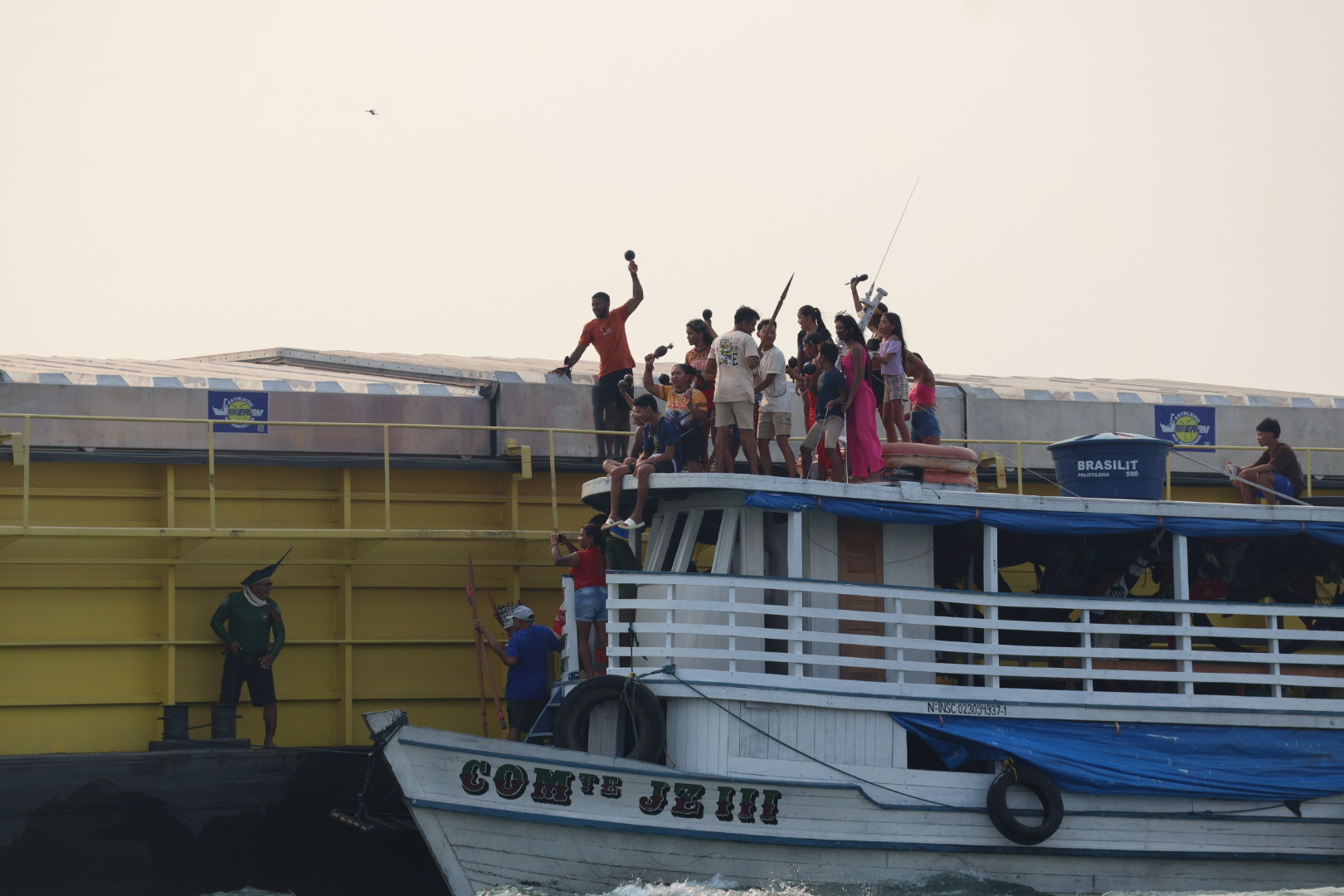
Hundreds of Indigenous protesters on several small boats and canoes stopped and boarded barges carrying soybeans and fuel on Brazil’s Tapajós River in the eastern Amazon. The demonstrations on Nov. 14 and 15 were to demand protection for the river amid industrial expansion and legal recognition of Indigenous territories in the region. The two-day demonstration near Santarém, in Pará state, drew more than 650 protesters. “Our children need this river, just as we need this river,” Jackson Tapajós, executive secretary of the Tupinambá Indigenous Council who participated in the protest, told Mongabay by phone. Smoke in the air from nearby forest fires was so thick that protesters could not see the barges approach until they were close, he said. Indigenous women negotiated with armed security guards after approaching the fuel barge on Nov. 14, explaining that the group was peacefully protesting. The guards allowed them to board but stayed with them, Tapajós told Mongabay. “We managed to talk to some of these guards … but they were by our side the whole time, the whole time with their guns, so that creates a lot of tension,” Tapajós said. The Tapajós River is an export artery for the region, carrying large amounts of soybeans and corn from Brazil’s agricultural heartland to ports on the Amazon River, which ultimately connect to international trade routes via the Atlantic. According to the Ministry of Ports and Airports, 16.8 million metric tons of cargo was moved through the waterway in 2025, up 14.3% from 2024. “We fish in this river and use it to travel from one village to another. The river is part of our territories and our lives. That’s why we want to protect it,” Gilson Tupinambá, chief of the Tupinambá people, said in a statement published by nonprofit Amazon Watch. For the Tupinambá people the river itself is sacred; its rock islands are considered the home of the encantados, or spiritual beings, Tapajós told Mongabay. Under a previous waterway decree those islands could have been blown up to accommodate heavier ship traffic, Tapajós said. However, the government repealed the decree in February, after a 33-day Indigenous blockade of a Cargill grain terminal. None of the 12 Indigenous territories in the region has full legal recognition. In May, Brazil’s minister of Indigenous Peoples pushed to speed up the process following a technical visit to the region earlier in the month. FUNAI, Brazil’s national Indigenous affairs agency, has yet to begin studying the land claims for five of the territories: Tupinambá do Baixo Tapajós, Encantados/Kumaruara, Sarambiá, Terra Preta and Arapyun. The other seven are at different stages of the land recognition process; some have been stalled for nearly two decades. “We want to know what’s missing in each case, who’s responsible for moving it forward, and by when,” Lukas Tupinambá, coordinator of the Tapajós and Arapiuns Indigenous Council (CITA), said in a statement. Banner image: Indigenous protesters board a soy barge on the Tapajós River in Brazil. All images courtesy of João Vitor Tupinambá. Credits Topics
Indigenous protesters board soy and oil barges on Brazilian Amazon river
Full Article
Original Source
Read the full article at News →KhanList aggregates and links to publicly available news content. We do not host full articles from third-party sources. Always verify important information with original sources.