
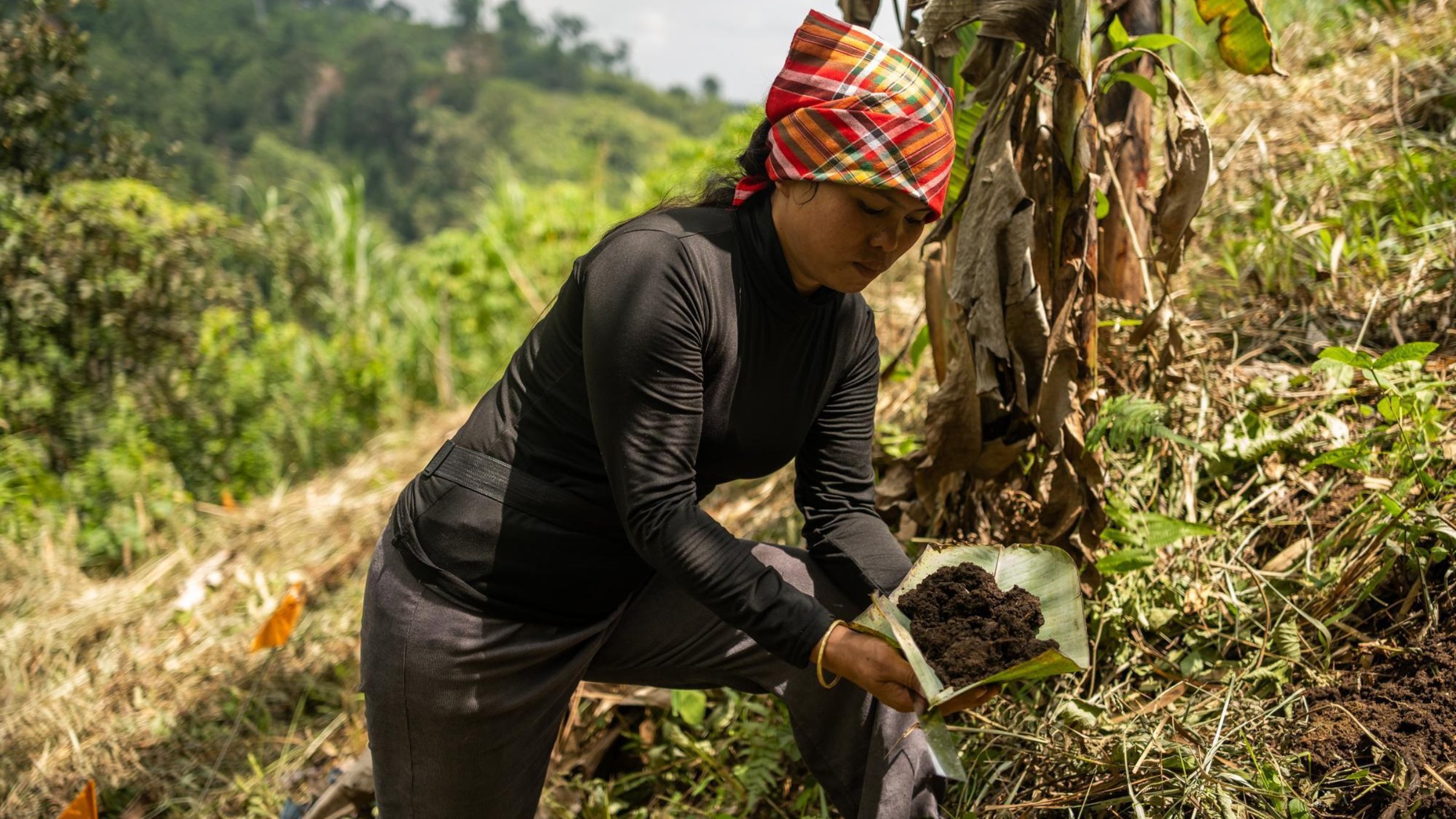
Indigenous T’boli farmers in Mindanao, Philippines, suspected that a shift from traditional organic corn to corn genetically engineered to tolerate the pesticide glyphosate could explain both changes to soil and increasing siltation in a nearby lake.With support from scientists and NGOs, the farmers set up test plots to test their hypothesis, measuring erosion, soil quality and biomass in two upland plots planted with either traditional or genetically modified corn.They found that significantly more erosion occurred in the plot with GM corn, which an independent expert attributed to the loss of biomass in plots treated with pesticide, combined with the natural forces of erosion in steep, exposed slopes. LAKE SEBU, Philippines — To the untrained eye, a handful of soil might appear to be a monotone brown. But to farmer Welna Sumulde, who grew up among generations of Indigenous T’boli farmers on the Philippines island of Mindanao, the slightest change in the color of the soil is a whisper from the land, a warning of its degradation. “Around 2023, we observed changes in our soil. The color became lighter, the leaves looked different, and the cassava we harvest became smaller. We also observed fewer living organisms on our soil,” Samulde told Mongabay. Samulde and other farmers in her community also thought changes in the soil might hold answers to a troubling puzzle: Why do fish keep dying in nearby Lake Sebu, a lake that lies in the natural basin below their upland farms? They said they began to suspect that soil erosion from surrounding corn farms was speeding up siltation in the lake — and that changes in farming practices were accelerating erosion. With the help of NGOs and scientists, the farmers were able to test this hypothesis. MASIPAG Mindanao coordinator Leo XL Fuentes, in yellow, conducts a soil test alongside farmers of the Lem Bulul Farmers Association. The farmers are comparing soil fertility and pH between traditional and chemical corn farms. Image by Geela Garcia for Mongabay. Corn-fed culture Although rice is the core of the Philippine diet, corn is the primary agricultural crop of Lake Sebu; a 2021 study found that 53% of the municipality’s agricultural area was planted with corn. In 2005, corn genetically modified to tolerate glyphosate-based herbicides such as RoundUp was approved for use in the Philippines. When glyphosate is sprayed on farmlands, all plants are killed except the genetically modified (GM) corn. Attracted by the prospect of less labor and higher yields, many farmers shifted away from their traditional organic and polycropping farming practices. Samulde is also the president of the Lem Bulul Farmers Association, an organization of T’boli farmers. Based on their shared observations, members hypothesized that the practice of conventional farming and the use of glyphosate may have accelerated soil erosion in the steep mountains where they plant corn. Welna Samulde holds a steel rod at the traditional farming experimental site at Lake Sebu. Since the experimental site is a slope, the sampling area was divided into three sections, and five sampling points in a “W” pattern were marked with steel rods. Image by Geela Garcia for Mongabay. The organization reached out to scientists from Magsasaka at Siyentipiko para sa Pag-unlad ng Agrikultura (MASIPAG), a farmer-led network of people’s organizations, NGOs and scientists, to help them conduct their research. “The farmers noted an enormous presence of soil in the lake, as the lake has also become shallower,” said Leo XL Fuentes, MASIPAG coordinator in Mindanao. “They believed the siltation was because of the soil erosion from the mountainous parts of the town, which prompted them to do an experiment to check on the soil loss.” Bayer Philippines, which distributes RoundUp herbicide and RoundUp-ready corn in the Philippines, told Mongabay via an emailed statement: “Glyphosate has been extensively studied and evaluated by regulatory authorities worldwide … which have consistently supported its safety when used as directed.” The company said it could only comment on the T’boli study after a complete review of the study and its findings, and did not respond to requests to schedule an interview. The farmer scientists’ methodology and results Samulde holds collected soil to demonstrate how the farmers measured the soil biodiversity. Image by Geela Garcia for Mongabay. Sitio Tenetem, the mountainous farmland where the Lem Bulul Farmers plant corn, is a 20-minute motorbike ride and a steep 30-minute hike from the nearest highway. In the fields, around seven farmers came carrying a levelling hose, measuring tapes and a plastic bucket to demonstrate how they measured the slope of the experiment sites. The research’s scope compared two farming sites. First, a traditional site that practiced organic farming with traditional white corn, and second, a conventional site where glyphosate is used with GM corn. With the guidance of MASIPAG and scientists, the farmers conducted experiments on both sites to measure and analyze the soil and its health — placing rods to measure erosion and establishing sampling points for soil and vegetation. “Every week, we measure the soil using the steel rods and take note of soil erosion. We tallied the data for one cropping season,” Samulde said. “In our experiment, we observed that there were more living organisms per plot of land for traditional farming,” she said, explaining that earthworms were found in 13 out of 15 sample points in the traditional field, compared to just six out of 15 sample points in the field of chemically treated corn. Farmers also collected and weighed all of the above-ground vegetation in a 1-meter (3.3-feet) test plot at the center of each area, including cover crops such as peanut (Arachis hypogaea) and Pinto peanut (Arachis pintoi)and. The biomass from the traditional farm was heavier, with a total of 620 grams (1 pound and 6 ounces) of vegetation, while the conventional farm was significantly lighter, with 220 g (7.8 oz). Soil samples from the traditional farm were observed to have a deeper brown color and more living organisms than samples from the conventional farming plot. Image by Geela Garcia for Mongabay. The farmers also studied the soil profile, the vertical cross-section of the soil from the ground surface extending to the bedrock. The topsoil is the darkest part of the soil because it is where organic matter decays. A rich brown signals a high concentration of organic matter; this means more nutrition and a stronger soil, less vulnerable to erosion. “In Bisaya, the farmers’ own language, they use the term ‘napanas yung yuta,’ which means that the soil has eroded. They say this when they start to see its parent material, composed of rocks, which are lighter than the topsoil,” Fuentes said. Farmers in a conventional corn farm in Sitio Tenetem prepare the land for another cropping using the slash-and-burn method. Image by Geela Garcia for Mongabay. Using the measurements from the soil rods throughout the season, the farmers calculated that soil erosion was more than five times higher in the test plot planted with modified (GM) corn varieties and glyphosate than it was in the traditional farming plot. According to MASIPAG, traditional farms lost 7.59 cubic meters of soil per hectare (108.5 cubic feet per acre), while conventional farms lost 39 m3 of soil per hectare (557.4 ft3 per acre) from March to July 2025. To help farmers visualize the soil loss, Fuentes explained that soil loss per hectare (2.5 acres) on farms using glyphosate is enough to fill more than five of the 7-cubic-meter (CBM) dump trucks often seen in communities due to mining. Meanwhile, the soil loss for the site without the herbicide would fill a little more than one. Soil erosion, in turn, has an impact on the broader ecosystem. “The soil that erodes from upland farmlands reaches the lake, and in the Lake Sebu system, we see that the lake suffers deposition due to the erosion,” Fuentes said. “This increases the soil in the lake, affects the oxygen for its living organisms, and becomes the cause of fish kills. This creates an impact on their livelihood.” Agricultural researcher Artemio Salazar, a retired research professor from the Institute of Plant Breeding (IPB) of the University of the Philippines Los Baños (UPLB), said that citizen-led research is important because, while there is plenty of research about the favorable effects of these technologies, there is little research on their effect on topsoil loss. Farmer Reydan Twalan hikes up to the farmland at Sitio Tenetem, Lake Sebu. The walk to the farmlands shows visible signs of erosion and landslides. Image by Geela Garcia for Mongabay. “The technology came from the United States, where most of the corn areas are flat with a thick layer of soil; however, the context is different in the Philippines, where corn is planted in mountainous areas. The problem lies when you apply that technology in sloping areas like the Philippines,” said Salazar, who was not involved in the MASIAPAG study. “Even with manual weeding, once you remove the vegetation that holds the top layer, and the field is in a sloping place, by force of gravity, there will be erosion. So for the herbicide, the loss of the topsoil is significant, especially in areas with a slope, because you remove all the plants except for the GM corn,” Salazar said. “The more sloped the area is, the bigger the topsoil loss is.” Salazar added that the continuous use of glyphosate can have long term impacts on food production, because once topsoil is lost, it takes many years for it to develop again. The costs of conventional farming Conventional corn farmer Loreno Samal harvests GM corn at his farm in Sitio Tenetem, Lake Sebu. Image by Geela Garcia for Mongabay. Conventional farmers like Boyet Samal joined the experiment because they wanted to see how they could improve their production. “Chemical inputs made our job easier, but we also didn’t know their effects on soil health,” Samal said. He also noted that conventional farming is more expensive than traditional farming. The seeds for GM corn cost 1,500 pesos per sack ($23.5 per sack), which weighs 20-25 kilograms (44-55 lbs) each, reaching about 20,000 pesos for a hectare of land ($313 per hectare, or 8,090 pesos or $127 per acre), he said. This amount does not yet cover the cost of fertilizers, herbicides and labor, which can reach up to 15,000 pesos ($235). On the other hand, the only capital required for traditional farming is for labor, as farmers do not need to buy new seeds and chemicals every new cropping season. “Sometimes, we don’t even have to pay high for labor because as an organization we practice bayanihan, a form of mutual aid and collective farming,” Samulde said. With input costs come financial risks, amplified by climate vulnerabilities such as extreme heat and typhoons that can affect harvests. In a recent cropping season, Samal said, his family lost 10,000-15,000 pesos ($157-$235). “We spend more on our inputs and investment than what we earn. We borrow money from the trader for the next cropping season, which also comes with interest. We earn back our losses from the earnings of other crops like abaca and banana,” he said. A portrait of farmer couple Jocelyn and Boyet Samal at a house in Lake Sebu. Image by Geela Garcia for Mongabay. None of the Lem Bulul Farmers Association members have been severely stuck in debt cycles, but for some, it took years to pay off loans they took from traders. However, returning to traditional farming is time-consuming. Glyphosate is known to persist in soils for up to six months after use. Based on his experience, Samal had to let the soil rest from the impact of chemical farming for three years to ensure that the soil had regained its health. Citizen science for food security MASIPAG hopes the results of the research can support lobbying for policies in the Philippine Congress to ban glyphosate — a difficult prospect since many farmers have adapted to using it. As a first step, Fuentes looks to local ordinances banning the use of glyphosate in riparian zones. “Based on the context of our study, these areas’ topography reveals that they are vulnerable to erosion,” he said. Some towns in South Cotabato, like Surallah, have passed local ordinances to ban the use of glyphosate. The Lem Bulul Farmers Association hopes to lobby for a similar ordinance to promote organic farming. On the left, GM corn harvest from conventional or chemical corn farms. On the right, harvest from traditional corn farms. Image by Geela Garcia for Mongabay. Salazar said that issues relating to GM and glyphosates can be challenging to navigate, since it means confronting large agri-corporations. And this is why, for Fuentes, these types of experiments, which put farmer-led citizen science at the forefront, are the marginalized peoples’ way of asserting their right to land. “At the end of the day, the battlefield is on the land, and farmers are our lead scientists because they know their land,” Fuentes said. “They are effective at influencing people in their communities, and in this way we’re able to democratize science.” He said he hopes to expand on the work of the T’boli famers by conducting similar experiments in more provinces in Mindanao. Samulde holding a traditional corn variety in her traditional corn farm in Lake Sebu. Image by Geela Garcia for Mongabay. Banner image: Samulde holds collected soil to demonstrate how the farmers measured the soil biodiversity. Image by Geela Garcia for Mongabay. Field reporting for this story was conducted with support from Oxfam Pilipinas’ “Patas na Bukas” grant. Credits Topics
Philippine corn farmers investigate links between chemical farming and soil erosion
Full Article
Original Source
Read the full article at News →KhanList aggregates and links to publicly available news content. We do not host full articles from third-party sources. Always verify important information with original sources.