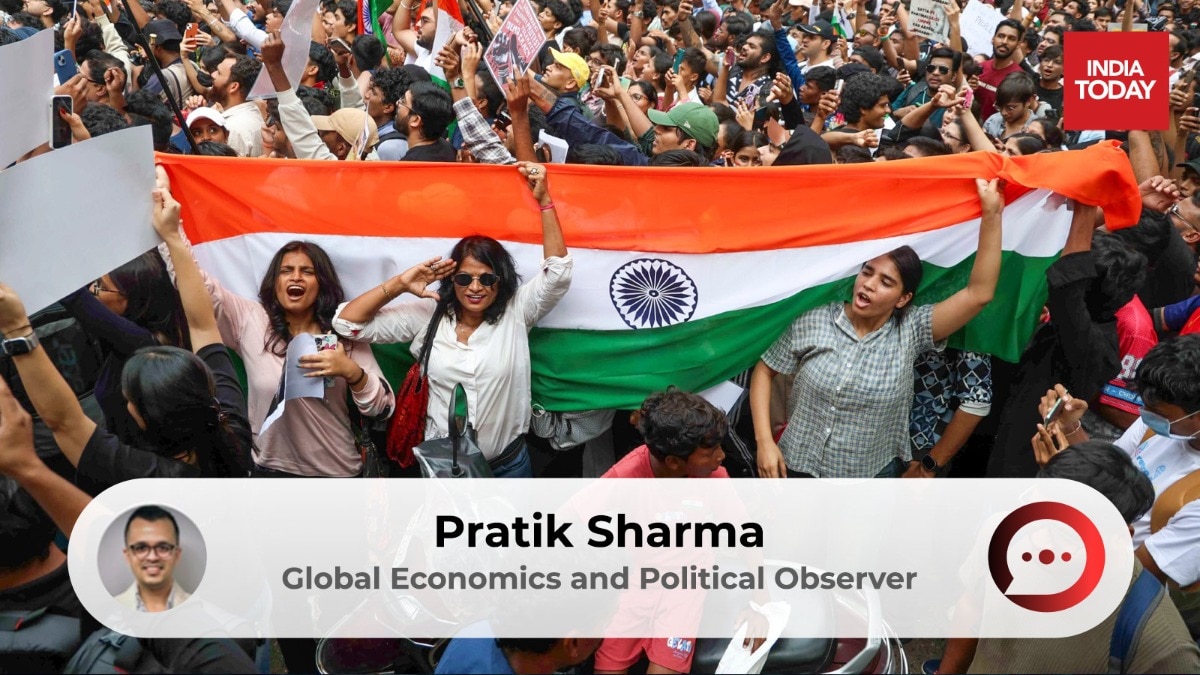
Over the past month, India watched something it had almost forgotten was possible: a largely leaderless, entirely online-native youth movement force a sitting Cabinet minister to resign under a government that has, for twelve years, treated dissent as a rounding error.The Cockroach Janta Party (CJP) went from a five-day-old Instagram page to 26+ million followers -- more than the ruling BJP's own handle -- within weeks of launch. It ballooned into street protests across Delhi, Lucknow, Mumbai, Kolkata, Bengaluru, Patna and Aizawl, dragged ministers into rounds of negotiations, survived a tear-gas-and-baton crackdown that injured over 150+ students at Parliament Street, and still ended with education minister Dharmendra Pradhan's resignation -- the first time in Prime Minister Narendra Modi's tenure that a high-profile minister has fallen to public pressure.That is not a footnote. That is arguably the most consequential socio-political event India has produced in over fifteen years -- not because it toppled a government, but because it reset the terms on which an entire society is allowed to argue with its elders and its rulers.RIPS THROUGH FOSSILISED VIRTUE-SIGNALING UNCLE MAFIAThe Economist called India a "republic of uncles" and the label resonates for a reason. The Uncle Mafia isn't one man -- it's a layered ecosystem. It's the WhatsApp uncle forwarding right-wing propaganda before breakfast. It's the university administrator who, after the Uttar Pradesh Governor's stray comment during a convocation visit, banned non-vegetarian food in all 18 hostel messes of Lucknow's King George's Medical University -- including student-run cooperative kitchens, no explanation needed beyond deference. And it's the Chief Justice of India, Surya Kant, who was recorded calling unemployed young critics "parasites of society" and comparing them to "cockroaches" in open court. His clarification came only after the internet had already run away with the insult and further added salt to the injury as he claimed “I only called the non-graduates as cockroaches, otherwise the youth respects me a lot”. This is the backdrop against which India's youth live: 40 per cent of graduates aged 15-25 are unemployed, graduate joblessness has been stuck between 35 and 40 per cent since 1983, and only 7 per cent of graduates land a permanent salaried job within a year of finishing college. Add paper leaks that wiped out a national medical entrance exam for 2.2 million aspirants, more than 20 suicides linked to exam failures, and hours lost daily to traffic and tuition, and you have a generation running on empty while being lectured about gratitude.What they built in response wasn't a manifesto or a violent takeover -- it was a meme with teeth. Protesters wore cardboard cockroach masks, scrawled resignation demands on diapers, staged satirical street theatre, and turned videos of police lathi-charges into darkly funny "subway surfer" escape reels that racked up organic views by the day. Even the Delhi Police, mid-crackdown, found themselves the subject of banter rather than blind fear -- protesters cracked jokes with the same constables tear-gassing them, refusing to let the state's brutality curdle into either despair or violence. The Uncles learned, in real time, that the republic isn't sustained by forwarded wisdom -- it's renewed by the "phone and reel-struck" kids they'd written off. Proof of the lesson landing: Modi himself abandoned his usual multi-camera, mitron-laden addresses for a three-minute, midnight, vertical selfie video, dropping his old "mitron" for "friends" -- and then had to release a second video accounting for the Gen Z coaching him on his camera angle and distance.REFUSING THE WITH-MODI-OR-AGAINST-MODI TRAPThe state's playbook for dissent has worked for over a decade: paint protesters as foreign-funded, separatist, or politically hijacked, then let the base's nationalist-religious cocktail do the delegitimising. It happened to the farmers who camped at Delhi's borders for over a year against the 2020 farm laws -- officials and BJP leaders branded them "Khalistanis," "anti-national," even "Maoist," and the government only capitulated after the protest's geographic footprint had been successfully contained to Punjab, Haryana and western UP, limiting the electoral fallout to a handful of states ahead of the 2022 polls.This time, the government reached for the same script -- dismissing the CJP as politically "manufactured" and warning that such groups could "hollow out the country" -- but the Gen Z cohort simply refused to bite. They stayed relentlessly on-message: paper leaks, minister's resignation, compensation for suicide victims, withdrawal of FIRs -- nothing about toppling Modi, nothing about left versus right. That discipline is what let a movement expand faster than any counter-narrative machine could chase it; the CJP's Instagram following outpaced the BJP's own within days, and the movement never needed to lean on the opposition Congress or the INDIA bloc for oxygen, resources, or legitimacy.Opposition leaders watched from the sidelines, cautious not to be seen "learning from" or co-opting a youth energy that was visibly more creative, more online-fluent, and frankly funnier than anything their own war rooms could produce. That is a movement that stayed about the issue -- and, in doing so, modeled something India hasn't seen in a decade: citizens across the ideological aisle starting to agree that a rigged entrance exam is a rigged entrance exam, full stop.WHAT LASTS BEYOND THE RESIGNATIONThere are footnotes worth savoring: most protesters pointedly avoided leaning on "Dhurandhar," the pro-state cinematic universe film, as protest iconography, choosing entirely original memes instead. Rural, tribal and urban youth mixed at protest sites with an easy "bro-code" camaraderie rarely seen across India's usual caste, class and regional fault lines. Volunteers organised logistics with the precision of a startup -- protein bars, cardio breaks, power banks, and AI tools cranking out placards on demand.In the aftermath, Modi has fired Pradhan and appointed Infosys co-founder Nandan Nilekani to head a six-member task force -- including a former Isro chief and a former Intelligence Bureau director -- to rebuild India's exam architecture.Whether that fixes anything is genuinely uncertain. What's not uncertain is that the satirical, evidence-driven, hyper-local lens Gen Z built to evaluate power will outlast this news cycle -- and it is now the innovator's dilemma sitting squarely in the ruling party's lap.Modi's BJP already came within a whisker of losing its majority in 2024, falling to 240 seats from 303 and needing coalition partners to govern for the first time in a decade. If the base-first, delivery-optional playbook continues while youth misery goes unaddressed, the next electoral reckoning could be sharper than that near-miss.For the opposition, the lesson cuts the other way: this generation (600 million youth voters under 30 by 2029) doesn't need saviors from any political aisle -- it will only reward those who bring something better than just showing up.- Ends(Views expressed in this opinion piece are those of the author)Published By: Devika BhattacharyaPublished On: Jul 28, 2026 13:39 IST
India's own chutnified Arab Spring 'Lite'
Full Article
Original Source
Read the full article at Indiatoday →KhanList aggregates and links to publicly available news content. We do not host full articles from third-party sources. Always verify important information with original sources.