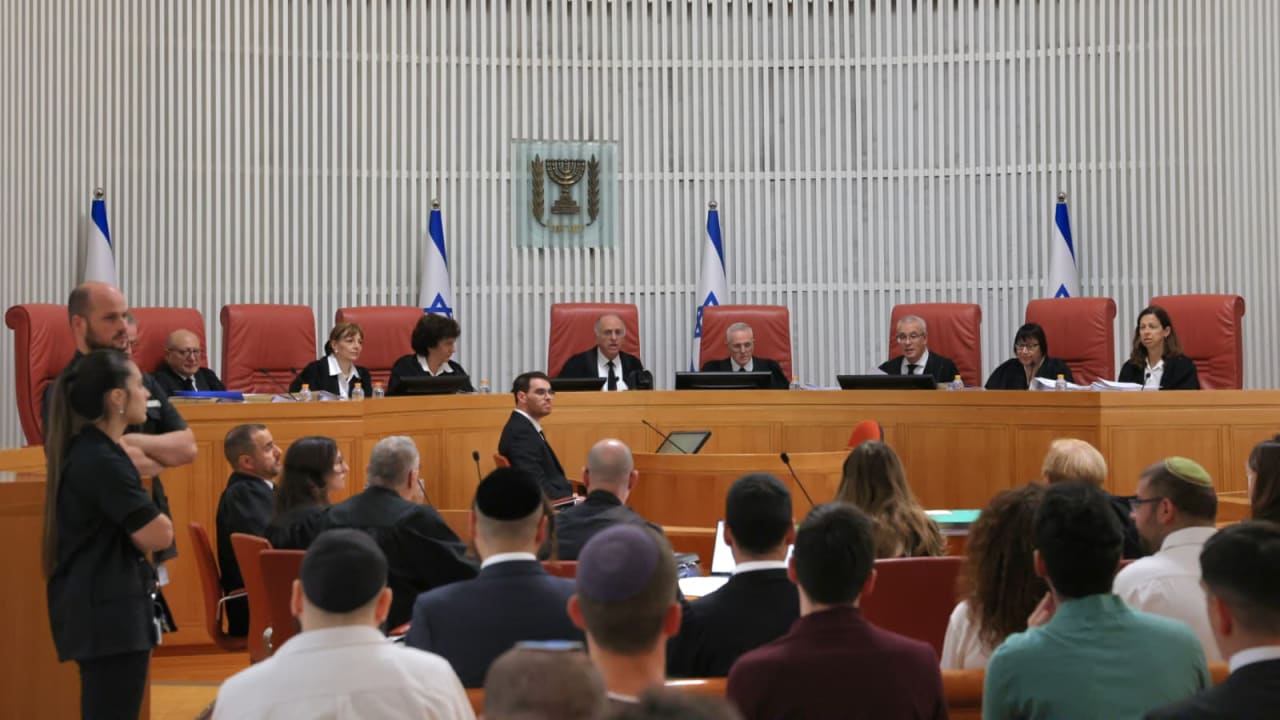
BySARAH BEN-NUNJULY 28, 2026 10:19Updated: JULY 28, 2026 11:43The High Court of Justice began hearing Tuesday morning arguments on a law whose legality is almost certainly decided.The law freezing draft enforcement measures for ultra-Orthodox (haredi) eligible men passed on July 14 but was frozen the following day by Justice Ofer Grosskopf following the filing of five different petitions against the law, including by opposition faction heads Yair Lapid (Yesh Atid) and Avigdor Liberman (Israel Beytenu).Grosskopf, in his short decision, focused on two aspects surrounding the law: the court's longstanding rulings on enlistment for yeshiva students; and the unequal weight the law grants to “only certain sections of the population.”Attorney-General Gali Baharav-Miara on Friday asked the court to strike down the law, arguing that it retains the duty to enlist while removing the consequences for refusal.She called it a "group immunity mechanism” that protects only one sector from arrest, investigation and prosecution - while leaving other draft evaders exposed to the full force of the law.A binder sits opposite lawyers at the High Court panel. (credit: MARC ISRAEL SELLEM/THE JERUSALEM POST)Knesset position focuses on defects in implementationThe Knesset's position, filed on Sunday by its legal advisers, focused more on defects in how the law was enacted rather than the broader and more fundamental constitutional argument hinted at by Grosskopf and affirmed by Baharav-Miara. Representing the Knesset in court on Tuesday, attorney Yitzhak Bart clarified to the court more what the legal advisory's position is. He explained that committees debating a bill have broad authority to make changes to it - as long as its actions don't result in a “new subject.”This boundary, he said, exists for two reasons: first, to avoid needing to start the process from the beginning; second, to give the committee the authority and breadth of power to make the changes it might need to improve the legislation.Fundamental subject of bill cannot be changedHowever, the fundamental subject of the bill cannot be changed. Bart said, “There is no escaping the conclusion that the new law introduced a new subject.”The subject difference, he explained, is between integration of yeshiva students and the freezing of enforcement measures.That difference, he noted, is minor but crucial: If the committee had continued to discuss the bill in its original format, but had added a clause on enforcement measures, “that might have been okay” - but that is not the case here. He described it as creating a new branch that is unconnected to the root of a tree.The scenario where the Knesset legal advisory reaches the conclusion that legislative defects lead to the conclusion that a law must be canceled is “extremely rare,” said Bart.Representing the Attorney-General's Office, attorney Aner Hellman added, “there is merit in strengthening the legal advisory so that MKs understand the implications and weight of going against advisory opinions - especially when it comes to legislative technicalities, as these are what make laws laws.”He added that “the red flags were raised all along” the legislative process by the Knesset legal advisory.He added, “There are certain procedural lines that cannot be crossed - particularly ones that outline how a bill becomes law.”On Monday, the government filed its own, two-page position to the court, explaining that it declined to hire a private attorney to defend the law because the outcome of the case was “known in advance.”Rather than provide a legal response to the petitions, the government’s two-page position focused largely on accusing the court of violating the separation of powers and the Attorney-General’s Office of obstructing efforts to increase haredi enlistment.Uri Keidar, the CEO of Israel Hofsheet, one of the petitioners, said, “the attempt by the government to torpedo equality before the law and grant immunity to haredi draft-evaders will not succeed... The time for equality has come.”Follow us on Google
High Court begins hearing arguments on law freezing draft enforcement for haredi men
Full Article
Original Source
Read the full article at Jpost →KhanList aggregates and links to publicly available news content. We do not host full articles from third-party sources. Always verify important information with original sources.