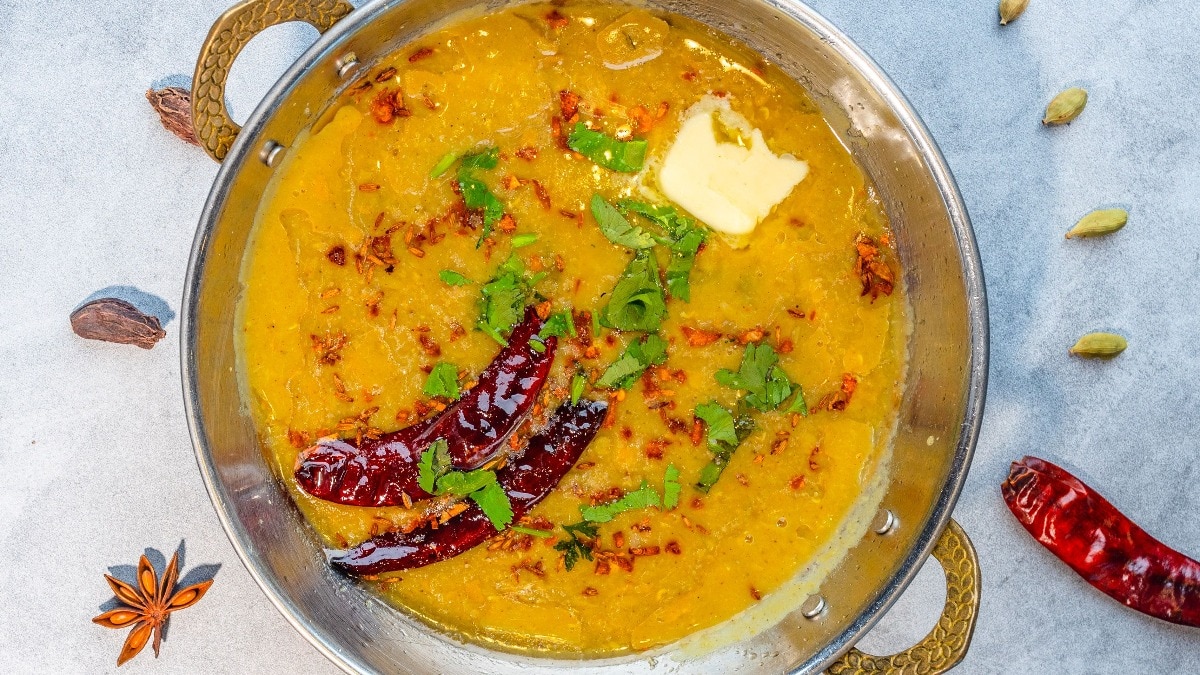
Indian scientists at ICAR have decoded the complete, gap-free genome of arhar dal, also called tur dal or pigeonpea, for the first time. Here is what the T2T reference genome means for cheaper pulses, climate-resilient crops and India's push for self-reliance in dal.On a plate in almost any Indian home sits a small yellow mound that rarely earns a second thought. It is pigeonpea, commonly known as arhar or tur dal. It hands more vegetarians their daily protein than almost any other crop in the country.In fact, it is the sixth most important grain legume on Earth, and one of the few crops that feeds the soil as generously as it feeds people, pulling up to 235 kilograms of nitrogen per hectare out of the air and locking it into the ground through tiny root nodules.And for the first time, scientists have read its complete genome, or the genetic instruction book, cover to cover, without a single missing page.On April 20, 2026, the Indian Council of Agricultural Research (ICAR) quietly uploaded a file to a global scientific database. It was the finished genome of a pigeonpea variety named Asha. This is neither a rough draft, as in 2011, nor an improved sketch, as in 2017. This time, it is the whole thing."Now we have completed a chromosome level assembly of 750 Mb, 99 per cent complete, using PacBio single molecule sequencing, organised at chromosome level, telomere to telomere," Professor Nagendra K. Singh, who led the effort at ICAR-NIPB, told India Today Digital. "Now our T2T genome assembly is recognised as the global reference by NCBI." To see why a data file counts as a national milestone, it helps to know what a genome is, and what was missing until now.WHAT IS THE ARHAR DAL GENOME, AND WHAT DID ICAR ACTUALLY DO?Every living thing carries a set of instructions written in DNA, the chemical that tells a cell how to build and run an organism. Those instructions are spelt out in just four letters, A, T, G and C, arranged in a precise order.The full set of these letters is a genome. In pigeonpea, it runs to 752.65 million letters, packed into 11 chromosomes, the tightly wound bundles in which DNA is stored.Think of the genome as a recipe book for building an entire plant. A reference genome is the master copy of that book, the version every other scientist compares their samples against.India first tried to read this book in 2011, when ICAR's National Institute for Plant Biotechnology (NIPB) in New Delhi produced the first pigeonpea draft, and the first crop genome sequenced entirely in India. But like most early attempts, it was full of holes. Some chapters were torn. Others were missing altogether. Pigeonpea seed variation in cream, brown, red and black colours shown in 10 petri dishes. (Photo: ICAR) "The first draft of the pigeonpea variety Asha was published by us 15 years ago," Professor Singh said. "With 511 Mb of sequence data, it had only about 60 per cent genome coverage of the pigeonpea genome, and was not organised into a chromosome level assembly."The pigeonpea genome had long been estimated at more than 800 million letters, yet those first drafts captured only about two-thirds to three-quarters of it. A truly complete, full-coverage reference was awaited for over a decade, and that is the gap ICAR-NIPB has now closed.WHAT DOES TELOMERE TO TELOMERE MEAN IN SIMPLE WORDS?The new genome is described as telomere to telomere, or T2T. The phrase sounds forbidding. It is not.Picture a shoelace. The little plastic tips at each end that stop it from fraying are called aglets. A chromosome has its own version of these tips, called telomeres, protective caps that sit at both ends.In the middle of each chromosome is a pinched waist, the centromere, which holds the structure together when a cell divides.For years, these two regions defeated scientists. They are built from the same short run of DNA letters repeated thousands of times, like a page that prints one line over and over. Older sequencing machines could not tell one repeat from the next, so they simply left blanks. Illustration of a chromosome with glowing telomere end caps. (Photo: Standford University) A telomere to telomere genome means every one of those blanks has been filled. The book has been read from the first tip to the last, straight through the difficult middle, with no gaps.To stitch the pieces into their correct order along each chromosome, the team leaned on a genetic map of 1,500 landmarks that they built using their own 62,000-marker pigeonpea DNA chip.ICAR's assembly captures all 11 centromeres and all 22 telomeres, which is what completeness truly means.The finished map, named NIPB_CcT2T_4, also labels 36,557 genes. A gene is a stretch of DNA carrying the instructions for one job, such as making a protein or resisting a disease. Labelling them is called annotation, and it turns a wall of letters into a usable index."Because of complete coverage, now we have all the disease resistance and transcription factor genes identified," Professor Singh said, referring to the master-switch genes that turn other genes on and off.WHY IS THE COMPLETE PIGEONPEA GENOME SO SIGNIFICANT?A complete genome is not a better dal by itself. It is a better map. And a better map changes how fast breeders can travel.For decades, building a new crop variety meant crossing plants and waiting, season after season, to see what emerged. With a full genome, scientists can locate the exact gene tied to a useful trait, be it drought tolerance, higher protein, or resistance to the wilt disease that rots pigeonpea roots, and select it directly.This is molecular breeding, using DNA signposts to pick winning plants without the long guesswork. A dwarf pigeonpea plot labelled Pusa Jawahar Arhar 2022-1 at a research farm (left) and the polished yellow split arhar dal it yields (right). Compact varieties like this are bred for machine harvesting and quicker maturity. (Photo: ICAR) The payoff is already visible on the map. In a recent review in the Journal of Experimental Botany, the ICAR-NIPB team, led by Professor NK Singh, lined up 68 stretches of DNA tied to 20 different traits against the new complete genome, from plant height and flowering time to seeds per pod and seed protein.Ten of them are dependable enough to use in breeding right now. One gene, with the tongue-twisting name CcTFL1, decides whether a plant keeps growing tall and leafy or stops and sets its pods together.Nudge it, and you get a shorter plant that ripens all at once, which is exactly what a machine harvester needs.HOW WILL THIS BENEFIT CONSUMERS AND FARMERS?The new breakthrough also opens the door to genome editing, the technology that makes tiny, precise changes to a plant's own DNA without adding anything foreign. The most complete map possible makes those edits safer and more accurate."Complete genome information is a prerequisite for genome editing in any species, so it will help in pigeonpea all the same," Professor Singh said.Asked which traits he would target first, he listed "dwarfness, closed flower purity, waterlogging tolerance, SMD disease, pod borer resistance and Fusarium wilt", the crop's most stubborn enemies.Sterility mosaic disease, or SMD, is a viral disease so damaging it is nicknamed the green plague of pigeonpea. Bowl of arhar dal or tur dal tempered with cumin, dried red chilli and butter in a kadhai or pan. (Photo: Pexels) India has already eased its rules here, exempting gene-edited crops that carry no foreign DNA from the stricter approvals that apply to genetically modified plants, and ICAR has launched a national gene-editing project that includes pigeonpea.A separate pest-resistant pigeonpea, engineered to fight off the pod borer caterpillar, is meanwhile waiting in the queue for regulatory clearance.The gaps in older drafts were never empty of meaning. Repetitive, hard-to-read regions often sit right beside genes that control important traits. Reading them properly means breeders are no longer working around blind spots."The genome annotation has revealed a large number of disease resistance and transcription factor genes in pigeonpea, which contribute to its resilience," Professor Singh said. "However, the actual genes have to be discovered and validated."CAN SCIENTISTS NOW DESIGN A PERFECT DAL PLANT?In a sense, that is the plan. Breeders talk about an ideotype, an ideal plant sketched out on paper before it exists in a field.For pigeonpea, the wish list is very specific: a knee-high plant of about 100 centimetres rather than a sprawling bush, a shorter time to harvest, six to eight plump seeds per pod, a soft thin husk that mills easily, a cooking time of five to seven minutes, and a protein content of nearly 30 per cent.Some of it is already arriving. India released its first compact, uniformly maturing arhar, Pusa Arhar 16, in 2018, and its first genuinely dwarf variety, Pusa Jawahar Dwarf 22-1, in 2024."In all, said Professor Singh, IARI has now released six dwarf varieties suitable for machine harvesting. These have a higher harvest index and yield about 2 tonnes in four months, which is more than twice the long term average yield of below one tonne per hectare." Two women stand amid a flowering pigeonpea field, the crop's small yellow blooms stretching to the horizon. India grows more pigeonpea than any country on Earth, much of it on rain-fed smallholdings. (Photo: ICRISAT) The complete genome is meant to make this kind of tailoring faster and surer, turning a slow guessing game into something closer to design.The other reason it matters is variety itself. Almost all the pigeonpea grown today has descended from a small handful of ancestors, which is why old favourites like Asha and Maruti have lingered in fields for decades. Of the 32 wild Cajanus species, only one is farmed.The rest, the crop's wild cousins, are a deep reservoir of genes for surviving drought, salty soil and pests, and a complete reference is the tool that helps breeders find and borrow them.To start mining that diversity, Professor Singh's team has "sequenced 46 diverse pigeonpea varieties and aligned them to the Asha genome", and a mini-core collection of 146 varieties has been re-sequenced and placed in the public domain.Fittingly, the pigeonpea was first domesticated in the eastern peninsular region of India around 4,500 to 5,000 years ago, so the hunt for its future is partly a return to its Indian roots.WILL THIS MAKE YOUR DAL CHEAPER AND MORE NUTRITIOUS?Eventually, that is the hope. India grows more pulses than any country on Earth, yet still imports large quantities of tur dal to meet demand. Pigeonpea yields have barely risen in decades, partly because the crop is often grown on poor, dry land, and partly because its useful genetic variety is narrow.The reason, Professor Singh explained, is a tale of two very different crops. "Rice and wheat yields increased due to increased harvest index, because of the introduction of non-lodging and input responsive plant type," he said. Pigeonpea never went through that revolution, staying tall, slow and sprawling while the cereals were remade.The review is blunt about the scale of the problem: India is by far the largest producer and consumer of pigeonpea, with roughly 4 million tonnes grown a year, yet productivity has stayed low and almost flat for six decades, with output creeping up only because more land was put under the crop. Bowl of pigeonpea or arhar dal served with steamed rice and green chilli, an everyday Indian meal. (Photo: Pexels) The government's Mission for Aatmanirbharta in Pulses, running from 2025-26 to 2030-31, aims to lift pulse production to about 35 million tonnes by 2030-31 and shrink the import bill. A complete genome is the scientific engine meant to help power that goal."Our completed genome and the 62K SNP chip will speed up pigeonpea breeding," Professor Singh said.The honest caveat is time. A reference genome is a starting line, not a finish. The road from a decoded genome to a hardier, cheaper dal in your kitchen usually runs several years of breeding and field trials.The same review says as much without flinching. Despite years of gene mapping, not one pigeonpea variety in India has yet been bred using these DNA markers, held back by the crop's complex genetics, a shortage of tested markers, its long growing season and modest research funding.But the blank pages that held Indian pulse science back for over a decade are, at last, filled in. For a crop that feeds millions their daily protein, reading its full story is where every future improvement now begins.- EndsPublished By: Radifah KabirPublished On: Aug 6, 2026 16:12 IST
India has read the arhar dal genome from end to end. Here is why it matters
Full Article
Original Source
Read the full article at Indiatoday →KhanList aggregates and links to publicly available news content. We do not host full articles from third-party sources. Always verify important information with original sources.