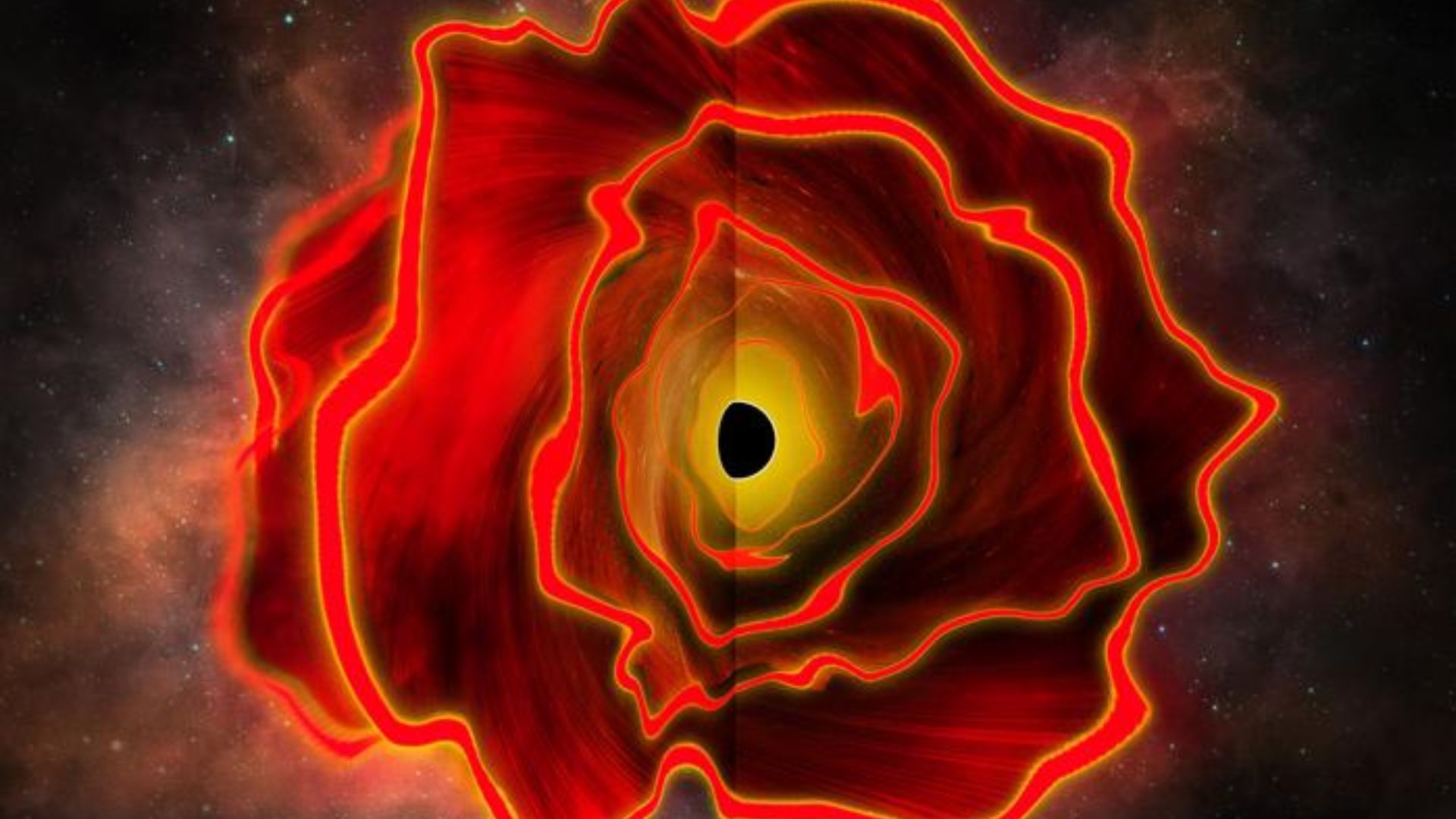
Astronomers using NASA’s James Webb Space Telescope (JWST) have identified what appears to be a previously unseen kind of astrophysical object: a “black hole star,” an enormous, glowing cloud of gas surrounding a rapidly growing black hole. The object, named MoM-BH*-1, lies in the constellation Cetus and is seen as it existed roughly 660 million years after the Big Bang. Researchers say it combines characteristics normally associated with two very different objects. The star-like appearance of a dense stellar atmosphere and the enormous energy output of an accreting black hole. The discovery could also explain one of JWST’s most intriguing early-universe mysteries. The population of faint, compact objects known as “little red dots.” MoM-BH*-1 does not appear to be a conventional star containing a black hole. Instead, researchers think it may be a young black hole buried inside an extraordinarily dense envelope of hydrogen gas. The central black hole is estimated to have a mass of roughly 100,000 times that of the Sun, while the surrounding gas envelope could extend to approximately the scale of our entire Solar System. That envelope is crucial to the object’s strange appearance. Ordinarily, an actively feeding black hole produces enormous amounts of energy through material falling into an accretion disk. But in this case, the dense gas surrounding the black hole appears to absorb and reprocess much of that radiation, effectively creating a pseudo-photosphere. A surface that makes the object appear more like a giant star. The result is an object that looks stellar from the outside but is powered by a black hole rather than nuclear fusion. JWST spotted something that didn’t look right The researchers encountered MoM-BH*-1 while searching JWST observations for extremely distant galaxies. What initially caught their attention was an unusually bright, intensely red point of light. Its spectrum contained an exceptionally strong Balmer break, a sharp change in brightness at particular wavelengths associated with hydrogen absorbing light. Such features can occur in stellar atmospheres, but the break seen in MoM-BH*-1 was far stronger than expected from an ordinary star. The object also showed almost no evidence of elements heavier than hydrogen and helium. Computer simulations provided a possible explanation. A sufficiently dense envelope of hydrogen could reproduce the object’s unusual spectral appearance, but something still had to explain its extraordinary brightness. That is where the black hole comes in. Far too bright to be an ordinary star According to the MIT researchers, MoM-BH*-1 produces roughly 100 billion times more energy than any known star can physically generate. Nuclear fusion therefore cannot readily explain its luminosity. An actively accreting black hole, however, can produce enormous amounts of energy as matter falls toward it. When the researchers incorporated a black hole into their models, a roughly 100,000-solar-mass black hole surrounded by a dense hydrogen envelope provided the best match to the JWST observations. The researchers therefore describe the object as a black hole star. However, the interpretation remains a model based on the observed properties rather than a photograph showing a black hole inside a star. Could this explain the “little red dots”? The discovery could be particularly important because JWST has repeatedly found mysterious compact red sources in the early universe. These little red dots (LRDs) appear abundantly in observations from the first few billion years of cosmic history, but their nature has been debated. Recent research has increasingly explored black-hole-star models for at least some LRDs. A June 2026 study identified 241 candidate black-hole-star-dominated sources across JWST observations, suggesting that the phenomenon may not be restricted to a single object. MoM-BH*-1 is unusual because its black-hole-star component appears to overwhelm its surrounding galaxy, giving astronomers an unusually clean view of the phenomenon. If similar objects prove common, they could also help explain how supermassive black holes became so large so quickly in the young universe. Rather than appearing suddenly as enormous black holes, some may have passed through an early, gas-enshrouded phase like this. The study was published in the journal Nature. Get the latest in engineering, tech, space & science - delivered daily to your inbox.Kaif Shaikh is a journalist and writer passionate about turning complex information into clear, impactful stories. His writing covers technology, sustainability, geopolitics, and occasionally fiction. A graduate in Journalism and Mass Communication, his work has appeared in the Times of India and beyond. After a near-fatal experience, Kaif began seeing both stories and silences differently. Outside work, he juggles far too many projects and passions, but always makes time to read, reflect, and hold onto the thread of wonder.
First known black hole star fueled by something stranger than reality discovered
Full Article
Original Source
Read the full article at Interestingengineering →KhanList aggregates and links to publicly available news content. We do not host full articles from third-party sources. Always verify important information with original sources.