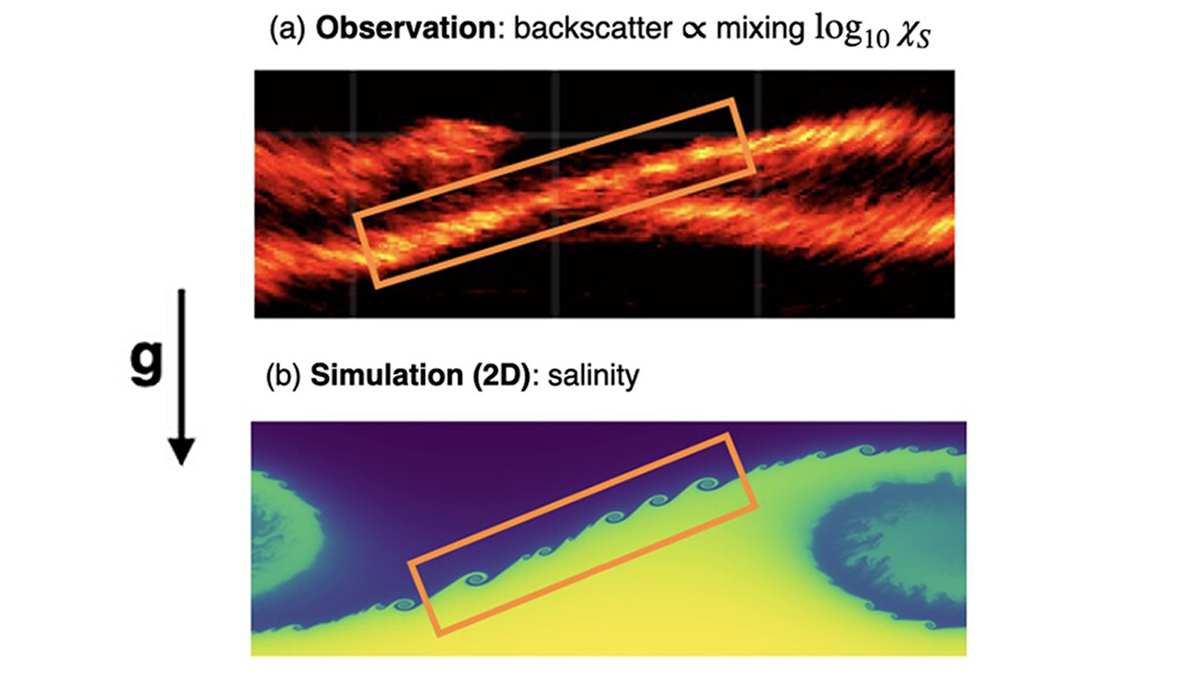
Structure of turbulent “braids” connecting the cores of a Kelvin-Helmholtz instability from (top) multibeam echosounding data near the mouth of the Connecticut River and (bottom) high-resolution numerical simulations. The horizontal scale of the images is a few meters. Credit: Lefauve et al. [2026], modified from Figure 16 (a, b) Editors’ Highlights are summaries of recent papers by AGU’s journal editors. Source: Journal of Geophysical Research: Oceans One of the most important hydrodynamic instabilities that triggers turbulence and mixing in marine systems is a specific type of shear instability known as the Kelvin-Helmholtz (KH) instability. When we think of KH instabilities, most of us—inspired by numerous experiments and numerical simulations conducted at low Reynolds number—envision the rapid formation of the characteristic overturning billows that become gravitationally unstable and finally collapse into turbulence. Based on innovative acoustic field data from a shallow estuarine system, laboratory experiments, and high-resolution idealized simulations, Lefauve et al. [2026] show that in real geophysical flows at high Reynolds number, the route to turbulence may be quite different. The central result is that the dominant mixing pathway is not the overturning and collapse of primary KH billow cores but that the strongest mixing occurs in thin “braids” that connect adjacent billows, where intense, strongly localized shear generates secondary instabilities and turbulence. While this result is not entirely new, although it may not be widely known in the oceanographic research community, this study is innovative in several important aspects. For the first time, multibeam echosounding field data were used to obtain an undistorted view of the geometry of KH instabilities and thus accurately estimate the slopes of the energetic “braids.” Based on this, the authors introduce a predictive scaling framework in which dissipation and scalar mixing can be determined using only local braid slope, shear, and layer thickness. Another novel contribution is the identification of a complete braid-centered lifecycle—thin braids sharpen to centimeter scales, develop secondary KH-like structures on the braid itself, transition to about 0.1 m turbulence, and finally decay into disorganized, turbulent filaments. Overall, the authors suggest that oceanic stratified mixing hotspots may be controlled primarily by continuously forced, filamentary braid turbulence generated by secondary instabilities, requiring a rethinking of both observations and parameterizations that are currently centered on primary KH overturning. Citation: Lefauve, A., Bassett, C., Plotnick, D. S., Lavery, A. C., & Geyer, W. R. (2026). The structure and lifecycle of stratified mixing by shear instabilities in continuously forced flows. Journal of Geophysical Research: Oceans, 131, e2025JC023905. https://doi.org/10.1029/2025JC023905 —Lars Umlauf, Editor, JGR: Oceans Text © 2026. The authors. CC BY-NC-ND 3.0Except where otherwise noted, images are subject to copyright. Any reuse without express permission from the copyright owner is prohibited.
How Fluid Mixing due to Kelvin-Helmholtz Instabilities Really Works
Full Article
Original Source
Read the full article at Eos →KhanList aggregates and links to publicly available news content. We do not host full articles from third-party sources. Always verify important information with original sources.