
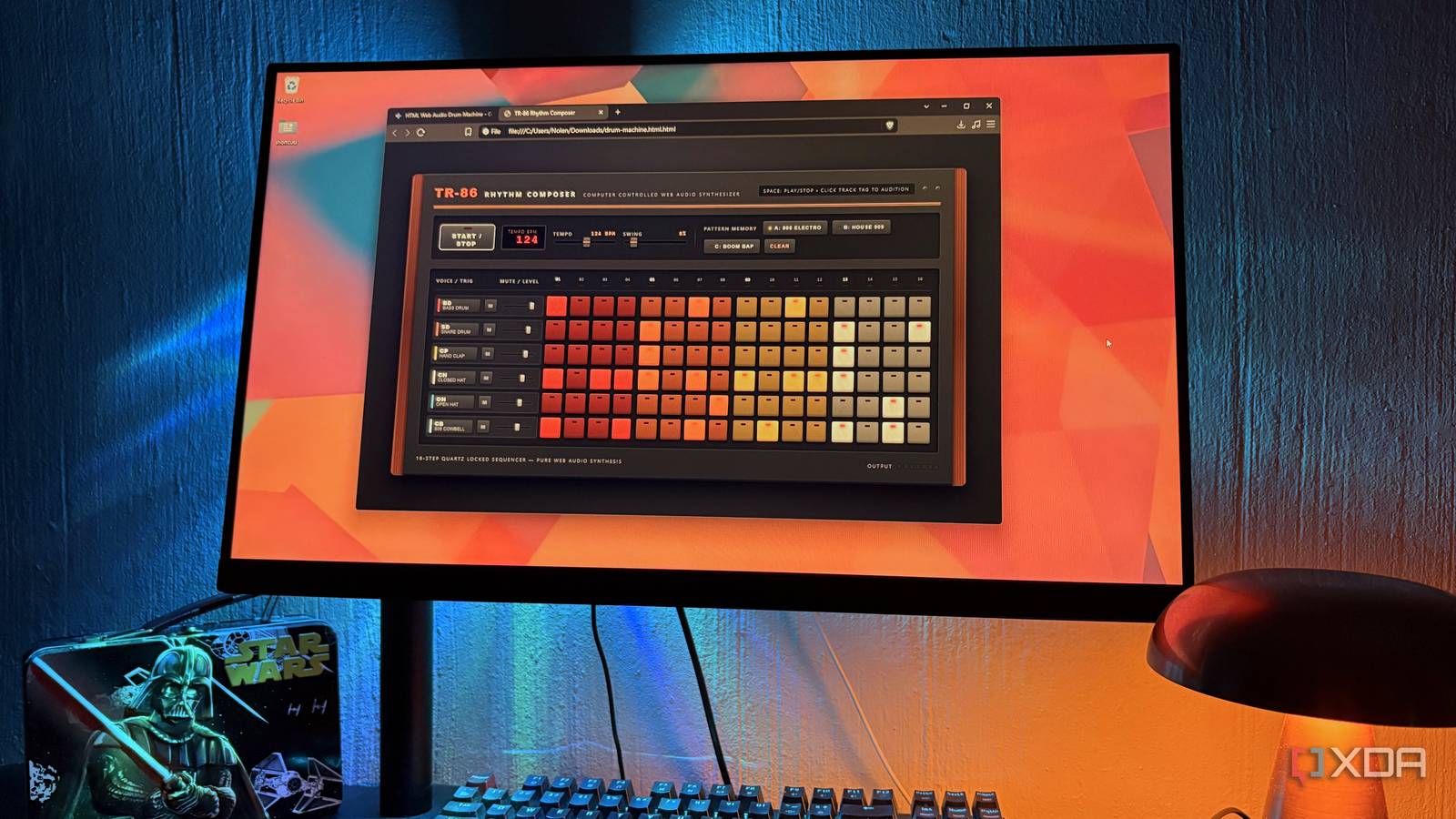
Published Nov 11, 2026, 12:30 PM EST Nolen began their writing career in 2019, with three years dedicated to editing the Creative section at MakeUseOf. Their expertise lies at the crossroads of technology and creativity, covering areas like photography, video editing, and graphic design. Outside of work, you'll often find Nolen diving into a good book, writing their own stories, or playing video games. Every new flagship model launches with a chart full of coding benchmarks, and most of them test things like fixing bugs in existing code or working through tasks in a terminal. But those numbers aren't always relevant because many people use these models for something else entirely, like getting a project started from a prompt instead of giving it a whole codebase. I fall into the latter category and like to build little utilities that I've always wanted to see come to life, and finally can without writing code. One thing I've always wanted to make one of my own was a little drum machine. This was by far my favorite plugin to play with in Pro Tools during my sound engineering diploma. And I also realized it's the perfect project to test a model on because there isn't only the visual and interactive element, but the audio has to stay locked in too. This is quite interesting because Gemini, Fable, and GPT-Astra can't actually hear the audio; they just write the code (Web Audio API) that instructs my browser to synthesize and play the sound locally. My brief asked for something that looks like hardware with six drum sounds on a 16-step grid and the usual tempo and swing controls. The sound mattered too, obviously, and every hit had to be synthesized from scratch. For reference, I used all the models on High effort. Gemini 4 Argon leans hard into the hardware fantasy It knew exactly which classic machine I was picturing Argon showed up with a bit of a cloud over it. Google announced it on September 30 with strong benchmark scores, but Bloomberg then reported that some Google employees with access felt it struggled with certain coding tasks, front-end design included, and two of them thought it looked tuned to ace tests more than real work. Google denies that it underperforms at coding. Front-end design is most of what this test is, though, so this was a case of "guess we'll see". It ended up with the most personality of the three. It named itself the TR-86 Rhythm Composer, borrowing Roland's naming almost exactly, and wrapped the panel in wood sides like an old Roland unit with the tempo glowing on a red LED readout. The steps are tinted in blocks of four so it gives you that visual of exactly where each beat starts without you having to count. Even the presets are named after genres like 909 house and boom bap, which tells me it understands the culture around these machines. It gave me sliders instead of knobs, which is a little less authentic, but they're definitely way more user-friendly. If you've ever tried to navigate a knob-like control on a screen, you know how frustrating those can get and they don't replicate the real-life feel at all. It also had some layout bugs when I resized the screen, so those will have to be fixed in the code. The sound was surprisingly stable, but perhaps a little thin. The kick doesn't carry much low end, and up top the hats get bright and a little fizzy, so it sounds more like a rough imitation of a classic drum machine than a kit I'd actually use as a backing beat for an edit. Fable 5.1 treated it like an engineering job It really did approach this like a sound engineer Fable 5.1 is Anthropic's top public model, released on September 1, and it sits in a tier Anthropic calls Mythos-class (it shares weights with Claude Mythos 5.1, which is invite-only). And it's still paid for with extra usage credits, so it doesn't come as part of my Claude Pro plan. Reviews seem to point to lots of steps and tool use as the areas where it shines, which is pretty much how it approached my drum machine. In the precise Claude fashion we expect by now, it made itself a short task list, wrote the file straight into a folder on my PC, and then opened it in its own browser pane to check for console errors - these are the little warnings a page will give you when its code misbehaves. It took five minutes just for the planning phase alone, which was the slowest of the bunch by a long shot, but this means it's more thorough. It also went past the brief, with eight tracks instead of six after adding a low tom and a rimshot. The closed hat cuts off the open hat's tail the way it does on a real 909. That's called a choke, and I don't think an AI would bother adding it without understanding how these machines actually get played, so it clearly understood the concept and put some thought into it. The controls were proper authentic knobs, and although they look good, I'm deducting points because, like I've said before, they are so difficult to maneuver. And then it also had the classic green LCD tracking the pattern at the playhead. Timing runs on a separate background clock too, since browsers tend to slow down tabs you aren't looking at, so the beat stays steady while I'm working in another app. It was upfront that it couldn't actually hear what it made and had tuned the sounds by their settings alone, which I appreciate. And I think you can kind of hear that. The kit is clean and tight, but a little clinical with sharp hits and not much body behind them. GPT-6 Astra kept the design simple It was the one I kept going back to with headphones on Astra is OpenAI's current flagship, released September 3, and OpenAI's president said with it that the company had entered the era of artificial general intelligence. On the API it costs 2.5 times what the previous flagship did. And reviewers seem to be split: some praise it for video games and visual work, while others find its writing weaker. I ran it in ChatGPT Work mode to do this project. It reported working for about a minute, then handed back a single code block with a built-in preview button - I do like this about ChatGPT because it gives you something you can instantly interact with. The design is the most restrained of the three, with one orange accent on dark grey panels and sliders for everything. This also meant that the beats weren't color-coded, which I think is a big no for a drum machine because the whole point of them is to give you that easy visual tracking. But I will give it props for the rest of the design and layout, it had the best spacing of them all and nothing felt cluttered. It stuck to exactly six voices and nothing extra, so on paper it's the least ambitious build here. It sounded the best to me, though. The kick has a proper low-end thump that rolls off smoothly. Snares are usually where synthesized kits sound cheap, but this one actually had some body under the noise, while the hats stayed soft at the top instead of getting harsh. The whole kit sat together like a proper mix, whereas the other two felt a little flat and disjointed. Nothing clipped either even when I turned on the same beats from all the rows at once (this is going to sound bad regardless of the drum machine, but my point is that it didn't become unbearable). From what I could hear, it sounded like each hit also had a smoother fade-out, or perhaps the default levels were just more sensible, or perhaps both. The drum machine I'd actually keep open Fable built the better instrument on paper and it also looked the best visually, so I'll actually be keeping this design for future use, as long as I can fix the clunkiness of the knobs. But Astra was definitely the better-sounding one, and I think it got the most out of the Web Audio API. In fact, I'd probably marry the two of them: swapping Astra's audio engine into Fable's design. Unfortunately, Argon trailed behind quite a bit, living up to the reputation it's garnered thus far, but I will give it credit for understanding the vibe.
I made Gemini 4 Argon, Fable 5.1, and GPT-6 Astra build the same audio tool, and the best-looking one wasn't the best-sounding one
Full Article
Original Source
Read the full article at Xda-developers →KhanList aggregates and links to publicly available news content. We do not host full articles from third-party sources. Always verify important information with original sources.