
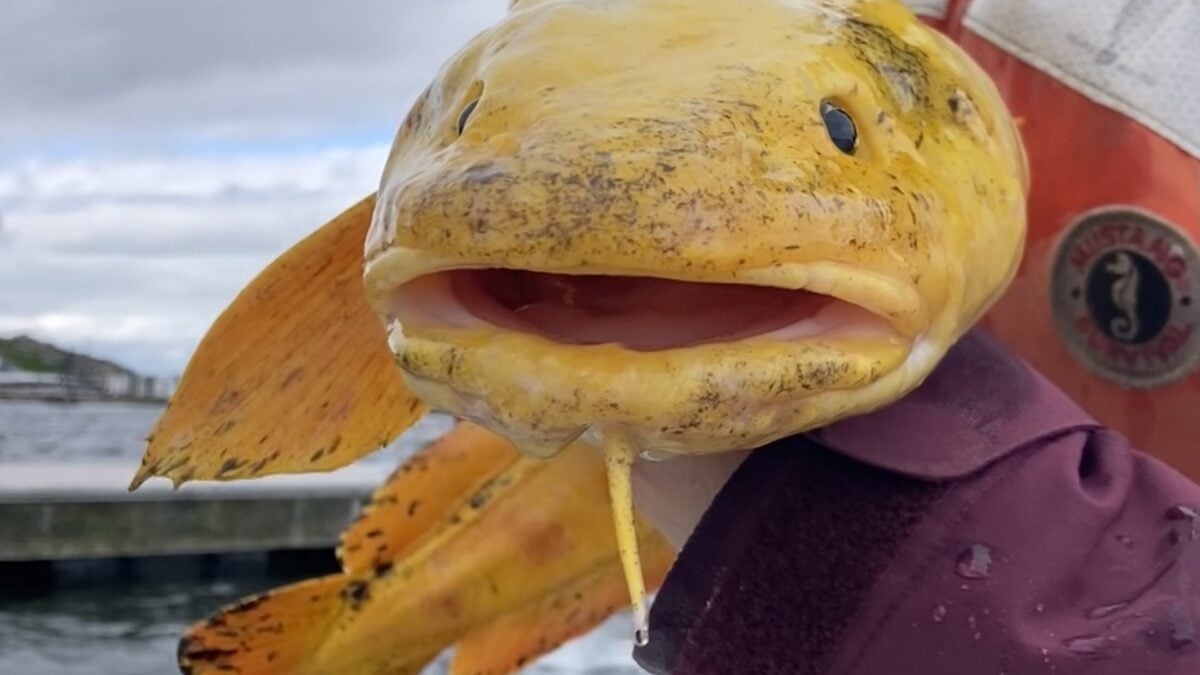
During a routine survey in New York’s Oswega Harbor, a team of biologists got a little more color than they bargained for: an unusually vivid burbot that looks like it had been dipped in orange sherbet. Biologists with the U.S. Fish and Wildlife Service (USFWS) caught the rare native fish last month while surveying the Oswego Harbor for invasive species. Its discovery highlights the effectiveness of their efforts to detect non-native species in the harbors, rivers, and embayments of the Great Lakes, according to USFWS. The burbot population in Oswego Harbor is extremely low, and the species typically inhabits deeper, cooler waters. This burbot’s color also makes it an exceptionally rare find. The fish has a rare genetic condition that suppresses its normal pigmentation, resulting in the bright orange-yellow color. A burst of sunshine Burbot (Lota lota) have elongated bodies, broad, flattened heads, and a single whisker-like barbel dangling from their lower jaw. This little appendage helps them sense their surroundings and locate food. The Lower Great Lakes Fish and Wildlife Conservation Office Aquatic Invasive Species team displays their rare find of an unusually colored burbot. © USFWS Their usual coloration is quite different from the bright yellow-orange fish caught in Oswego. They’re typically olive, brown, or dark green, with mottled markings and a pale belly. The recently caught burbot looks more like an overgrown goldfish due to xanthochromism, a rare biological condition caused by a genetic mutation that suppresses normal pigmentation and produces a yellow-orange appearance. The condition is considerably less common in wild fish than albinism or melanism, according to USFWS. Although its unusual coloring might make it look like a tropical fish that somehow found its way into a New York harbor, the burbot is actually right at home in the Great Lakes. The cold-water species is the only member of the cod family that spends its entire life in freshwater. On the lookout for invasive species Burbot populations in the Great Lakes have experienced dramatic declines over the past century, with invasive sea lampreys preying on the native species. The recent discovery of a yellow burbot is particularly exciting, and not just because of its unusual color. As part of the Service’s Aquatic Invasive Species Early Detection and Monitoring Program, biologists use a multi-gear fish-surveillance strategy to detect watchlist species in the Great Lakes. Early detection often allows for better prevention and removal measures. But because invasive species are often rare when they first enter new waters, the program uses methods such as electrofishing, fyke-netting, gill-netting, and environmental DNA (eDNA) analysis to increase the likelihood of detection. Therefore, the recent detection of a rare native species shows that the program can identify fish that are less likely to be found in those waters, including newly invading species with extremely low numbers. “So, what would catching a one-in-a-million native species suggest? An effective survey strategy, along with a bit of luck!” USFWS wrote in a statement.
Biologists Caught a Rare Golden Fish in New York—and It’s Good News for the Great Lakes
Full Article
Original Source
Read the full article at Gizmodo →KhanList aggregates and links to publicly available news content. We do not host full articles from third-party sources. Always verify important information with original sources.