
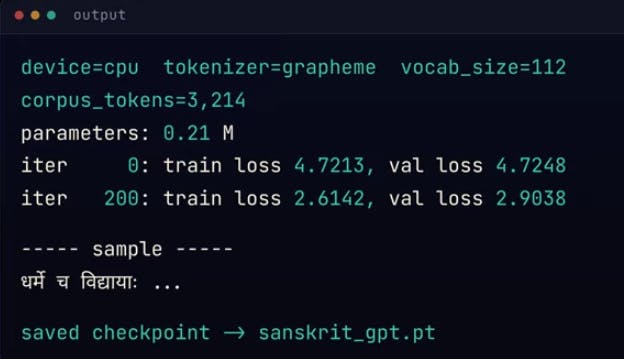
A from-scratch transformer, ~250 lines of Python, and one Unicode lesson that humbled me. GitHub repository link I’ve understood transformers “at a high level” for a while now. Attention, embeddings, the usual diagram with the arrows. But I’d never built one. And there’s a specific kind of knowledge you only get from typing out the code yourself and watching it break.So, I gave myself a weekend and a constraint: build a GPT small enough to understand completely, but on a language that would actually fight back — Sanskrit. I have a pile of Devanagari text and an NVIDIA DGX Spark sitting on my desk, so why not? The Goal: Predict the next syllable. A GPT does exactly one thing: given some text, predict what comes next. Everything else — chat, translation, reasoning — is built on top of that single reflex. So, my whole model is just: feed it some Sanskrit, ask it to guess the next unit, and correct it a few thousand times. The interesting word there is unit. In English, “predict the next character” is unambiguous. In Sanskrit, it’s a trap.The Gotcha: A “character” is a lie. The classic way to build a character-level model is one line: chars = sorted(set(text)) # the entire vocabulary This is perfect for English and a disaster for Devanagari. Here’s why. What your eye reads as one syllable is often several Unicode code points stacked together:कि = क + ि (2 code points, 1 syllable) क्ष = क + ् + ष (3 code points, 1 cluster) श्री = श + ् + र + ी (4 code points, 1 cluster) So set(text) doesn't give you Sanskrit characters. It gives you orthographic shrapnel — bare consonants, floating vowel signs, lone viramas. Your model is then forced to re-learn Devanagari spelling from scratch before it can learn anything about the language, and it can happily generate nonsense like a vowel sign attached to nothing.The fix is to split on grapheme clusters — the chunks humans actually perceive as characters — using the regex module's \X:import regex tokens = regex.findall(r"\X", text) # one akshara-ish unit per token I put both tokenizers side by side and ran the same sentence through each:Sample: संस्कृतम् ज्ञानम् श्रीगणेशाय नमः code-point : स | ं | स | ् | क | ृ | त | म | ् | ... (32 tokens) grapheme : सं | स्कृ | त | म् | ज्ञा | न | म् | श्री | ... (17 tokens) Look at स्कृ, ज्ञा, श्री — whole and intact under grapheme splitting, shattered under code-point splitting. And the measured trade-off on my toy corpus was striking:tokenizer vocab size sequence length code-point 50 845 tokens grapheme (akshara) 160 476 tokens The grapheme tokenizer has a bigger vocabulary but produces 44% shorter sequences — meaning the model sees far more real context in the same window, and every token it emits is a valid on-screen syllable. You can’t generate an orphan vowel sign if no such token exists. I made invalid output unrepresentable just by choosing the right unit. That single decision is the most important one in the whole project. One honest caveat worth knowing: a Unicode grapheme cluster is close to a Sanskrit akshara but not identical — they were defined by different people for different goals. For a weekend model, \X is the pragmatic sweet spot. The model, in plain words. With tokenization sorted, the network itself is almost anticlimactic. It’s a small stack of transformer blocks, and each block does two things: Attention — every syllable looks back at the earlier ones and pulls in information from whichever it finds relevant. (One head might learn to bind a vowel sign to its consonant; another might learn that a danda । ends a clause. Nobody tells them to — they specialise on their own.) A small MLP — each position then “thinks” about what it just gathered. Attention is communication; the MLP is computation. Stack four of those, add embeddings at the bottom and a prediction layer at the top, and that’s the entire model. I wrote the attention math out by hand instead of calling a library, so I could actually see the query · key → mask → softmax → weighted values dance. If you want the line-by-line, it's all in my TEACHING.mdTraining, and the first wobbly words Training is a four-line loop repeated a few thousand times: predict, measure how surprised the model was by the right answer, compute gradients, nudge the weights. Watching the loss fall is weirdly addictive. On my tiny starter corpus (twenty famous verses), here’s a sample after a short run:sample outputIs it gibberish? Mostly, yes — and that’s the point I want to make. Every “word” it produced was built from valid aksharas, no broken syllables, because of the tokenizer choice. The output is nonsense not because the model is broken, but because it’s starving. Twenty verses is nothing. Which brings me to the part nobody warns you about. training loss The real bottleneck wasn’t the AI. It was the PDFs. I assumed the neural network would be the hard part. It wasn’t. The hard part was getting clean Devanagari text out of a PDF. Three failure modes, roughly in order of how often they bit me: Scanned images. Half my “PDFs” were just photographs of pages. Text extraction returns almost nothing. The only fix is OCR. Legacy non-Unicode fonts. Older Sanskrit typesetting fonts store glyphs at ASCII positions, so extraction hands you Latin-looking garbage instead of देवता. You need a font-specific re-mapper or, again, OCR. Reordered vowel signs. Even clean Unicode PDFs sometimes emit marks in the wrong order. Normalising to NFC (unicodedata.normalize("NFC", text)) quietly fixes most of these. So my data script doesn’t pretend. It measures how much real Devanagari it extracted from each file and refuses the bad ones, printing an OCR recipe instead:sample_corpus.txt devanagari=100.0% chars_kept=845 [OK] old_scan.pdf devanagari= 2.3% chars_kept= 11 [⚠ LOW → needs OCR] If you take one practical thing from this post: budget most of your time for data, not modelling. The transformer is a solved, copy-pasteable artifact. A clean, deduplicated, properly-encoded Sanskrit corpus is the actual moat — and it’s the thing the big multilingual models are worst at, because they treat Sanskrit as a rounding error inside a hundred other languages.What this weekend actually bought me. I didn’t build anything anyone needs to use. The output babbles. But I now understand — in my hands, not just in a diagram — what an embedding is, what attention computes, why the causal mask exists, what “loss went down” really means, and why Indic NLP is genuinely harder than English NLP. That last point is the strategic one. The off-the-shelf models are bad at Sanskrit largely because of tokenization and data scarcity — exactly the two things a focused individual can fix better than a big generalist team. The compute isn’t the moat. The care is.Next, I’m going to stop pretraining toys and start fine-tuning a real multilingual base model on a properly OCR’d corpus — but now, I’ll understand exactly what every library call is doing under the hood. Which was the whole point.Run It Yourself The full project — both tokenizers, the data pipeline, and the ~250-line model — is here: [👉 repo link]. It runs on a laptop CPU for the toy corpus and flies on a DGX Spark. pip install -r requirements.txt python devanagari_tokenizer.py # see the gotcha for yourself python train_sanskrit_gpt.py --smoke # 30-second sanity run If you found the tokenization bit useful, that’s the part I’d love feedback on — how are you handling aksharas in your Indic NLP work?[👉 like / follow me, subscribe — and tell me which ancient language I should try next.]
I Built a Tiny GPT That Speaks Sanskrit in a Weekend — Here’s What Broke
Full Article
Original Source
Read the full article at Hackernoon →KhanList aggregates and links to publicly available news content. We do not host full articles from third-party sources. Always verify important information with original sources.