
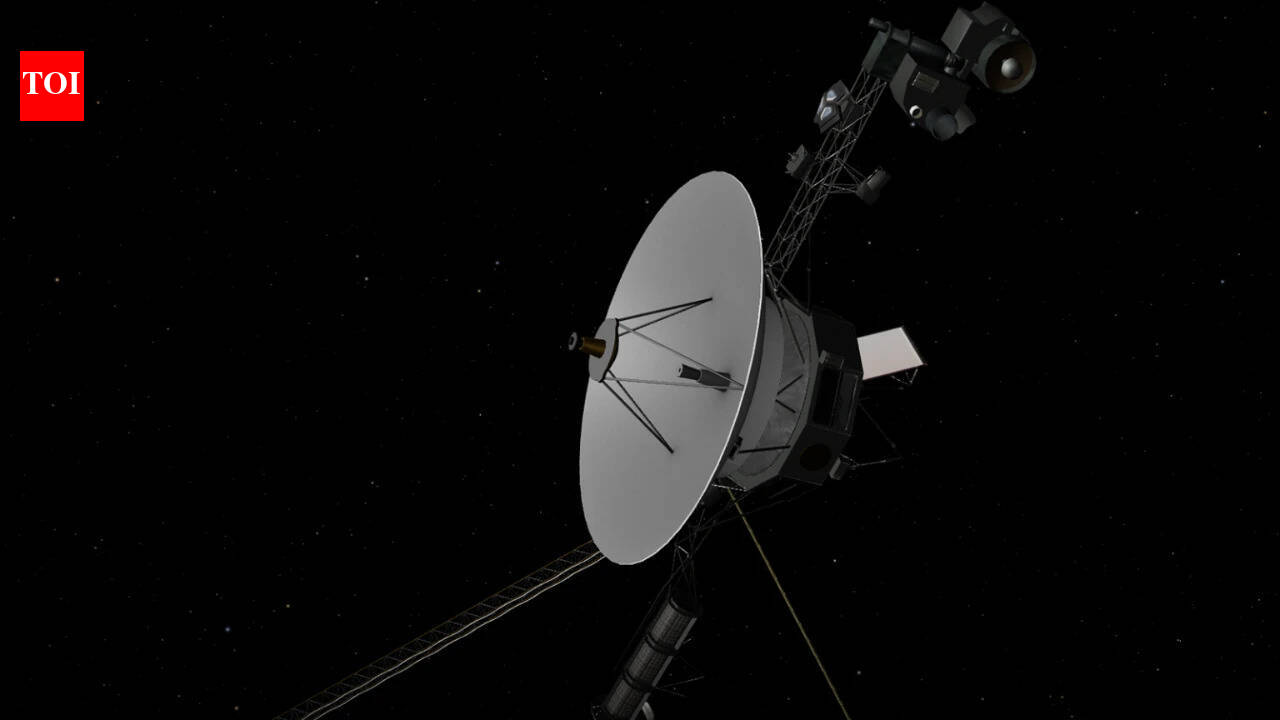
Imagine sending a message into space and waiting 24 hours just for it to arrive. And if you expect a reply, be prepared to wait another full day.That's how far Nasa's Voyager 1 has travelled from Earth. Nearly 49 years after its launch, the spacecraft is approaching an extraordinary milestone that no human-made object has ever achieved, travelling one light-day away from our planet.When it reaches the mark on Wednesday, November 18, even a signal travelling at the speed of light will need an entire day to bridge the distance between Voyager 1 and Earth.More than 26 billion kilometres from Earth, Voyager 1 is travelling at approximately 61,000 km/h. To put that distance into perspective, one light-day is the distance light travels in 24 hours, covering nearly 25.9 billion kilometres.Even at the speed of light, a signal sent from Earth will take an entire day to reach the spacecraft. A response would take another 24 hours to return, meaning a simple exchange between Nasa and Voyager 1 could take approximately 48 hours.But the distance becomes even more staggering when compared with a light-year. One light-year is approximately 9.46 trillion kilometres. Despite travelling at nearly 61,000 kph, Voyager 1 would need around 18,000 years to cover that distance at its current speed. According to the AP report, it would take more than twice that time before the spacecraft comes near another star.The Voyager 1 milestone is part of one of Nasa's most ambitious space exploration programmes, which began in 1977 with the launch of two robotic spacecraft, Voyager 1 and Voyager 2.The mission was originally designed to study the outer planets of the solar system, particularly Jupiter and Saturn, but a rare alignment of the giant planets allowed Nasa to plan a much wider exploration.According to Nasa, such an alignment occurs roughly once every 175 years and enables spacecraft to use the gravitational pull of planets to change their trajectories and travel towards other destinations. The technique, known as a gravity assist, helped the Voyager spacecraft explore regions of the solar system that had never been studied so closely before.Voyager 1's extraordinary 49-year journeyLaunched on September 5, 1977, from Cape Canaveral in Florida, Voyager 1 was designed to explore the outer planets of the solar system, but its journey eventually took it far beyond its original mission.The spacecraft first reached Jupiter in March 1979, sending back detailed images and scientific observations of the planet, its atmosphere and moons. Among its major discoveries was active volcanic activity on Io, Jupiter's innermost large moon, marking the first time volcanoes were observed on a world beyond Earth. It also discovered two previously unknown moons, Thebe and Metis, and a thin ring around Jupiter.In November 1980, Voyager 1 flew past Saturn, studying its complex ring system, atmosphere and largest moon, Titan. Its observations of Titan's thick atmosphere provided important insights into one of the most intriguing worlds in the solar system. Having completed its primary planetary mission, the spacecraft continued towards the outer reaches of the solar system.In February 1990, from approximately 6 billion kilometres away, Voyager 1 turned its camera towards Earth and captured the iconic 'Pale Blue Dot' photograph, showing our planet as a tiny speck against the vast darkness of space. The image was later popularised by astronomer Carl Sagan, who was part of the mission's imaging team. NASA subsequently switched off the spacecraft's cameras to conserve power.On August 25, 2012, Voyager 1 crossed the heliopause, the boundary where the Sun's influence through the solar wind gives way to the interstellar environment. It became the first human-made object to enter interstellar space.Nearly 49 years after its launch, the spacecraft continues to travel farther into the galaxy, sending scientific measurements back to Earth and preparing to achieve another historic first by reaching one light-day from our planet
Humanity's farthest messenger: Nasa's Voyager 1 nears a one light-day milestone
Full Article
Original Source
Read the full article at Timesofindia →KhanList aggregates and links to publicly available news content. We do not host full articles from third-party sources. Always verify important information with original sources.