
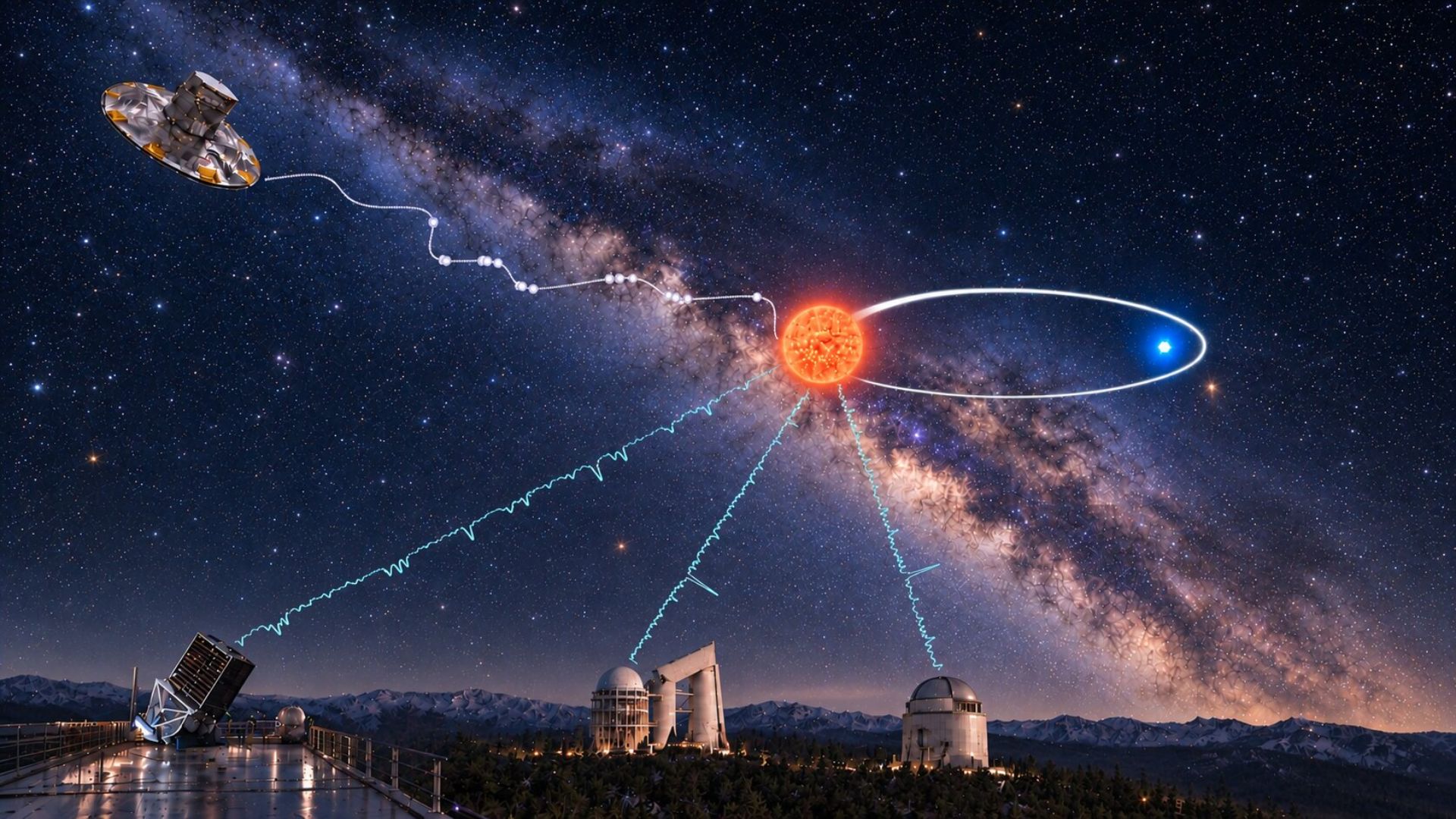
Chinese astronomers examining data from the Large Sky Area Multi-Object Fiber Spectroscopic Telescope (LAMOST) and the Apache Point Observatory Galactic Evolution Experiment (APOGEE) have found a likely supermassive neutron star accompanying a red giant, that is, neither big enough to be a black hole nor small enough to be a neutron star. This is a rarity even for astronomers and could help us understand the mass gap between neutron stars and black holes. Neutron stars are the remains of high-mass stars that have exploded. After the explosion, a star with a mass around 1.4 times that of our Sun fits into a sphere no larger than 12 miles ( 20 kilometers) across. Black holes, on the other hand, are remnants of even larger stars with mass at least five times that of the Sun to begin with. With no neutron star spotted with mass greater than 2.5 times that of the Sun, there remains a mass gap of 2.5 – 5 solar masses between them and the black holes. So, a rare spotting of an object in this mass gap opens up opportunities to understand where neutron stars give way to black holes. What did the astronomers spot? The astronomers spotted a new binary system, named J0008+0128. The binary system consists of the red giant and its companion, which was not visually confirmed. Instead, astronomers inferred its existence from its gravitational effects. This is not the first time astronomers have made such an association. However, its inferred mass, between 1.8 and 2.8 times that of the Sun, places it somewhere in the upper range of the mass gap between neutron stars and black holes, a rare and valuable find. The researchers found that the pair completes an orbit in 3.3 years, showing sufficient separation between the two. Yet the duo follows a near-circular path despite their separation. The absence of light other than that of the red giant signifies that the companion is not another regular star but a neutron star. In similar binaries, neutron stars draw material from other companions, adding to their own mass. But in this case, the neutron star is too far away to pull material from the red giant either. A neutron star or more? The astronomers conducted more than than 300,000 simulations involving binary systems to understand how such a system has been formed. Yet, none of these simulations could explain the mass and orbital properties of the system. The closest resemblance the team has for this system is Gaia NS1, a neutron star with a mass of about 1.9 suns and a two-year orbit. While J0008+0128 is a bit more extreme, it does fit all explanations. One possible explanation is that the binary system is actually a triple system with two very close small neutron stars or a neutron star and a white dwarf orbiting the red giant. Alternatively, it may have been a triple system in which the smaller bodies merged, the researchers suggest. The astronomers are confident that the formation of the system cannot be ruled out in principle and may have required a combination of extreme yet plausible parameters. The research findings were published in Science Advances. Get the latest in engineering, tech, space & science - delivered daily to your inbox.Ameya is a science writer based in Hyderabad, India. A Molecular Biologist at heart, he traded the micropipette to write about science during the pandemic and does not want to go back. He likes to write about genetics, microbes, technology, and public policy.
Chinese scientists detect likely supermassive neutron star over 1.8x bigger than sun
Full Article
Original Source
Read the full article at Interestingengineering →KhanList aggregates and links to publicly available news content. We do not host full articles from third-party sources. Always verify important information with original sources.