
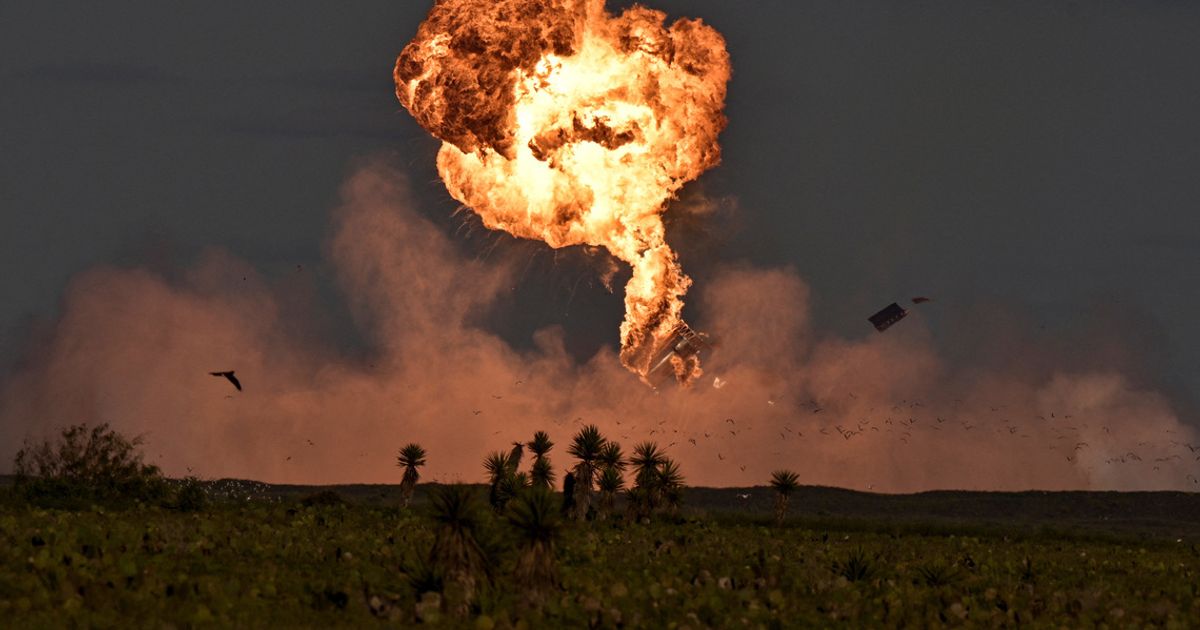
STARBASE, TEXAS - SpaceX’s Starship spacecraft was “healthy” as it orbited the Earth and on track to return on Nov 14 to its Texas launch site, where Elon Musk’s company was planning to “catch” the vehicle for the first time.It was the 15th test flight of the world’s biggest and most powerful rocket system, originally meant to feature a groundbreaking twin capture of both the Super Heavy booster and the Starship.Successful recoveries of both stages would have marked a milestone in the space industry’s decades-long pursuit of fully reusable rocket systems that can drastically reduce mission costs and make frequent launches possible.But that achievement slipped out of reach minutes after the 124m rocket blasted off on the afternoon of Nov 13 from its launch pad at Starbase.After the midair separation of the two stages, the Super Heavy booster was initially set for capture at Launch Pad 2, SpaceX spokesman Dan Huot said.But near the end of its descent, “the booster aborted itself for a GNC (guidance, navigation and control) issue that it detected”, he said.It diverted instead to the Gulf of Mexico just off the launch site, where it automatically self-destructed before hitting the water.Meanwhile, the Starship spacecraft that gives the rocket system its name was orbiting the Earth, which it was expected to do 14 times before returning on Nov 14.“Starship and its heat shield are healthy,” SpaceX said around seven hours after the mission started.The test flight of the world’s most powerful rocket system was aimed at a first “catch” of the ship and booster (pictured). PHOTO: REUTERS“We’re not tracking any issues right now with the vehicle or with the range for our return, so everything continuing to look good,” Huot said.Starship on Nov 13 launched 26 satellites to join others in Musk’s Starlink satellite internet constellation.Complex catchClayton Swope, an aerospace expert at the Center for Strategic and International Studies, called the mission a “mixed bag so far” after the failure to catch the Super Heavy, something SpaceX has done three times previously.“At least the Starship made it to orbit, like on the last test flight,” he said.Some versions of the Starship spacecraft are designed to launch internet satellites and data centres into orbit, while other iterations will be made to ferry people to the Moon and Mars.US space agency NASA is counting on Starship to serve as a lunar lander on its Artemis mission, and administrator Jared Isaacman congratulated SpaceX on Nov 13 for “another spectacular launch” – without mentioning the booster disappointment.SpaceX plans to return Starship to Earth after more than 22 hours of flight and recover it at around 3.20pm local time (Nov 15, 5.20am, Singapore time) on Nov 14.The “catch” is extraordinarily complex because the spaceship will be falling much faster and from a much higher altitude than the booster.Like the three previous Super Heavy recoveries, Starship is meant to carry out a controlled descent and nestle between two mechanical “chopstick arms” at the launch site.“We’ll only go for it if the ship passes all of these system checks and decision gates along the way, and there are lots of them,” SpaceX commentator Kate Tice said.Owing to the risks of losing control of Starship, SpaceX has planned for various scenarios where it will shorten the test flight and plunge the spaceship into the Pacific Ocean if necessary.Refuelling challengeMusk, the world’s richest person, has already revolutionised the space sector with the partially reusable Falcon rockets, which regularly launch satellites and carry astronauts to the International Space Station.But the Starship project has been plagued by years-long delays as SpaceX grapples with novel engineering challenges, including the unsolved problem of transferring fuel to the spaceship while in orbit – a requirement for any journey to the Moon or Mars.Following SpaceX’s high-profile stock market debut in June that raised about US$85.7 billion (S$110 billion), the company is investing heavily in production and launch capabilities.During a tour of its 93,000 sq m factory at Starbase on Nov 13, SpaceX officials told journalists that it now has the capability to produce a spaceship every two weeks and a booster every four weeks. AFP
SpaceX’s Starship set for return to Earth after booster catch aborted
Full Article
Original Source
Read the full article at Straitstimes →KhanList aggregates and links to publicly available news content. We do not host full articles from third-party sources. Always verify important information with original sources.