
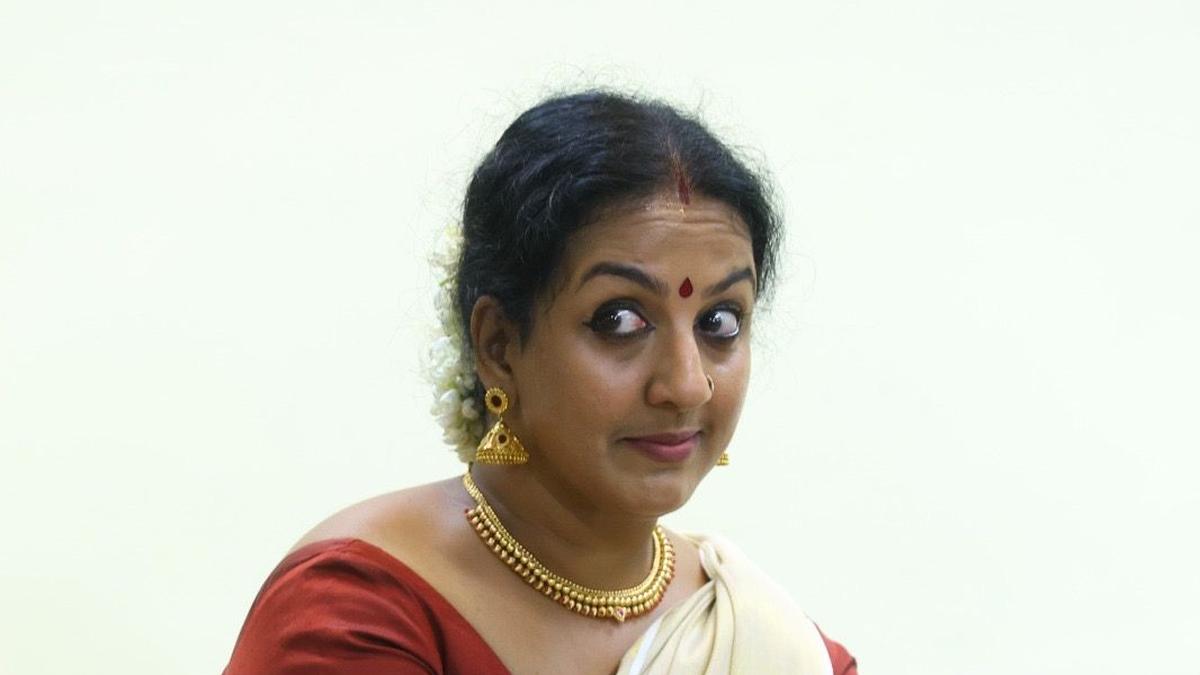
Kalamandalam Krishnendu’s session also highlighted Vyangyavyakhya’s directive on how subtle emotions should be conveyed through the eyes and not through elaborate body movements. | Photo Credit: Special Arrangement Nethra abhinaya, or communication through the movement of the eyes, is a nuanced technique in the art forms of Kudiyattam and Nangiar Koothu of Kerala, and it takes years to master. They are often referred to as the window of the soul, but for a Kudiyattam but for a Kudiyattam artist and audience, the eyes serve a far greater role — as one of the primary instruments of storytelling.This was brought out beautifully in the lecture demonstration on Nethra abhinaya held as part of the Sahiti Saurabha series of Dr. V Raghavan Centre for Performing Arts, which featured a special presentation by Kalamandalam Krishnendu, accompanied by Dhanarajan on the mizhavu. The occasion was the 118th birth anniversary of Dr. V Raghavan, and the launch of his book Hinduism- An Anthology and Nandini Ramani’s Tapestry of Memories. Krishnendu began her demonstration by dissecting the mechanics of the act of “seeing”. | Photo Credit: Special Arrangement Krishnendu explained that Nethra abhinaya holds paramount significance in Kudiyattam and Nangiar Koothu. This is primarily because the movements of the body in the art forms are limited, resulting in the narrative focus being placed on intricate facial expressions and subtle eye movements. She said her session would offer a focussed glimpse into a few key aspects of the craft.Krishnendu began her demonstration by dissecting the mechanics of the act of “seeing” — illustrating how an artiste identifies an object at a distance, tracks it as it draws closer, and follows it as it recedes. To bring this to life, she performed an excerpt from one of her own choreographies, portraying Goddess Parvati spotting a vimana in the distance, watching it approach, and observing it moving away.Following this was ‘Madhupana’, portraying the flight of bees from flower to flower and drinking nectar. Krishnendu subtly depicted this through rapid eye movements and isolated facial muscle control.Next, she demonstrated how Nethra abhinaya can describe a monumental object by performing ‘Kailasa nokki kaanal’. Portraying Ravana gazing upon Mount Kailasa, she used controlled eye movements and minimal bodily movement to evoke the mountain’s immense height, circumference and layered structure.To show how Nethra abhinaya can map out a vast geographical space, Krishnendu presented one of her own choreographies adapted from The Mahabharata. In this piece, Gandhari unties the blindfold from her eyes and looks out over the expanse of Kurukshetra. The detailed reaction of her eyes opening after years of darkness was striking. As she takes in the war-torn battlefield, her gaze fills with grief and the agony of losing her sons. Her focus then shifts to the immediate foreground — wrecked chariots and fallen horses and elephants. The spatial contrast was effectively captured by Krishnendu. To show how Nethra abhinaya can map out a vast geographical space, Krishnendu presented one of her own choreographies adapted from The Mahabharata. | Photo Credit: Special Arrangement She then took up ‘Sikhini Salabham’ from the 11th-century Sanskrit drama Subhadradhananjayam, written by King Kulasekhara Varman. In this episode, Arjuna is on his way to Dwarka and comes across a hermitage filled with extraordinary, harmonious sights — fireflies dive unharmed into a sacrificial fire, an elephant charges at an unperturbed lion, and so on. Krishnendu performed a brief segment depicting a fawn nursing from a tigress, capturing the movements of both animals and the fawn nudging the tigress for milk using just Nethra abhinaya and minimal facial/bodily gestures.The final presentation, drawn from Kamsa Vadham Nangiar Koothu, showcased Nethra Abhinaya as a tool for revealing a character’s conflict. Discussing her PhD research and King Kulasekhara’s theories as given in the Vyangyavyakhya, Krishnendu noted his directive that subtle emotions should be conveyed through the eyes and not through elaborate body movements. As the turmoil is internal, the actor must rely on restrained movements of the eyes to convey them. To illustrate this, she portrayed Devaki eagerly awaiting her first glimpse of Krishna as he enters Mathura, communicating a storm of conflicting emotions, terror and fear, purely through her eyes. Published - November 18, 2026 10:40 pm IST
How the eyes unfold stories in Indian classical dance
Full Article
Original Source
Read the full article at Thehindu →KhanList aggregates and links to publicly available news content. We do not host full articles from third-party sources. Always verify important information with original sources.