
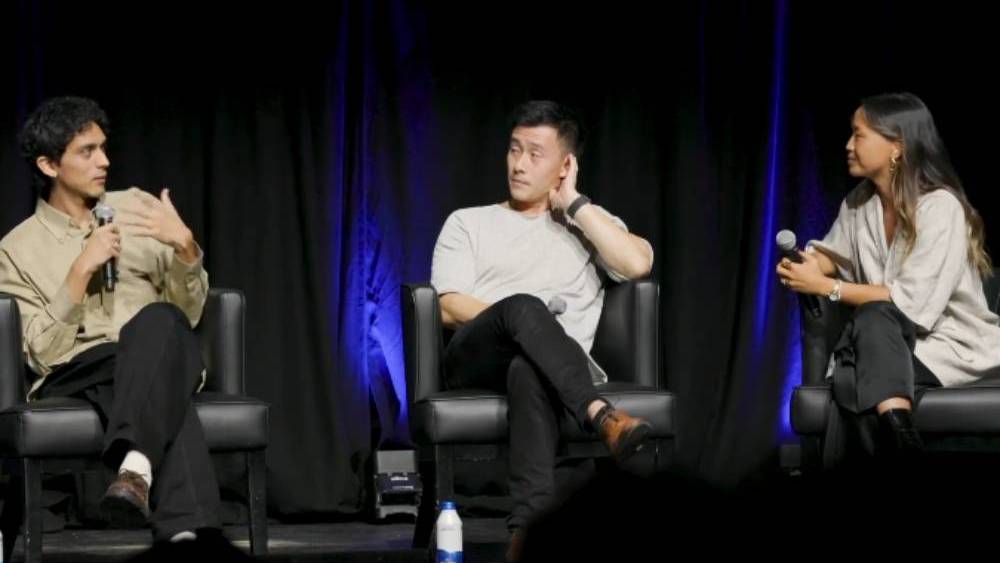
Pursuing a career as a filmmaker isn’t for the faint of heart. This week, three young creators who have been supported by the Adobe TV & Film Fund — Leo Aguirre, Michael Lei and Mel Mah — presented their short films at a special screening in Miami Beach hosted by Adobe and spoke about their work and what’s next. Variety moderated the conversation with the filmmakers in partnership with Adobe. The screening took place Nov. 10 at the Fillmore Miami Beach historic Art Deco theater, held during this year’s Adobe MAX 2026 creativity conference. Aguirre, a writer, director and visual artist raised on the U.S.-Mexico border, said his main advice to aspiring filmmakers is to “really believe in yourself.” “No one’s going to want to make your movie more than you,” he said. “Tell people to get on the train or get out of the way. And I think that’s the approach you have to have for your movie.” Mah, a writer, director, and producer from Toronto, said it’s important for filmmakers to “remember that art is created from the heart. Your mind is there to help, but it’s an emotional medium. And movies, the best ones, no matter what, they’re meant to move people.” She added that in addition to doing work on your scripts every day, you should “do things outside of film” to explore other passions and hobbies. “That’s what actually makes you a great filmmaker, because we’re telling stories about real life and you’ve got to go out there and live it in order to be to be able to tell those stories,” Mah said. Lei, an award-winning Chinese-born filmmaker, emphasized that it’s a difficult line of work. “It’s a really hard thing that to try to do film and it’s probably the most expensive art form, or one of the most expensive art forms, just because the amount of resources it takes to bring a crew and cast together and to do it convincingly,” he said. “You have to really, really love it and you have to want it for the right reasons,” Lei said. “It’s not a medium to get wealthy in. It’s not a medium to get famous.” Lei’s short that screened at the Adobe event was “The Rift,” a sci-fi-inflected story about a young man suspected of a mysterious affliction that makes him perceive the world in daylight while everyone, including his own father, sees darkness. Lei said it was the first public screening of “The Rift” — and he said it was gratifying to hear the response of a live audience. “I don’t know how to say this in other words, but it’s like, I will carry this on a hard day, you know? Like, I will remember this moment a few months from now where the writing is not coming or I get a rejection, but I’ll remember this moment and go, ‘You know, that’s what it’s worth it. This is what it’s for, exactly.'” Lei said “The Rift” will hopefully be a gateway for the story to become a feature-length film. “It’s a script that I’ve been carrying for the better part of the 2020s. And to have the opportunity through Adobe to actually go and film this proof of concept taught us so much,” he said. Aguirre’s short film “Isme” is about a tempestuous NYC teenager who steals a necklace from a woman on her deathbed — and “develops an obsession that leads her down a spiritually perilous path,” per the logline. “It’s a film about what we hold in this life and then what we hold in the next,” Aguirre said. “We all grew up with this idea of who we need to be. And then there’s artifice. And sometimes we feel completed by something that’s material.” Aguirre’s script for his debut feature, “Verano,” was selected for the 2025 Sundance Screenwriters & Directors Lab and is a recipient of the 2025-2026 Academy Nicholl Fellowship. “Verano,” which was supported by Adobe, was shot over the summer and Aguirre is hoping to premiere the film in the spring of 2027. “It was hard to get money. It was hard to get people to commit to helping us out,” said Aguirre. “But it was it was a very beautiful experience in so many ways.” Making “Isme” helped prepare him to embark on the feature film because he learned “how can we scale down and try to make the most of what we have.” Mah, who is a 2024 Women in Film directing fellow and founder of Decorum Pictures, also saw her short film “And That’s The Way The Cookie Crumbles” debut at the Adobe screening. The synopsis: A yoga influencer spirals into an existential crisis when a fortune cookie predicts her imminent death, and she begins to expose the hypocrisy of the mindfulness empire she’s built around a life she doesn’t actually live. “There’s so many things up there that I would have done differently, but there are so many things that also fell into place beautifully, too,” Mah said about her short film. “And I think that’s part of the beauty of filmmaking is we actually don’t have as much control as we think.” The story was somewhat autobiographical (Mah is herself a yoga and mindfulness teacher), but she said actress Dia Frampton, who plays the main character, “surprised me by bringing so much more of her spin on it. And I think because I’m so close to the character, I had imagined it maybe more in the way that I would be in that situation. But pleasantly surprised at how the performance was different.” Mah is currently developing her debut feature film “This Way to Home,” a road-trip dramedy starring Ken Jeong, with filming scheduled for spring 2027. “This Way to Home” was selected for Gold House’s Gold Pitch program at the Toronto International Film Festival and has secured CAN$1 million in production financing from Telefilm Canada. Each of the filmmakers were encouraged by the boom at the theatrical box office in 2026, the best year for the industry since COVID. “I am a hopeless optimist, and I really think that we’re always going to be going to the theaters,” Mah said. “I don’t think anything’s going to replace that. And I do think there’s something in us that craves being in a room, quiet, seated all together and getting to experience the same emotions.” The trio also recounted how they realized they wanted to become filmmakers. Said Mah, “I’ve always been a storyteller, but maybe in a different way. My first passion was dance. I was a professional dancer for a long time, and that’s what took me from Toronto to Los Angeles originally. So from a young age, I started learning how to tell stories non-verbally and with my body. And then it was actually once I was living in Los Angeles that I started making my own dance films. And that’s when I realized that I wanted to step into filmmaking.” She added that her father “raised me on really great films. He taught me how to edit with Adobe.” “When I discovered filmmaking, it felt like something I could actually share with my parents — a passion that I could pursue that I knew they’d really be behind,” Mah said. Lei said that his own father similarly introduced him to film when the family emigrated to the U.S. “That’s that’s how we learned about culture. That’s how we learned the language. He was a huge Tom Cruise fan,” he said with a laugh. “We just grew up on, like, ‘Top Gun,’ ‘Days of Thunder,’ all that stuff. And we watched ‘The Godfather’ every Christmas because [my father] thought it was a Christmas movie, because there’s that one scene that takes place at Christmas.” But the big moment for Lei was when he was living in New York during 9/11 and watching the first Oscars that took place afterward in March 2002. “And there was a really beautiful monologue at the beginning of that, which was serendipitously given by Tom Cruise, and he talked about the magic of movies and storytelling, and it was such a sensitive time for us as a community in New York,” he said. “And I just remember thinking, movies had been such a profound thing for me, growing up. And it was really meaningful. And I guess you could say Tom Cruise told me to make movies that day, but that was probably like the flashbulb moment for me.” Aguirre said he grew up in El Paso and his grandparents lived just across the border in Mexico. “I’d spend the summers there watching anything that my grandpa was watching… like these golden age Mexican films,” he said. While Aguirre originally wanted to be an actor, “my parents were like, ‘That’s a terrible idea.’ And then one summer I did this [theater] workshop and I thought, ‘I don’t want to act on the stage anymore. I want to try to do it for the screen.’ And then I liked being behind the camera a lot more. And that was a kind of natural progression.”
Up-and-Coming Filmmakers Talk About Their Craft, Challenges, Inspirations and More at Adobe TV & Film Fund Screening
Full Article
Original Source
Read the full article at Variety →KhanList aggregates and links to publicly available news content. We do not host full articles from third-party sources. Always verify important information with original sources.