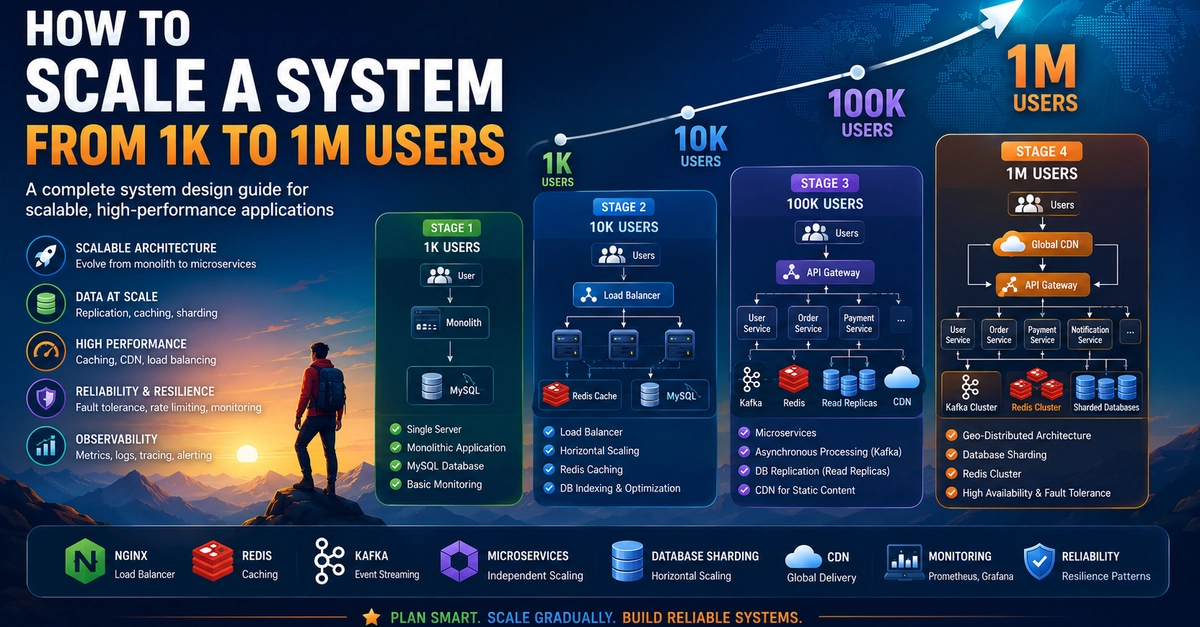
Most developers think scalability means: Microservices Kubernetes Distributed systems Event-driven architecture Massive cloud infrastructure But real-world scalability is very different. The best systems evolve gradually based on: Traffic growth Real bottlenecks Business needs Engineering maturity Every successful platform — from Netflix to Uber — started simple and scaled step by step. A practical scalability journey often looks like this: 1K Users Monolith architecture Single database Simple deployments Faster feature delivery At this stage, simplicity matters more than complex architecture. 10K Users Load balancer introduced Redis caching added Stateless APIs Database optimization becomes critical This is usually where databases become the first bottleneck. 100K Users CDN for static assets Async processing Message queues Database replication Event-driven workflows Now distributed system concepts start becoming important. 1 Million Users Microservices architecture Distributed caching Database sharding Reliability engineering Advanced observability At this scale: failures become inevitable. Systems must recover gracefully. Important Lessons About Scalability 1. Premature Microservices Are a Mistake Most startups do not need microservices early. Monoliths provide: Faster development Easier debugging Lower operational complexity 2. Databases Become Bottlenecks First Before scaling infrastructure: optimize queries add indexes use caching properly avoid N+1 queries 3. Caching Changes Everything Technologies like Redis can dramatically reduce database load and improve response times. 4. Reliability Matters More at Scale As systems grow: monitoring retries circuit breakers rate limiting observability become critical engineering requirements. Final Thoughts Good system design is not about building the most complex architecture. It is about: solving real bottlenecks keeping systems reliable scaling incrementally making the right trade-offs at the right time The best scalable systems are usually the simplest systems that evolved carefully over time. Complete detailed guide with architecture diagrams, scaling patterns, caching strategies, microservices, sharding, reliability engineering, and Spring Boot best practices available on ProfileDocker. Take me to complete details guide : https://www.profiledocker.com/blog/how-to-scale-a-system-from-1k-to-1-million-users-complete-system-design-guide-fo-OeuCUY Alternatively you can also visit to medium page : https://medium.com/@shantan.golla/how-systems-actually-scale-from-1k-to-1-million-users-12999e8b9455
How Systems Actually Scale from 1K to 1 Million Users
Full Article
Original Source
Read the full article at Dev →KhanList aggregates and links to publicly available news content. We do not host full articles from third-party sources. Always verify important information with original sources.