
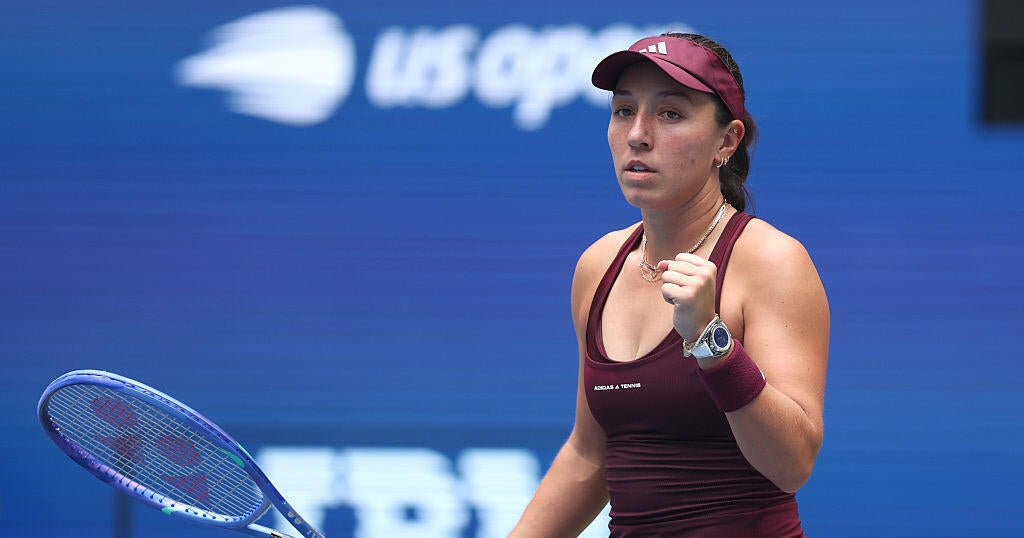
By Lauren Fichten Digital Reporter Lauren Fichten is a journalist at CBS News covering artificial intelligence, digital safety and online extremism. She joined CBS News after graduating from UNC-Chapel Hill and was previously an associate producer at the CBS News National Desk. Read Full Bio September 4, 2026 / 5:40 PM EDT / CBS News Add CBS News on Google Seeing fans with their phones out during a tennis match would've been a strange sight even a decade ago. But at the U.S. Open this year, the digital world has become intertwined with the game as live AI insights reshape the tournament experience.On Tuesday night, when Coco Gauff faced off against Zeynep Sönmez of Turkey, AI-generated analysis trickled in through the U.S. Open app, tracking key moments, each player's likelihood to win and a new metric called "serve quality." Cameras around the perimeter of Arthur Ashe Stadium in Queens, New York, collect data on players' limb movement. Lauren Fichten Cameras lining the perimeter of Arthur Ashe Stadium track the ball, racket and players' limbs, collecting data points like elbow and knee flexion and wrist flex velocity. Then, IBM's agentic software development platform, Watsonx, processes the data from the court to measure the efficiency, accuracy and consistency of a player's serve, a number out of 100 that can be seen in the U.S. Open app postmatch.Gauff's winning serves had a "controlled racket preparation and deep knee bend during her setup," according to the serve quality summary. There will be over a billion data points produced by the end of the tournament, said Tyler Sidell, IBM's technical program director for sports and entertainment partnerships.The data-driven experiences, he said, are meant to be a conversation starter for fans."There's so much unpredictability in sports — you could take a look at all the data, but anything can happen out there on the court," he said. "That's the fun about it. We want to provide an insight, but still, let's watch the matches play out." AI insights are not just about the fans who can access them in the app (about 14 million of them, according to IBM). The features have also become a tool for players.Jessica Pegula, who advanced to the fourth round of the U.S. Open on Friday, uses AI to identify patterns in her opponents' serves before facing them in a match."Tennis is a lot of problem solving on the court, so it's a lot of patterns, and I think serve is a really big one," she told CBS News. "It's the one controllable shot we have in tennis."Although the game can turn around at any moment, for Pegula, the data remains useful. The IBM Data Operations center processes data throughout the duration of a match. Lauren Fichten "You can get a lot of analytics, but sometimes things change during the match, sometimes someone changes their strategy, or they maybe go against the grain of what you thought they were going to do, and you still have to really trust your instinct," she said. "But I think mentally it just gives you that feeling of being prepared before you go into a match." The "likelihood to win" feature has been a staple of the U.S. Open digital experience for about six years, Sidell said, but this is the second year fans can track the fluctuating likelihoods in real time as a match plays out. The feature is built on trusted media sources and recent performances, which are aggregated to generate a player's odds of winning.Gauff was predicted to win Tuesday by 72%, a number that rose as she built momentum in the first set. Another AI-powered feature, "key moments," provides brief blurbs of analysis as a game unfolds. "Gauff has three opportunities to win the match, with Sonmez needing a heroic response," said a key moment in the second set of the match.A dramatic fluctuation in likelihood to win prediction came later that evening when the men's No. 1 seed, Alexander Zverev of Germany, played a nail-biting match against Italy's Lorenzo Sonego that dragged into the early morning. Zverev had an 87% likelihood of winning before the match. But toward the end of the fourth set, Sonego had a 93% chance of winning. It flipped again when Zverev made a comeback. Match Chat, an AI-powered assistant in the app, also can answer questions about players, matches and the venue.When asked where one could get a Honey Deuce, the signature cocktail of the U.S. Open, it swiftly sent the locations of the bars and asked, "Do you want the nearest Honey Deuce bar to your gate?" In: Sports Artificial Intelligence Tennis
How AI is reshaping the U.S. Open for players and fans
Full Article
Original Source
Read the full article at Cbsnews →KhanList aggregates and links to publicly available news content. We do not host full articles from third-party sources. Always verify important information with original sources.