
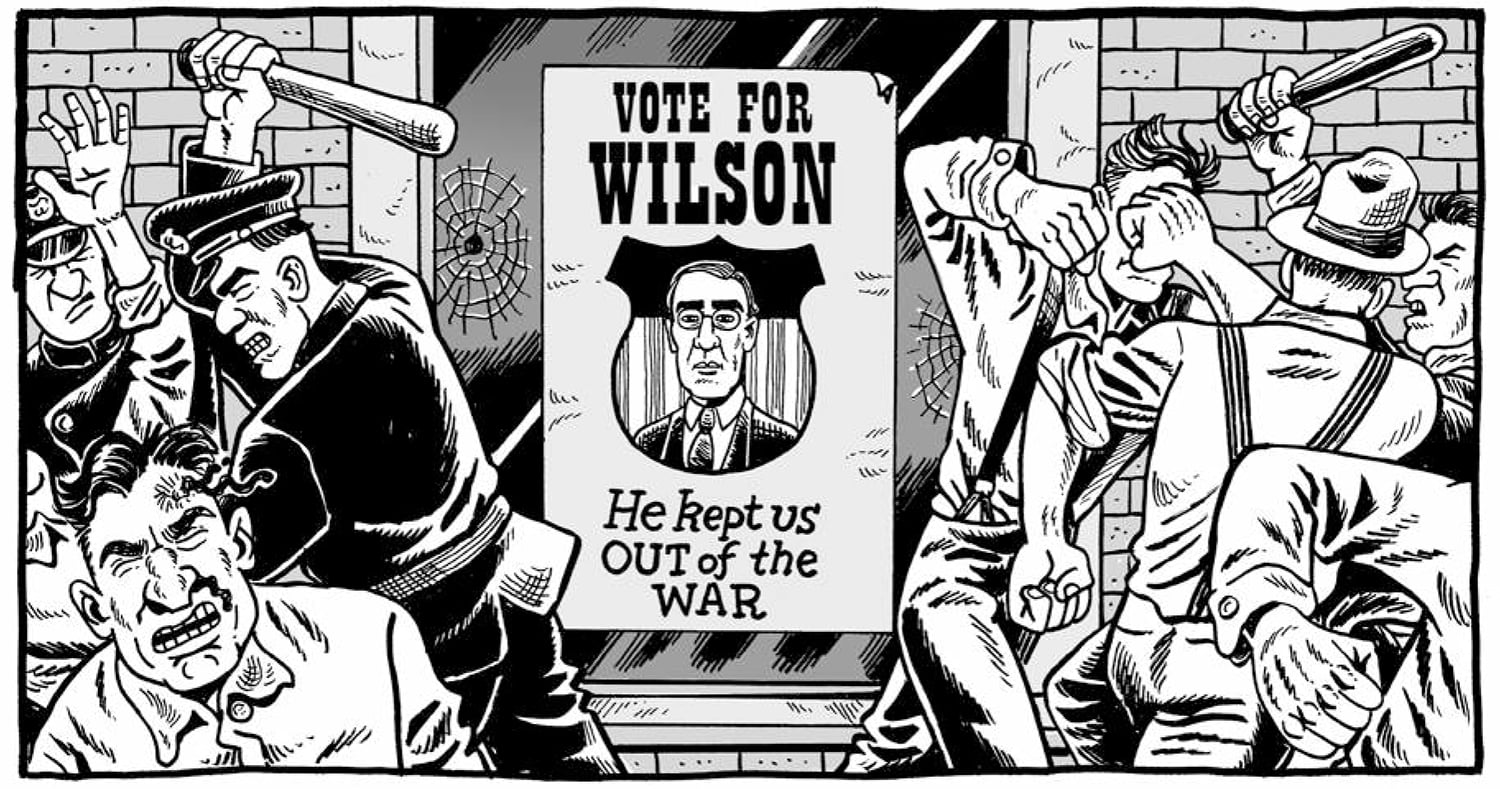
An unambiguous autocrat holds the White House. Americans now fear not only the corruption of their municipal law enforcement, but the menace of a paramilitary force of racist thugs that owes allegiance only to the executive branch. Plutocrats work hand-in-glove with white nationalists, spies have penetrated the political press, and the government prosecutes dissenting speech as treason and threatens its opponents with distortion. The year, of course, is 1916. The cartoonist Derf Backderf has a remarkable sense of which historical moment can be mined for unfamiliar parallels to the present day. His 2020 book, Kent State: Four Dead in Ohio, arrived perfectly timed to rebut disingenuous concerns over supposed campus-activist illiberalism; his 2012 My Friend Dahmer, about his high school friendship with future serial killer Jeffrey Dahmer, felt eerily attuned to a U.S. school culture traumatized by mass shootings. An unambiguous autocrat holds the White House. Americans now fear not only the corruption of their municipal law enforcement, but the menace of a paramilitary force of racist thugs that owes allegiance only to the executive branch. Plutocrats work hand-in-glove with white nationalists, spies have penetrated the political press, and the government prosecutes dissenting speech as treason and threatens its opponents with distortion. The year, of course, is 1916. The cartoonist Derf Backderf has a remarkable sense of which historical moment can be mined for unfamiliar parallels to the present day. His 2020 book, Kent State: Four Dead in Ohio, arrived perfectly timed to rebut disingenuous concerns over supposed campus-activist illiberalism; his 2012 My Friend Dahmer, about his high school friendship with future serial killer Jeffrey Dahmer, felt eerily attuned to a U.S. school culture traumatized by mass shootings. For his new graphic novel, The Dissidents: Autocrats! Vigilantes! Communists! And Cartoonists!, he has identified a doozy. The book is set among leftist cartoonists working in the small-but-fierce newsroom of The Masses, the Greenwich Village magazine that published cartoons, poetry, political essays, the occasional drawing by Picasso, and at least one interview with Lenin, and that sent John Reed to cover the Bolsheviks in Moscow in October 1917. It’s a comfortable milieu for Backderf, a veteran of the U.S. alternative press for which The Masses represents a kind of platonic ideal. While the book’s dialogue is largely invented, its research is impeccable. Every time I thought, “That can’t possibly be true,” I looked it up, and it was. The life of The Masses was short: From 1911 to 1917, it was a leading organ of U.S. socialist thought, but after the passage of the Espionage Act of 1917, the U.S. Postal Service refused to deliver the magazine on the grounds that it was interfering with conscription. The publication shut down amid punitive prosecutions of its masthead and reconstituted as The Liberator, which was milder in tone. The new magazine was thus able to print Reed’s history-making dispatches; those articles would become the basis of his book Ten Days That Shook the World, arguably the most important document in English on the October Revolution. Three vintage illustrated magazine covers: the central issue of Liberator showing an illustrated crowd scene featuring women in broad-brimmed hats, flanked by two issues of The Masses. Covers of The Masses and Liberator.Wikimedia Commons The eyes through which Backderf shows us all this historical detail and contemporary resonance are those of Joe Hertle, a progressive artist working for the Newspaper Enterprise Association. Hertle is Backderf’s own creation, but the NEA is still around today, syndicating comic strips and stories of various kinds to papers around the United States. Backderf imagines Hertle as a low-ranking cartoonist there, only in his mid-20s when the story takes place. He’s interested in the burgeoning labor movement—early on in the story, he loses his leg below the knee to a trolley car during a riot. But he’s also fascinated by the brilliance of the artists publishing in The Masses, which turns out some of the most beautiful U.S. artwork of the period with their illustrations and cartoons, all while dogged by a bloodlust that seems to have infected their whole society. Backderf has an enviable array of artists to defend the radical politics he explores here. Foremost is probably Art Young, a brilliant cartoonist who clashed with his less didactically minded colleagues. “They want to run pictures of ash cans and girls hitching up their skirts in Horatio Street,” he groused in 1916, “regardless of ideas and without title.” Those colleagues were John Sloan and George Bellows, and they took the name of the Ash Can School from Young’s potshot. There’s something transcendent in the way Backderf contextualizes and reproduces obscure illustrations by future luminaries alongside Harry Ryle Hopps’ famous “Destroy This Mad Brute” military recruitment poster. What, after all, is Bellows without his comrades in the socialist press and his contemporaries in the broadsheets? Three-panel black-and-white comic strip showing a man in an overcoat and fedora approaching an outdoor newsstand, followed by dialogue panels where he asks the vendor for a magazine. Joe Hertle, the fictional protagonist of The Dissidents, finds little sympathy for his politics in Woodrow Wilson’s United States.Abrams Books In many respects, The Dissidents is a bracing remedial education. The villain of the piece is Woodrow Wilson, a U.S. president who is traditionally celebrated for leading the country onto the global stage during World War I and for his own academic work as a historian and president of Princeton University. But Backderf, drawing on Adam Hochschild’s recent history of the period, American Midnight, as well as contemporaneous accounts, contends convincingly that we ignore the domestic character of Wilson’s government at our peril. He was, after all, a fervent racist who screened D.W. Griffith’s The Birth of a Nation at the White House and immediately allowed the expansion of government office segregation upon taking office—this after plying Black leaders with promises of moderation. Wilson signed the notorious Sedition Act of 1918 and the aforementioned Espionage Act, which still plagues U.S. civil libertarians with its layers of secrecy, obfuscation, impunity, and good old bureaucratic busywork. More importantly (for Backderf’s purposes), he started a censorship board for editorial cartoonists called the Bureau of Cartoons. The bureau enlisted popular illustrators to sell the idea of censorship to their peers: One guidelines pamphlet boasted a cover by no less an eminence than James Montgomery Flagg, of the now-iconic “I Want You” poster. The most striking contemporary analogue in The Dissidents is that of the American Protective League, a consortium of violent goons whose existence was approved by Wilson and which was allowed to operate under color of law, despite being a club of bullies little better than the Ku Klux Klan. With Wilson’s imprimatur, they waged undeclared war on pacifists and conscientious objectors, raiding businesses and conducting arrests at their own discretion. During one three-day period in 1918, they were even allowed to conduct draft card checks throughout New York City and arrest supposed dodgers—as well as those who simply forgot to carry their draft cards with them. In this era, too, to my surprise, segregation enthusiasts were using the not-quite-a-slur “hyphenated Americans” to refer to people who had the temerity to bring along some of their own culture when they moved to the United States. (I’ve been hearing U.S. conservatives try for laughs with this one since the 1990s.) Emma Goldman’s deportation at the end of the book feels inevitable. All of it seems eerily similar to the 2024 Republican National Convention and its signs urging “mass deportation now” and to the work of the Department of Homeland Security’s militarized enforcement arms—Immigration and Customs Enforcement, Homeland Security Investigations, and Customs and Border Patrol. But Backderf places all of these familiar organizations and characters in a context so meticulously drawn—both historically and with his pen—that The Dissidents is a vivid evocation of an entire period, not just the parts that invite contemporary comparisons. That evocation comes primarily through the art history in The Dissidents, a genuinely wonderful contribution to our shared understanding of the period. Backderf’s own style is deliberately prosaic, with lots of heavy black ink, but the artists he’s chosen for his cast of characters often use a black crayon, and Backderf includes stats of their cartoons on his own pages; these bring forth a whole range of values seen nowhere else in the book’s world. Comic page featuring panels of a man receiving and reading a magazine, opening up to a centerfold political cartoon depicting a figure facing a military firing squad, titled "The Deserter." Joe admires the provocative political cartoons in The Masses.Abrams Books Backderf takes great pains to dramatize all the different layers of artistic expression available to the general public during World War I, and how they changed in response to social pressures. To avoid seeming too sympathetic to the Germans, The Katzenjammer Kids and Hans und Fritz, both created by Rudolph Dirks, were renamed The Shenanigan Kids and The Captain and the Kids, respectively. Cartoonist Art Young drew scathing indictments of capitalism, official impunity, and even the Associated Press; he was charged under the Espionage Act and put on trial, through which he snoozed defiantly. Other Masses contributors weren’t as lucky: For organizing French railway workers to strike, Robert Minor was imprisoned abroad by the U.S. military and narrowly avoided being executed; Maurice Becker, arrested for being a conscientious objector, was held and tortured at the United States Disciplinary Barracks in Fort Leavenworth, a military prison in Kansas. The rest of the press seemed to consider these men to have gotten off easy. “We are now at war, and militant pacifists are earnestly reminded that there is no shortage of hemp or lamp-posts,” snarled the Wall Street Journal in a bravely unbylined front-page editorial on April 6, the day the United States formally entered the war. This, too, evokes more recent memories of the U.S. press disciplining its less hawkish members. (The Journal recently published an letter under the delightfully petulant headline “The Iran War Isn’t Deranged.”) Undergirding the eeriness of its parallels, depending on how depressed you’ve been lately, you might find in The Dissidents a sense of relief. I certainly did. It’s not that things aren’t terrible, but it’s worth remembering that they’ve been bad before and gotten better (and worse) as the passage of time has done its thing. If it’s not exactly a comfort to feel that somewhere in the U.S. character there lurks a penchant for thuggery, it is at least nice to think that, for long periods, its expression has been curbed and limited. “Things don’t last forever, Joe,” the great, subtle artist Cornelia Barns tells our hero, as the net begins to tighten around the radical journalists of The Masses. And that’s true enough, for good and for ill.
How a World War I Crackdown Predicted ICE
Full Article
Original Source
Read the full article at Foreignpolicy →KhanList aggregates and links to publicly available news content. We do not host full articles from third-party sources. Always verify important information with original sources.