
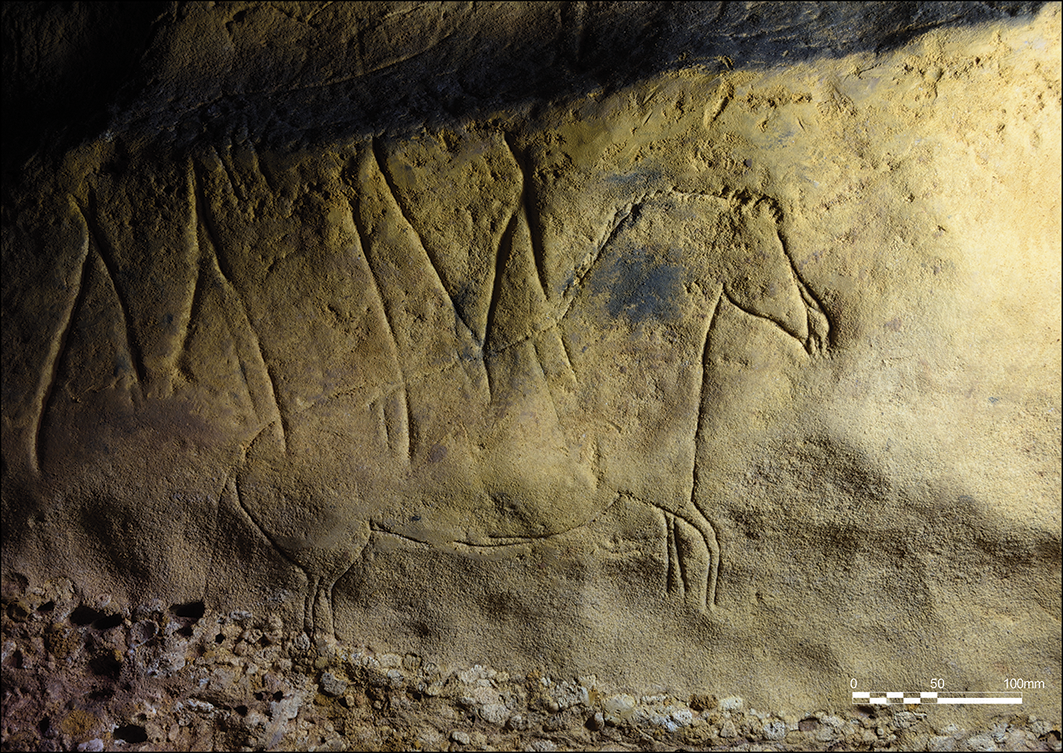
Prior to the discovery, rock art in northeastern Spain was “very scarce,” one archaeologist says. The drawings show dozens of animals, as well as more abstract shapes, which are distinct from other Paleolithic styles November 6, 2026 1:57 p.m. An engraving of a horse, one of roughly 280 artworks found in the cave, is estimated to be 26,000 years-old. Josep Maria Vergès Bosch and Míriam Salas-Altès Tourists, explorers, archaeologists and others have been visiting the Cova de la Font Major, a cave system in Catalonia, Spain, since at least the 12th century. They’ve explored two miles of underground caves and rivers; left graffiti; and even opened a museum in the 1990s. But it wasn’t until recently that a team of archaeologists discovered what, for centuries, these relatively modern visitors had apparently failed to notice. Hidden in plain sight, left behind by some of the cave’s very first inhabitants, was the third-largest collection of Ice Age-era engravings to have ever been found on the Mediterranean side of the Iberian Peninsula. “At the moment of discovery, I experienced a mixture of excitement at encountering something both unexpected and extraordinary and profound disbelief,” Josep Maria Vergès, an archaeologist at the Catalan Institute of Human Paleoecology and Social Evolution (IPHES), tells Gizmodo’s Gayoung Lee. “It seemed inconceivable that none of the many visitors who had traversed the gallery … had ever noticed the presence of these prehistoric engravings.” During a series of excavations in 2019, researchers from IPHES identified some 280 Paleolithic engravings on the cave’s walls. The motifs were wide-ranging, comprising 55 distinct animals—horses, a bear, deer and early types of wild cattle among them—and dozens of abstract patterns, lines and loops. Their research was published this week in the journal Antiquity. Paleolithic rock art on the Iberian peninsula is plentiful but unevenly distributed. Prior to the discovery at Cova de la Font Major, rock art identified in Catalonia was “very scarce compared with the abundant record of the neighboring Franco-Cantabrian region,” Vergès explains in a statement. It remains unclear how the markings had never been documented before. They are in a part of the cave that has been open to tourists since 1957. The general consensus was that the walls of the cave were too “irregular both in relief and color” to preserve art, per the article. The researchers speculate that lighting may have had a role to play in the belated discovery. “When you shine a light straight on the engravings, they are really difficult to see. You have to play with light from different directions to see the depressions,” Míriam Salas-Altès, an archaeologist with IPHES and a co-author of the study, tells Nature’s Chris Simms. An engraving of a bear is among the 55 animal etchings found in the cave. Josep Maria Vergès Bosch and Míriam Salas-Altès The drawings appear to be advanced and distinct from the neighboring Franco-Cantabrian style of rock art. Some designs, the researchers posit, may represent the earth or bodies of water, and at least 20 inscriptions could form something like a prehistoric “movie or animation,” Salas-Altès tells Nature. These scenes show animals in repetition, with their limbs and heads changing positions, as though meant to depict running or movement. Using radiocarbon dating on bits of charcoal discovered inside one engraved groove—beside which a small flint bladelet was also recovered—the researchers estimated that the artworks are roughly 26,000 years old. The researchers found that early humans traversed the sprawling cave system incrementally, visiting different sections over different periods of time. The earliest evidence of prehistoric activity inside dates to roughly 41,000 years ago. One cavernous area, near an entrance, was likely busier during the early Bronze Age, between 4,200 and 2,700 years ago. Here, fragments of a dagger, sword and axe were discovered. Another artery of the cave was occupied during the Neolithic era, up to 7,400 years ago. Did you know? Cave DNA Researchers recently discovered that traces of ancient DNA from humans can survive for millennia on cave walls and in rock art, based on findings from 11 sites in Spain and Portugal. The DNA likely appears in the rock art because prehistoric artists would apply red ochre paint with their hands or spit it from their mouths on to the cave wall. Despite identifying these timelines, the researchers have not yet determined how any one group of people may have used the cave—for shelter, rituals or other practices. What is clear, they say, is that Catalonia has a much richer Paleolithic history than previously thought. Following this finding, the researchers say, the region deserves more attention in Ice Age studies. “Contrary to what was previously thought, northeastern Iberia holds first-rate Paleolithic rock art sites,” Salas-Altès says in the statement. “The Mediterranean art of western Europe is now enriched by a new body of rock art, which allows us to characterize in greater depth a Mediterranean graphic tradition with an identity of its own, distinct from that of the Franco-Cantabrian region.” You Might Also Like Get the latest stories in your inbox every weekday. More about: Ancient Civilizations Archaeology Art Art History Caves New Research Spain
For Centuries, Cave Visitors Walked Right by 280 Ice Age Engravings. The Newly Discovered Rock Art Is Rewriting Catalonia's Prehistory
Full Article
Original Source
Read the full article at Smithsonianmag →KhanList aggregates and links to publicly available news content. We do not host full articles from third-party sources. Always verify important information with original sources.