
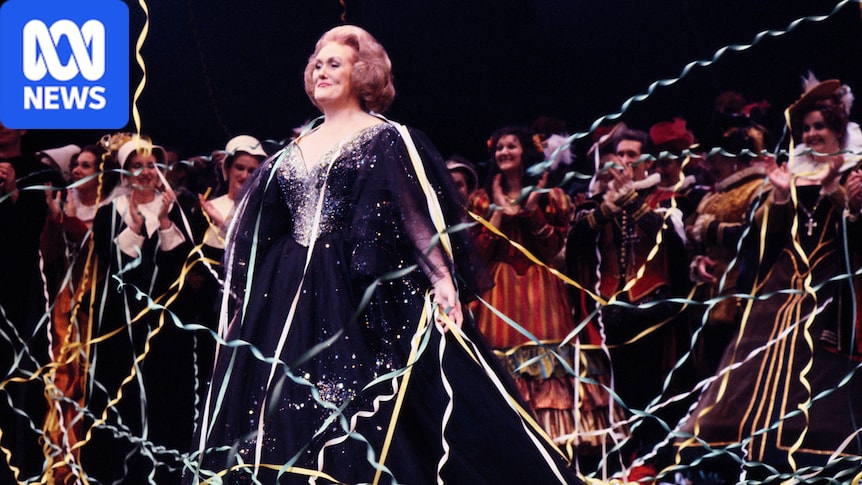
Her name is emblazoned across some of Australia's premier arts venues. But how did Dame Joan Sutherland become one of opera's most celebrated singers?Known for the agility and purity of her voice, the Australian soprano earned the nickname La Stupenda, meaning "the stupendous one"."In the opera world, everyone knows who Joan Sutherland is," says Australian tenor John Longmuir."No-one's ever been able to repeat the success or the technical artistry she achieved."Alongside contemporaries such as Maria Callas, and with the support of her husband Richard Bonynge, Sutherland helped revive bel canto operas by Bellini, Donizetti and Rossini that had largely disappeared from major stages.Joan Sutherland with Luciano Pavarotti in a gala concert at the Sydney Opera House in 1983, conducted by Richard Bonynge. (La Stupenda, book by Fiona Janes)Marking 100 years since Sutherland's birth on November 7, 1926, three musicians and Sutherland's granddaughter reflect on her influence and enduring legacy.The 'La Stupenda' effectSutherland set a standard few singers have matched.Born and raised in Sydney, Sutherland spent much of her early career performing with opera companies in the UK and Europe during the 1950s.The production that propelled her to international stardom was Donizetti's Lucia di Lammermoor, staged by Franco Zeffirelli in 1959.In 1960, Sutherland performed the title role in Handel's Alcina at Teatro La Fenice, in Venice, earning the nickname "La Stupenda", which she carried for the rest of her life.More than six decades later, singers still regard Sutherland as a benchmark for technical excellence."There's just no-one as virtuosic or as technically capable as she was," says Ali McGregor, a former principal soprano with Opera Australia who met Sutherland and worked with Richard Bonynge.Joan Sutherland singing the title role in Alcina. (La Stupenda, book by Fiona Janes)McGregor, who recently founded the FLUXUS Opera Lab project, recalls hearing a recording of Sutherland singing The Gypsy and the Bird and being struck by the purity of her tone."That recording was my first introduction to opera as an art form," she says.McGregor adds that "whenever I had a coloratura role to learn at Opera Australia, I would turn to a Sutherland recording".For many opera singers, Sutherland's recordings were a resource for learning as well as inspiration.Longmuir was inspired to become an opera singer at age 16 after watching a VHS recording of Sutherland performing at the Sydney Opera House.He later became the inaugural winner of the Bel Canto Award, a competition established in Sutherland's memory in 2011.Similarly, soprano Cathy-Di Zhang says her teacher frequently pointed to Sutherland as a model of technical excellence while she was learning to sing."Sutherland ended up becoming the most recorded soprano in history," Longmuir says.La Stupenda's stage presence was as memorable as her voice."Physically, she was extremely commanding," McGregor says.Sutherland was tall and broad and, according to Longmuir, "she had her own costume designers, and productions were built around her"."Zeffirelli did the sets and costumes for her to make sure that she looked and sounded and moved well in these amazing, lavish productions," Zhang says.A partnership that changed operaSutherland married Australian pianist and conductor Richard Bonynge in 1954.The couple worked together extensively throughout their careers.Bonynge coached Sutherland on her singing and conducted many of the operas and recordings in which she appeared.Speaking of how Sutherland and Bonynge helped revive bel canto operas, Longmuir explains, "In bel canto [beautiful singing], the emphasis is on the beauty of the voice." Joan Sutherland in Rossini's Semiramide. (La Stupenda, book by Fiona Janes)"Every emotion, every character, you express through the voice, and that's what Sutherland did," Zhang says.To do that, "you have to have mastered every technical element of singing on all notes of your range from bottom to top, from very soft to very loud," Zhang says.Operas by Bellini, Rossini and Donizetti are regularly performed today, but this was not the case in the 1950s.Sutherland and Callas helped bring back operas that most thought were "too hard to sing", Zhang says.Throughout her career, Sutherland became closely associated with many of these roles.Among her most iconic are Bellini's Norma, Rossini's Semiramide, Marguerite de Valois in Meyerbeer's The Huguenots and Marie in Donizetti's The Daughter of the Regiment.But for Bonynge's dedication and the power of Sutherland's voice, these operas would have been hidden in archives, Longmuir and Zhang say."I don't know if they would have reached what they reached without each other," says Natasha Bonynge, the couple's granddaughter."They had a beautiful way of supporting and pushing each other and growing a body of work through their careers."The different worlds of Joan SutherlandDespite her public profile, Sutherland remained a private person."She really kept herself to herself," McGregor says."I personally would love to know more about who she was as a person."Natasha Bonynge describes how Sutherland "had very different worlds and she balanced them quite amazingly"."I knew her as Mimi. I got to know Dame Joan as a much older person after she passed, through people sharing stories with me when they were in her world," she says.Joan Sutherland as Norma with the San Francisco Opera. (La Stupenda, book by Fiona Janes.)Bonynge describes Sutherland as a "little music box" who would hum constantly around the house and entertain her grandchildren with songs such as Three Little Maids from School.Asked if she knows Sutherland's favourite role, Bonynge says: "I've heard she loved Norma because the role felt more grounded and real to her than others.""She also loved sharing the more playful roles, like The Daughter of the Regiment, with my brother and me."Sutherland's needlework was also legendary. Longmuir remembers admiring her cross-stitch work while visiting her Sydney home, while Bonynge recalls her grandmother spending rehearsals sewing tapestries and keeping a close eye on every detail of the opera.What Joan Sutherland means for Australian opera todaySutherland proved to generations of Australian singers that you could be a star on a global scale."As an ambassador for Australian artists, her legacy is huge," McGregor says."Because she was the first person I ever heard, it seemed utterly normal that an Australian singer could perform on the world stage."But McGregor says honouring Sutherland means more than celebrating her achievements."If we can learn anything from Sutherland, it's that we do have the capacity to develop what Australian opera is," McGregor says.We should value where we've come from, but we can't view opera through the lens of Joan Sutherland's time alone, according to McGregor."We're a hugely multicultural country with incredible stories to draw upon," she says.Rather than looking for singers who can replicate Sutherland's success, McGregor believes the industry should support artists forging their own paths.Joan Sutherland in The Merry Widow in 1981. (La Stupenda, book by Fiona Janes: Robert Cahen)Zhang and Longmuir note that Sutherland and Bonynge themselves "weren't doing super popular things at the time either.""We always think the olden days are the golden days," Zhang says.The Joan Sutherland and Richard Bonynge Foundation supports emerging singers, including Longmuir and Zhang, through awards and professional development opportunities.For these younger singers, Sutherland's greatest legacy is demonstrating the expressive power of the human voice."That is timeless, and that's how it's always been in opera," Longmuir says.Bonynge says the lesson at the heart of her grandmother's life is simple:"Nobody's going to do it for you. Nobody's going to make it easier. It's just up to you to go out there and get the thing done."Listen to La Stupenda, an audio series celebrating the life and legacy of Dame Joan Sutherland at ABC Classic throughout November.Get the latest classical music stories direct to your inbox
How Australian singer Dame Joan Sutherland became a global opera sensation
Full Article
Original Source
Read the full article at Abc →KhanList aggregates and links to publicly available news content. We do not host full articles from third-party sources. Always verify important information with original sources.