
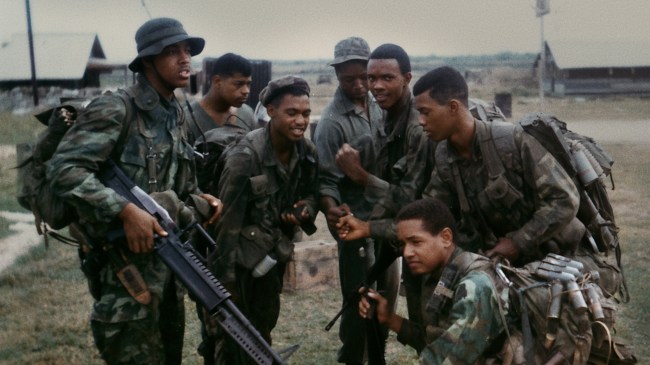
Editor’s Note: This review was originally published during the 2026 Sundance Film Festival. “Soul Patrol” opens in select theaters from Kino Lorber starting Friday, November 6. The Vietnam War ended over a half-century ago, but the 20-year war remains a conflict that American artists keep going back to, finding new avenues and perspectives to tackle the many stories of the generation of men who had their lives irrevocably shaped by the conflict. Recent takes have centered the (often-neglected) perspective of the Vietnamese, or — like Spike Lee’s underrated late-career great “Da 5 Bloods” — explored the relatively under-examined service of Black men who served in the war. “Soul Patrol,” a new documentary from director J.M. Harper, looks at the Black soldiers of the war through the perspective of Ed Emanuel, a writer who served as a 17-year-old. In his 2003 memoir of the same title, Emanuel described tracking down and reuniting with the men he served with in the first Black special operations Long-Range Reconnaissance Patrol team, during his short 1968 to 1969 tour. “Soul Patrol” finds the men in 2024, in what will be the last reunion they hold. Gathering together, the men — Emanuel, Lawton Mackey, Thad Givens, Emerson Branch, Jesse Lewis, Willie T. Brown, Willie Merkerson, and Norman Reid — sit in the conference room of a Florida hotel to discuss the memories of their service that has stuck with them over the decades, in the hope that their discussion can help them move on. The opening, and Emmanuel’s narration, help bring context to the small stretch of the war that the film explores. In 1968, as the young men went to serve their country, America itself proved more turbulent than ever; Emanuel was on the plane to Vietnam as Robert F. Kennedy’s assassination was first reported. Protests against the war were growing, and the Civil Rights movement opposed the war as well; a speech from Martin Luther King Jr. becomes a crucial emotional turning point for Emanuel later, as he begins to wonder whether the trauma he experienced serving in the war was worth it. Through the film, Emanuel and the footage of the reunion between the men guide the audience through their experiences, from the trauma they endured to the discrimination and tokenization they faced as Black soldiers fighting for America. One scene peels back at the men’s conflicting feelings around the nickname for their unit, a racialized moniker that’s simultaneously endearing and patronizing. Others focus on formative experiences Emanuel experiences throughout the war, including a hazy night in Bangkok that’s proves formative both sexually and emotionally. Harper — whose debut feature “As We Speak” also played at Sundance — has a loud, uncompromisingly blunt style, and the film missteps most clearly when his directorial choices verge on heavy-handed. The film makes clumsy use of actor-led reenactments that are a little too slick and generic to slot seamlessly into the Super 8 footage and actor interviews that make up the bulk of the story. This particularly applies to an opening visual metaphor, in which an old veteran is haunted by a vision of his past, which proves more excessive and obvious than enlightening. Other formal choices feel designed to provoke emotional reactions the material can easily do on its own, particularly a loud, string-heavy score that feels overly generic for the material. It’s when the film mostly gets out of its own way and lets the men’s experiences do the work that “Soul Patrol” really shines. The Super 8 footage collected from their tour in Vietnam, most of which was shot by the men themselves, is visually arresting and intimate, and Harper frequently employs quick cuts and montages of that on-the-ground film and b-roll of newscasts and ads of the time to flesh out the world they once inhabited. The reunion scenes are simply but artfully shot in black and white, including a revealing conversation among the men’s wives and partners about living with them that gently broadens the perspectives in the film’s portrait. “Soul Patrol” admirably never tries to sum up the full experience of what Vietnam was, rather just trying to sum up what it was for these men. In the film’s closing stretch, it turns its attention to the men’s difficult experiences returning home from the war, with a candor and a vulnerability that’s hard not to tear up from. As one member of Soul Patrol reflects eloquently towards the end of the film, “We need to tell the stories to look at where we were at, where we come from, and where we headed. You need to know your beginning before you can figure out your ending.” Grade: B “Soul Patrol” premiered at the 2026 Sundance Film Festival. Kino Lorber opens the film in select theaters starting Friday, November 6.
‘Soul Patrol’ Review: The Vietnam War’s First Black Special Ops Team Shares Their Stories in An Enlightening Documentary
Full Article
Original Source
Read the full article at Indiewire →KhanList aggregates and links to publicly available news content. We do not host full articles from third-party sources. Always verify important information with original sources.