
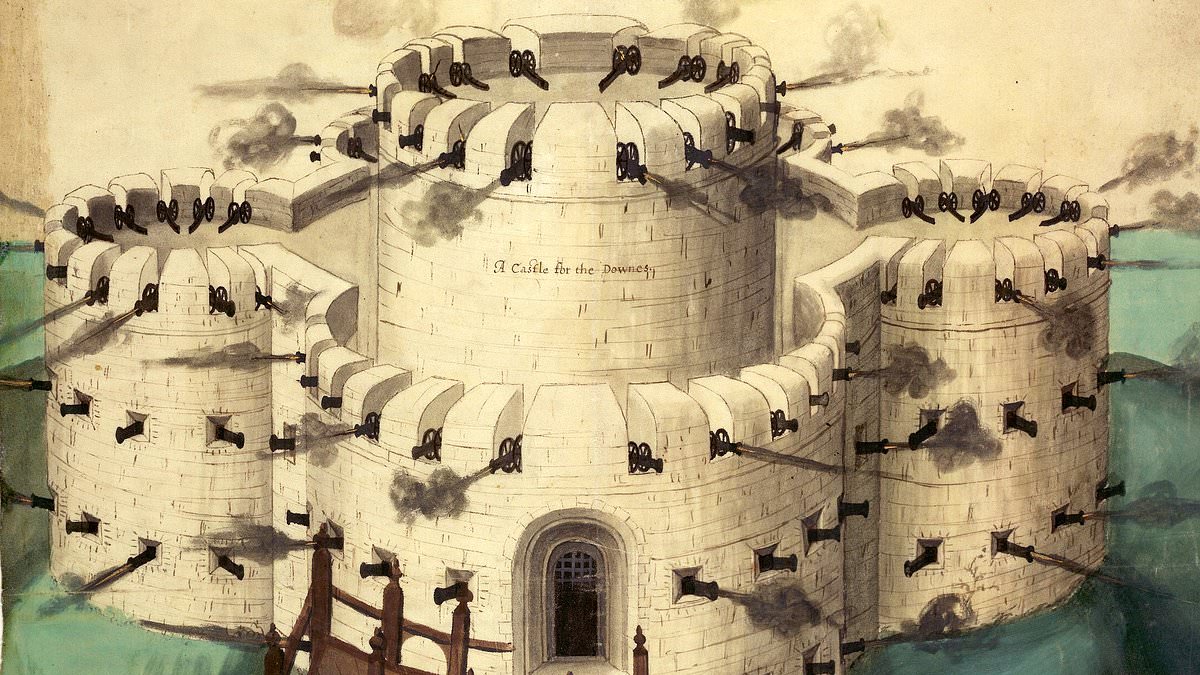
Part of King Henry VIII's long–lost Sandown Castle has been rediscovered hiding in plain sight.Stones from the 16th–century fort were reused to build part of Dover Castle, about nine miles (14.5km) down the coast, according to a new study.Archaeologists discovered a previously unknown report from 1883, stating that materials from Sandown were being sold off and sent to Dover.Those stone chunks from Henry VIII's maritime defences now form part of the Constable's Gate at Dover, which provided quarters for the castle's commanding officer.After Sandown Castle fell victim to coastal erosion in the 1800s, its valuable stones were sold off to form everything from coastal defences to a pier at Deal.However, until now, this hidden connection to Britain's most famous castle had gone totally unnoticed.Dr Moore says: 'When you stand beside the Victorian extension at Constable's Gate and realise that parts of its masonry came from Sandown Castle – a fort Henry VIII built and the sea later claimed – it sends chills down your spine.'It's a tangible connection across centuries of history.' Part of King Henry VIII's long–lost Sandown Castle has been rediscovered hiding in plain sight. Pictured: A 1539 early design for either Sandown or nearby Walmer Castle Today, Sandown Castle has been reduced to ruins by coastal erosion. However, its stones have been found making up part of Dover Castle Before the 1500s, the Crown had typically felt that coastal defences were the responsibility of local lords and that raids from sea were simply a manageable nuisance.However, after King Henry VIII broke with the Catholic Church to divorce his wife, Catherine of Aragon, tensions between England and Rome made the threat of invasion very real.France and the Holy Roman Empire forged a new alliance, and the Pope encouraged both to invade England to avenge the insult.In response, Henry VIII commissioned the construction of three state–of–the–art forts at Sandown, Walmer and Deal – collectively known as the 'Castles of the Down'.These were built for £27,092 at the time – the equivalent of over £22million today – and were meant to protect the critical landing point on the Kent coast.Sandown featured a large keep and four circular bastions, decked out with positions for 39 artillery pieces, 31 handguns, and fitted with special vents to carry away powder smoke.The anticipated invasion would never arrive, and Sandown wouldn't see any actual fighting until it was seized by pro–Royalist insurgents in 1648 during the English Civil War.But it wasn't cannon fire or explosives that finally toppled the mighty fortress of Sandown. Archaeologists have uncovered evidence that the stones from Sandown Castle were taken to build the Constable's Gate at Dover (pictured), which provided quarters for the castle's commanding officer Researchers uncovered a previously unknown report from 1883, stating that materials from Sandown were being sold off and sent to Dover Castle (pictured)Instead, the castle was simply built too close to the sea, and rapid coastal erosion ate away at the ground beneath it.By 1785, the sea started to breach the castle's outer defences, and by the 1860s the entire structure had to be abandoned.The upper levels were destroyed with explosives and the foundations were encased in concrete to protect against further erosion.Meanwhile, any blocks of stone that remained were sold off for various building projects around the country.Dr Moore's previous research has traced those stones to Eastry Union Chapel, Walmer Castle and Deal's second pier abutment.Now, he has used a combination of archival and archaeological research to show that some of the stones from Sandown also made their way to Dover.Dr Moore says: 'This sheds light on how Dover Castle's 19th–century works incorporated masonry from an earlier Tudor fortress.'Sandown Castle is best known as a casualty of coastal erosion, but the documentary trail and the surviving fabric show that parts of it lived on at Dover Castle and at other sites across East Kent.'The Act of Supremacy and the Dissolution of the Monasteries The Act of SupremacyThe Act of Supremacy, established in 1534, was an important English act of Parliament that recognised Henry VIII as the 'Supreme Head of the Church of England.' Prior to 1534, the supreme head of the English Church was the Pope of the Roman Catholic Church. Henry VIII introduced the Act primarily because he needed a male heir to the throne and had been unable to produce an heir with his wife, Catherine of Aragon. He had not tried for years to obtain an annulment of his marriage but The Pope had refused.According to the church at the time, a validly contracted marriage is indivisible until death.With the Act enforced, it declared the king 'the only supreme head on Earth of the Church of England' and that he would therefore enjoy 'all honours, dignities, preeminences, jurisdictions, privileges, authorities, immunities, profits, and commodities to the said dignity.' The act also required an oath of loyalty from English subjects that recognized his marriage to Anne Boleyn. Significantly, the Act marked the beginning of the English Reformation and was repealed in 1554. The Dissolution of the Monasteries Shortly after, Henry dissolved and disbanded monasteries throughout England, Wales and Ireland. By the 1530s, at a time of increasing tensions between the Pope in Rome and King Henry VIII, monasteries were seen as corrupt and out of touch with the common people of England and Wales. After detaching England, Wales and Ireland from the authority of the Roman Catholic Church, Henry's next step was to disband the monasteries.He did this partly to reform the church but also to strip the monasteries of their huge wealth.A set of administrative and legal processes between 1536 and 1541 saw the king appropriate their income, dispose of their assets, and provide for their former personnel and functions.
Hidden in plain sight: Stone from Henry VIII's long-lost Sandown Castle was reused in Dover Castle, study finds
Full Article
Original Source
Read the full article at Dailymail →KhanList aggregates and links to publicly available news content. We do not host full articles from third-party sources. Always verify important information with original sources.