
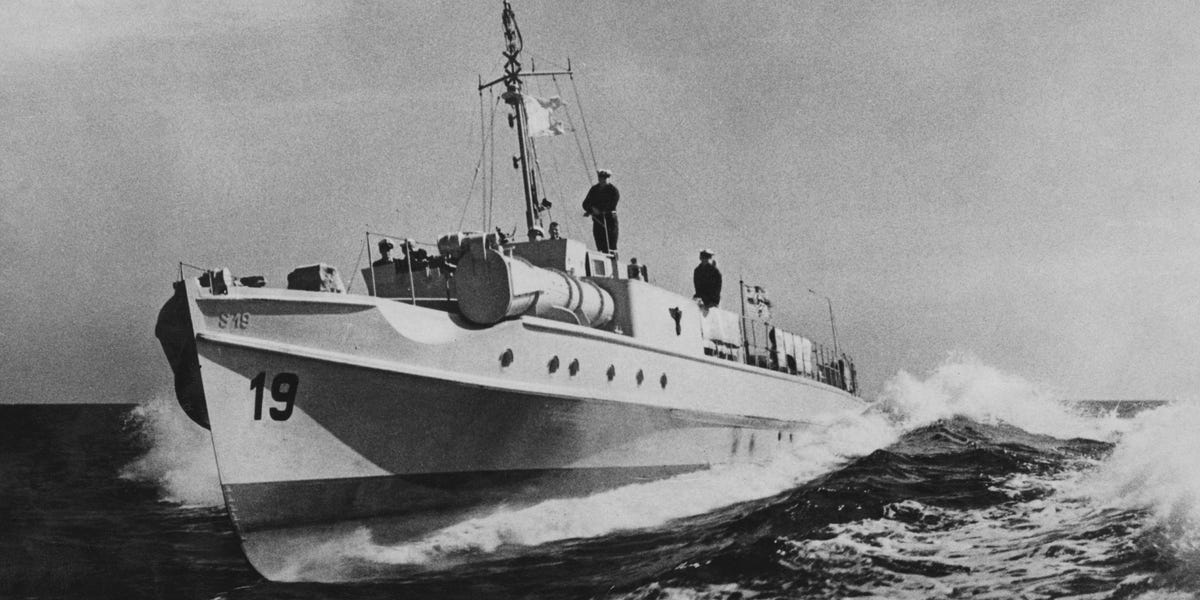
3 min readHere’s what you’ll learn when you read this story:Near the end of World War II, Germany’s Kriegsmarine experimented with a lightweight attack speedboat in the Ionian Sea, but all examples were thought lost to the war. The LS 6, which sank on Sept. 29, 1943, sat at the bottom of the sea for 83 years until a team of historians and divers found and identified the wreck. The 41-foot-long craft still rests 315 feet deep in the water. Near the conclusion of WWII, German engineers tucked an aircraft-inspired engine inside a ship, creating an experimental lightweight and fast attack boat for the German Kriegsmarine. But these unique speedboats, called Leichte Schnellboote, were quickly erased from history, as none of them survived the war. That is, until just recently, when a team of divers plunging 315 feet below the surface of the Ionian Sea discovered the LS 6, which is now the only known example of such a light speedboat in existence.The search for the rare 41-foot-long LS 6 started in 2013, led by historian Karelas George and a team of researchers and divers from the company AegeanTec. By poring over historical documents, the team honed in on a search area. Using sonar technology, the team was able to identify the remains of a ship about 60 miles north of the Greek island of Lefkada. Then the team’s divers descended into the Ionian Sea to positively identify the shipwreck on the bottom as the LS 6.“The moment the silhouette emerged from the depths reminded us exactly why we do what we do,” the AegeanTec team wrote on Facebook. “Few experiences compare to the privilege of being the first to dive, document, and identify a forgotten piece of history.”A first-hand account published on WW2Wrecks—and another one in Greek on Naval History—tell the story of the ship in 1943 and again in 2026.Originally crafted with a newfangled engine and lightweight aluminum to lay mines, and later used to scout Allied submarines and attack them with depth charges, the LS 6 and its sister ship, the LS 5, were never paired with the sonar-equipped minesweepers they needed to do their jobs. Instead, they were used for their speed as reconnaissance or transport craft. Damage to the LS 6 occurred on Sept. 24, 1943, when the researchers behind the shipwreck’s discovery believe Italian fighter-bombers flying for the Allies after Italy’s armistice—rather than British aircraft, as long believed—pierced part of the ship’s hull. The boat needed a tow to Piraeus for repairs, but the hull was badly damaged, and it sank during the effort.“The fact that the vessel had been built from aluminum to reduce its weight, combined with the unusual circumstances of its loss while under tow, immediately convinced me that this was an extraordinary target for both historical investigation and technical diving,” said researcher George Karela, according to WW2Wrecks.“Through a camera carefully passed inside the engine room hatch, we recorded the unmistakable shape of the Jumo engines,” the report stated. “The evidence was becoming overwhelming.”Soon, the team knew it had a Kriegsmarine speedboat, but they weren’t sure precisely which one until they found the remains of its towing line. “This is more than a dive,” the team wrote. “It’s a journey through time.”Tim Newcomb is a journalist based in the Pacific Northwest. He covers stadiums, sneakers, gear, infrastructure, and more for a variety of publications, including Popular Mechanics. His favorite interviews have included sit-downs with Roger Federer in Switzerland, Kobe Bryant in Los Angeles, and Tinker Hatfield in Portland.
A Research Team Dove 315 Feet Beneath the Surface—and Found the 1943 Wreckage of an Experimental Nazi Ship
Full Article
Original Source
Read the full article at Popularmechanics →KhanList aggregates and links to publicly available news content. We do not host full articles from third-party sources. Always verify important information with original sources.