
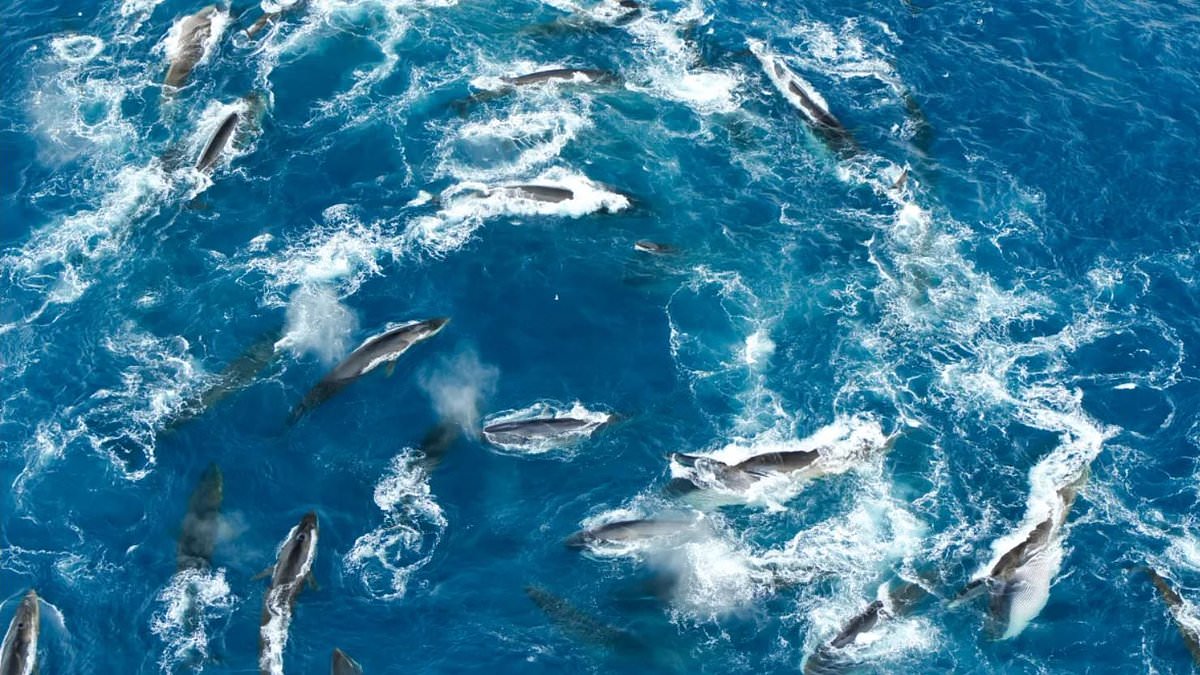
Blue Planet III has captured the moment dozens of fin whales work together, catching krill in a never-before-seen hunting strategy.Fin whales, the second-largest of all whale species, are normally solitary animals, rarely travelling in large groups or forming families.However, near Elephant Island, just off the coast of Antarctica, about 50 of the massive creatures came together for a coordinated hunt.In behaviour due to be recognised in a scientific journal, the whales formed a swirling ring of bodies, creating a pen around a dense ball of krill.The 27-metre-long whales then took it in turns to scoop up huge mouthfuls of the crustaceans in what one scientist described as a 'feeding frenzy'.Although rumours and anecdotal accounts have long suggested that fin whales might hunt these densely packed 'krill bait balls', it has never been directly studied before now.Dr Helena Herr at the University of Hamburg, who has written a scientific paper on the findings, told the Daily Mail that witnessing the event was 'extraordinary'.She says: 'Even after many years of studying fin whales, seeing so many of these enormous animals feeding together, all around us, was a truly humbling experience.' Blue Planet III has captured the moment dozens of fin whales work together, catching krill in a never-before-seen 'feeding frenzy'Scientists and TV producers have spent almost the last 20 years hunting for this rare behaviour.Rumours had suggested that these dense spherical balls of krill could attract fin whales to the waters near Elephant Island, but this seemed extremely unlikely.'Supergroups of this size are rarely observed in nature and are only known for a few whale species,' says Dr Herr.'For fin whales, such aggregations have so far only been documented in their Southern Ocean feeding grounds.'However, three years ago, Dr Herr and the Blue Planet team spotted a large group of fin whales gathering.At first it looked as if the whales were swarming in a chaotic cluster, but aerial drones showed that they were actually moving in a coordinated circle around a single point.The researchers weren't able to get in the water and confirm the existence of a krill bait ball, but all the signs point towards this being the most likely explanation.Dr Herr says: 'Our analysis is based entirely on aerial footage and surface behaviour; we have no underwater imagery showing how the krill are distributed or whether they form a bait ball. The fin whales, the second largest whale species, took it in turns taking huge mouthfuls of tiny krill Fin Whales: Key facts Scientific name: Balaenoptera physalusWeight: 40-80 tonnesLength: 75-85 feetLifespan: 80-90 yearsHabitat: Deep, offshore waters of all major oceans, primarily in temperate to polar latitudes.Diet: Krill, small schooling fish, and squidConservation status: Vulnerable 'We know that the area supports high krill biomass, and our working hypothesis is that the whales swim in coordinated circles to concentrate the krill into dense prey patches and prevent them from dispersing.'The team also noticed that the whales showed a strong preference towards leaning on their right-hand side, which might help explain how they are able to co-ordinate their behaviour.The right side of a whale's jaw is white, and the left is black or grey, so whales could be looking at their neighbours to see which side to lean on.Alternatively, the whales might be communicating using a system of low-frequency calls.Dr Herr says that this is one of the 'most exciting questions' raised by these observations, and something she hopes to investigate in the future.Seeing this incredibly coordinated hunting for the first time is particularly exciting because fin whales came very close to being hunted to extinction in the 20th century.Hunting fin whales was banned in the Southern Hemisphere in 1976, and since then their population has shown promising signs of stability. This is the first time that this coordinated behaviour has been scientifically observed, with experts calling it 'extraordinary' The scene will be shown as part of Blue Planet III, narrated by David Attenborough, this Sunday on BBC1In the 1970s, there were just 5,000 fin whales left in the southern waters, which has risen to between 40,000 and 50,000 today.This striking recovery might be part of the reason that researchers are now observing these mass gatherings for the first time.Now, Dr Herr says she hopes that Blue Planet III will bring more attention to the importance of protecting our oceans.She says: 'These whales are showing encouraging signs of recovery after being driven close to extinction by whaling, but their future depends on the health of the ecosystem they rely on.'I hope the film helps people understand why this remarkable ecosystem deserves our attention and protection.'The scene will be shown as part of Blue Planet III, narrated by Sir David Attenborough, this Sunday on BBC1.
Having a whale of a time! Blue Planet III captures the moment dozens of fin whales work together catching krill in a never-before-seen 'feeding frenzy'
Full Article
Original Source
Read the full article at Dailymail →KhanList aggregates and links to publicly available news content. We do not host full articles from third-party sources. Always verify important information with original sources.