
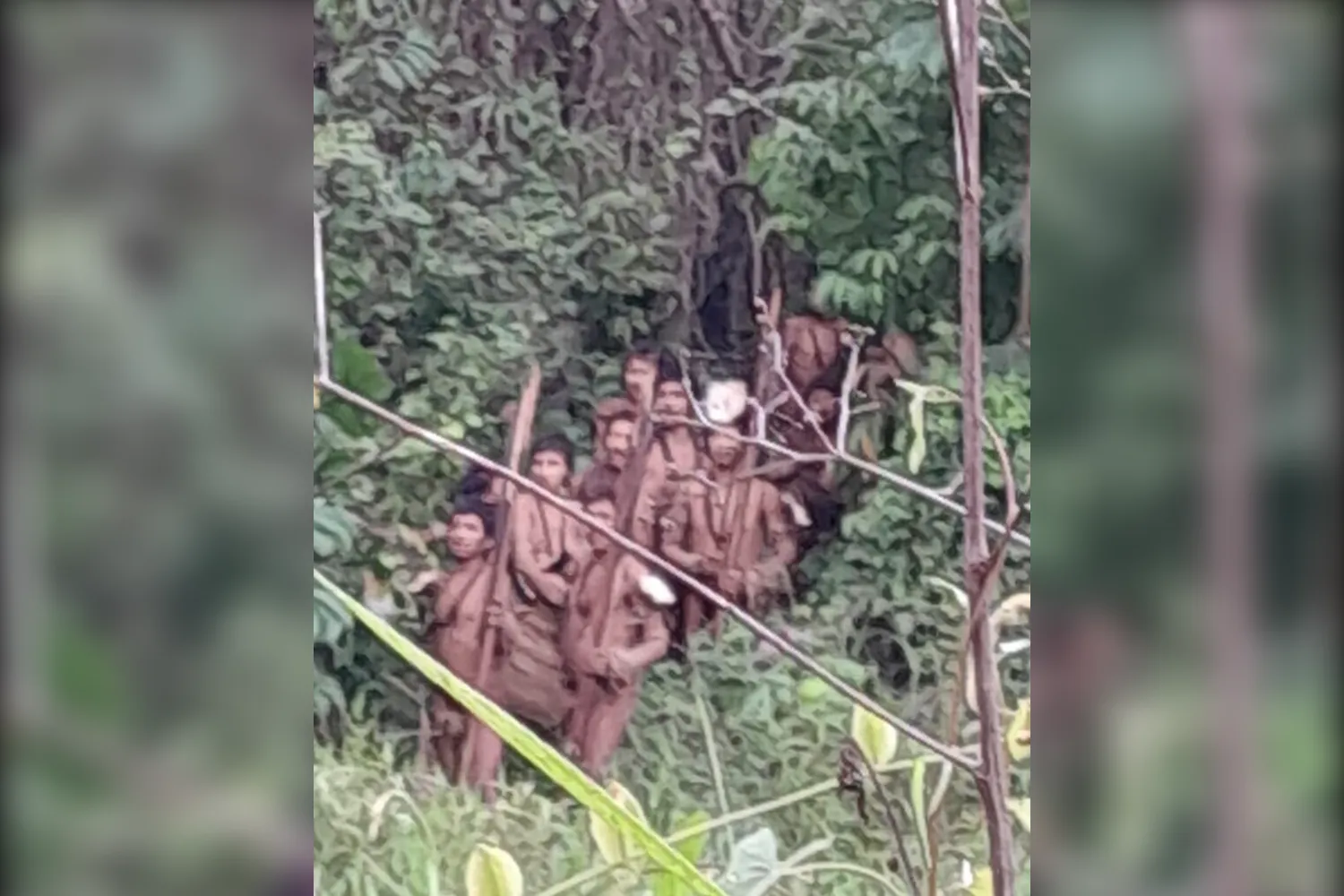
Around 20 members of the Indigenous Awá tribe emerged from the rainforest and received food from neighboring villagers. The group has not made contact with the outside world in decades, so experts say deforestation may have left these individuals with no other option November 20, 2026 12:08 p.m. The Awá emerged from the forest on November 16 © Guajajara For decades, the Awá, an Indigenous tribe in the Brazilian Amazon rainforest, has lived in almost complete isolation from the modern world. That changed on November 16, when a group of around 20 men, women and children emerged from the forest’s edge. The Awá individuals, some of whom carried spears or wore necklaces and headdresses, made contact with a government agency that supports Indigenous peoples and the Guajajara, a larger, non-isolated Indigenous group that lives adjacent to the Awá. Both reside in Brazil’s Arariboia Indigenous Territory in the northeast state of Maranhão. Guajajara members captured photos and videos of the encounter, which have been shared by the London-based Indigenous advocacy group Survival International. The interaction lasted for several hours, Stephen Gibbs reports for the London Times, though the two groups spoke different languages, rendering communication almost impossible. Near the end, the Guajajara shared yams with the Awá, who took the offering and, smiling, retreated among the trees. However, Guajajara spokesperson Olimpio Santos Guajajara warns this should not be taken as a heartwarming story but as a worrying sign about the sustainability of the Awá’s voluntary isolation. “We were trying to avoid contact with them,” he tells Brazil’s Globo television network, per the London Times. Since the late 1980s, the national government has followed a no-contact policy regarding isolated tribes like the Awá, allowing the Indigenous peoples to remain away from modern society at their discretion. “Unfortunately, today they felt forced to come and make contact,” Santos says. Sarah Shenker, head of Survival International’s Brazil office, says the pressures of illicit deforestation, cattle ranching and hunting might be pushing the tribe to its limits, forcing them to emerge from isolation to survive. “They’ve shown so clearly for so long that they don’t want contact with outsiders,” she tells the New York Times’ Zane Irwin. “The fact that they’ve come out now does indicate they’ve probably felt forced to. … Because their lives are so intricately related to the forest, it would be impossible to completely separate the pressures on the land.” The Brazilian government has designated certain swaths of the Amazon, including Arariboia, as protected Indigenous land. But as deforestation and farm development have increased, these small territories are one of the few places still home to the Amazon’s historic hardwoods, Shenker tells the Times. Thanks to conservation efforts and renewed enforcement, deforestation is slowing in Brazil. Still, estimates suggest that nearly 20 percent of the Amazon, which spans several South American countries, has been destroyed since the 1970s, and the forest can’t handle much more. Did you know? In Isolation At least 196 uncontacted tribes live in ten countries worldwide, according to Survival International. Roughly 95 percent reside in the Amazon rainforest. In recent years, hunters, loggers and ranchers have increasingly encroached upon the Awá territory. They previously cut down over 34 percent of one legally protected Awá reserve. Survival International says the Brazilian government has hardly responded to these intrusions. In its place, a team of Guajajara people known as the Forest Guardians has taken to defending the Arariboia territory, and several members have died during these conflicts. Repeated hunting and deforestation pose significant strain to the Awá way of life. The tribe survives off the forest, hunting wild boar, deer, monkeys and fish, and gathering fruit and honey, according to the Times. The forest is also central to the people’s medicinal and spiritual practices. But this is only possible in an “ever-smaller island of Amazon rainforest, surrounded by destruction,” says Caroline Pearce, director of Survival International, in a statement. When the Awá made contact with the Guajajara village, the effects of this habitat loss were clear: Uirá Garcia, an anthropologist at the Federal University of São Paulo who has studied the isolated tribe for 20 years, tells Globo that some members of the group looked “exceptionally thin,” per the London Times. This was particularly concerning given the timing of the encounter in the middle of the Amazon’s rainy season—typically a time of abundance in the forest. Experts also worried that contact with the modern world may pose serious health risks to the Awá. They have not received any vaccinations or built immunity to common viruses like influenza, measles and chicken pox, making them vulnerable to any pathogens present in the Guajajara population. Introduced diseases are currently the primary killer of isolated tribal people. To guard the Awá from further exposure, the Brazilian government agency dedicated to protecting Indigenous peoples has enacted an emergency contingency plan. It includes restricting outsider access to the area surrounding where the group members emerged, the London Times reports. Past estimates have put the total Awá population at roughly 450 people—only around 100 of whom still live in complete isolation from the rest of the world, separated into a few small, mobile bands. As one of the globe’s last nomadic hunter-gatherer tribes, they draw intense interest from the scientific community and general public alike. But, Shenker says, the tribe is better off remaining somewhat of a mystery. “We would rather not have images and not have video footage of the uncontacted Awá,” she tells Steven Grattan from the Associated Press, “when that means that they are living in the way that they choose in their forest, able to get on with their lives, hunting, fishing, gathering.” You Might Also Like Get the latest stories in your inbox every weekday. More about: Brazil Ecology Environmental Justice Indigenous Peoples Rainforest
An Isolated Group of Amazonian Hunter-Gatherers Made a Rare Request for Help From Outsiders, Raising Concerns About Forest Degradation
Full Article
Original Source
Read the full article at Smithsonianmag →KhanList aggregates and links to publicly available news content. We do not host full articles from third-party sources. Always verify important information with original sources.