
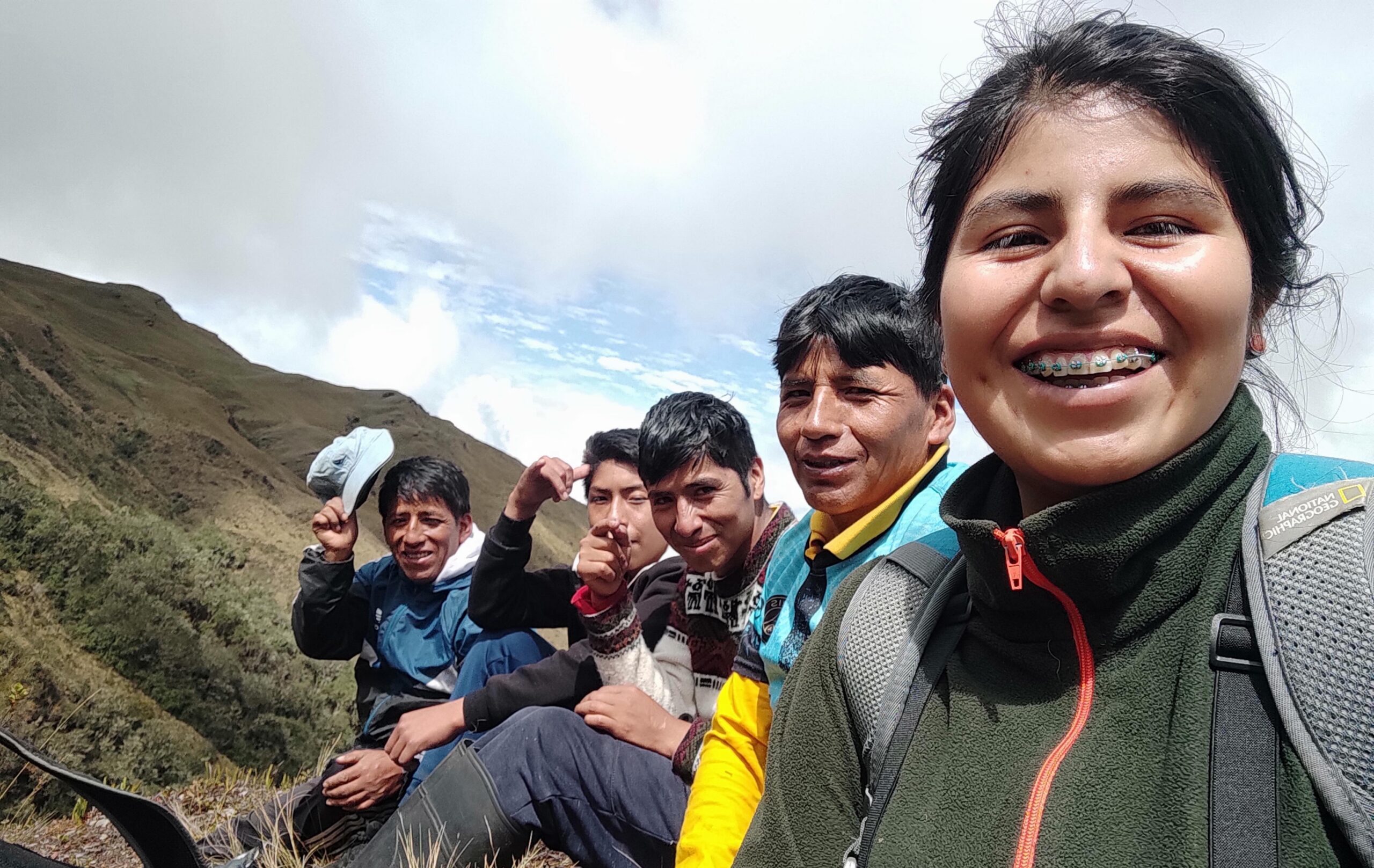
An Indigenous-led conservation project on the Pumataki private community reserve in Peru, gathers data on the presence and numbers of Andean bears — compiling some of the first local records of the species on the reserve.The project was developed by Maribel Pacco, a local from the Pillco Grande community, who uses the camera traps to inform a Quechua-language environmental education program for youth, though limited funding has forced the project to scale back some of its future plans.Pumataki is recognized by a legal framework which allows landowners, in this case the community of Pillco Grande, to convert their holdings into a nature reserve called a Private Conservation Areas (ACP).The Andean bear (Tremarctos ornatus) is listed as vulnerable to extinction on the IUCN Red List; in Peru, it is threatened by habitat loss, poaching and the impacts of climate change. Maribel Pacco grins as she recalls the first time she saw an Andean bear close-up in the wild. At the forest edge, a mother and her cubs browsed on bromeliads while the volunteer ranger watched for hours in awe. “I’m not a biologist, but at that moment, I decided to become a conservationist,” she says. Today, Pacco leads a camera-trap project to estimate bear numbers and movements in Pumataki, a private community-owned reserve in the buffer zone of Manu National Park, in southeastern Peru. With the help of her Indigenous Quechua community of Pillco Grande, the project has generated some of the first local records of Andean bears (Tremarctos ornatus) in Pumataki. So far, they have identified 10 individual Andean bears, distinguishable by the unique pattern of facial markings. Though modest and only 3 years old, information gathered from the camera traps helps inform a Quechua-language environmental education program for youth and is shared at community meetings to highlight the area’s biodiversity. “In the last few years, I’ve seen a lot more involvement of women in Andean bear conservation which is fantastic to see,” said Rebecca Zug, a professor of biology at the Universidad San Francisco de Quito, who is not involved in the project. “There is also so much more power in Indigenous communities building conservation from within and learning about their own biodiversity from someone like Maribel than in having an outside voice come in.” For now, limited funding has forced the project to scale back some of its future plans. However, environmental education and camera trap monitoring continue, with community members taking turns in groups of five to visit the reserve and to maintain the cameras. The community identified 10 individual Andean bears, distinguishable by the unique pattern of facial markings. Image courtesy of the Pillco Grande community. Maribel Pacco (seated, second from left) poses for a photo with her team and visitors. Image courtesy of the Pillco Grande community. The team Pacco has gathered is analyzing the behavior and activity patterns of different species to compile a biodiversity inventory. They hope the information gathered on the number of Andean bears and their territories will be used by universities in future research. The Andean bear, also known as the spectacled bear, roams from Venezuela and Colombia in the north to northern Argentina in the south while facing an array of threats along the way. Despite being classified as vulnerable on the International Union for the Conservation of Nature (IUCN) Red List, Andean bear populations face pressures from habitat loss and fragmentation, poaching, retaliatory killings due to crop raiding and the effects of climate change. Peru, particularly in southeastern Peru where Pumataki is located, is one of the species’ strongholds. An estimated 5,000 bears are believed to roam cloud forests, dry forests, and the páramo and puna grasslands across the country. “Peru has some of the biggest blocks of habitat left for the species across its range, but this is a forest-dependent species, so habitat loss and habitat fragmentation are major threats,” says Russ Van Horn of the San Diego Zoo Wildlife Alliance and co-chair of the IUCN Andean Bear Expert Team. Important refuges remain where extensive protected forests continue to support Andean bear populations. Pumataki — a private cloud forest reserve — is one such refuge in the Cusco region. Bridging different communities Though small in size, this reserve is recognized by a legal framework which allows landowners to convert their holdings into a nature reserve called a Private Conservation Areas (ACP). Recognition can be granted for a minimum of 10 years, with the possibility of renewal, or made in perpetuity. Pumataki lies on the eastern slopes of the Andes, bordering the vast Manu National Park. Often shrouded in mist, the forest teems with wildlife. It is a home to the Indigenous Quechua community of Pillco Grande, whose members own and manage the reserve. For local people, this rugged landscape traditionally holds deep spiritual significance. It is the abode of Apu Kañaqway, a sacred mountain revered in the Quechua worldview as a protective spirit. Children from a local school take part in an environmental education session. Image courtesy of the Pillco Grande community. An environmental education trip to the Pumataki reserve. Image courtesy of the Pillco Grande community. For Pacco, who grew up among these forests, conservation is entwined with a spiritual connection to the land. “In my childhood, I would hear stories about the Apu, which is very important in our culture, and my father would take me to visit the reserve where he worked as a volunteer guard,” she says. Pacco’s early connection to the landscape eventually drew her into conservation work. During college, she became a volunteer ranger in Manu National Park, where she encountered one of its most elusive residents: The Andean bear. She quickly developed a fascination with the species, she tells Mongabay. “I fell in love with bears, their behavior, everything about them, and the role they play in the forest ecosystem. The other rangers taught me how to track their footprints and use camera traps, and I learned a lot,” she says. Those experiences laid the foundation for her own conservation project. In 2023, Pacco received a Conservamos por Naturaleza (We Conserve for Nature) grant from the Peruvian Society for Environmental Law (SPDA) to launch a community-led initiative to monitor Andean bears in Pumataki and conduct environmental education. According to the SPDA, Pacco’s ability to bridge different communities was a strength. “Maribel can connect with different people. She speaks Quechua and can communicate with local communities, but she also speaks Spanish and English and can communicate with people from abroad,” says Carolina Butrich, a manager at the SPDA. A pair of Andean bears photographed by the camera trap project. Image courtesy of the Pillco Grande community. A community effort Tracking one of the cloud forest’s most elusive large mammals is no easy feat. With camera traps, a GPS device and training from the San Diego Zoo Wildlife Alliance, Pacco began surveying the forest and reaching out to her community to document the presence of bears. One of the principal hurdles, however, was getting more local people to participate. “The biggest challenges were getting more people in the community involved, because most of us are just looking for ways to work and support our families,” says Justa Peña Condori, an early recruit to the team. Gradually, through persistence and group meetings, Pacco was able to convince more community members to accompany her on camera-trapping excursions in the forest. She also began conducting environmental education in Quechua at the local school, teaching children about Andean bear ecology using images and video footage captured by the camera traps. Individual bears can be distinguished by their own “fingerprint”: A unique pattern of facial markings around the eyes, often resembling spectacles. These markings allow the team to identify individual bears caught on camera. The process has also been a way to engage schoolchildren, who can give each bear a name and learn about conservation in a more personal way. The camera traps have so far identified 10 individual Andean bears, providing the first records of the species in the area. The traps have also caught images of other cloud forest species such as the clouded oncilla (Leopardus pardinoides), dwarf brocket deer (Subulo chunyi), puma (Puma concolor), opossums and coatis helping to shift local attitudes toward wildlife. Maribel Pacco and her team locating camera traps by GPS. Image courtesy of Pillco Grande community. “It has raised awareness within the community about the biodiversity we have, and it has changed attitudes toward protecting the forest. Before, people here viewed conservation differently, but thanks to the images and videos, their perspective has changed,” says Juan Cristomo Pacco Ccora, a member of the project. For Pacco, however, protecting bears also means addressing some of the everyday pressures facing families in Pillco Grande. To make conservation more relevant to the lives of local people, she started an organic vegetable garden at the school, allowing children to grow vegetables such as carrots, lettuce, onions and cauliflower. The fresh produce helps supplement food supplies in Pillco Grande, while mothers sell vegetables in local markets to generate a small income. In this way, the project connects environmental education with practical benefits for the community. While they grapple with the limited funding they have to work on, Pacco says the project still helps strengthen the community’s efforts to manage and protect Pumataki. “As a result, we have formed a management committee, and we are now organizing ourselves to formalize it,” says Alberto Jancco Tacu, treasurer of the management committee of the Pumataki Private Conservation Area and a member of the project. Pacco remains upbeat and determined to continue in spite of the challenges. “I’m hopeful we can keep working in Pumataki, and I’m looking for new partnerships and alliances for the project,” she says. “We have to keep building what we’ve started.” Banner image: Maribel Pacco (seated, second from left) poses for a photo with her team and visitors. Image courtesy of the Pillco Grande community. How a fun women’s gathering led to small wildcat conservation in Peru’s Andes Indigenous guardians embark on a sacred pact to protect the lowland tapir in Colombia Citations: Arrieta-García, M. M., & Katona, K. (2025). Human-wildlife conflicts in Latin America: A systematic review of jaguars (Panthera onca) and Andean bears (Tremarctos ornatus). Biota Colombiana, 26. doi:10.21068/2539200x.1247 Castrillón-Hoyos, L., Rincón, L., Troncoso-Saavedra, J., Giraldo-Rojas, M., Hernández-Rincón, J., Velásquez-Vázquez, A., … Márquez, R. (2023). Occupancy and habitat use by the Andean bear are negatively affected by human presence and forest loss. Journal for Nature Conservation, 73, 126409. doi:10.1016/j.jnc.2023.126409 FEEDBACK: Use this form to send a message to the author of this post. If you want to post a public comment, you can do that at the bottom of the page. Credits Topics
Quechua community in Peru builds up Andean bear camera trap project on their own reserve
Full Article
Original Source
Read the full article at News →KhanList aggregates and links to publicly available news content. We do not host full articles from third-party sources. Always verify important information with original sources.